

12 Retired '80s Pyrex Patterns That We Want Back On Store Shelves
We may receive a commission on purchases made from links.
I'm a child of the '80s, and I grew up with a mother and grandmother who both had a weakness for Pyrex. Lots of the vintage Pyrex from the '60s, '70s, and '80s are pure nostalgia for me because they sat in my childhood kitchen. I also collect a little Pyrex myself, purely because I love the way it looks, but I am a bit selective in what I collect. I adore Forest Fancies, for example, and actually, nice quality pieces aren't that difficult to find because they were in production from 1981 all the way through until Corning Ware stopped its opalware.
I've amassed a pretty respectable collection of pretty but functional vintage Pyrex over the years, mostly from thrift stores and yard sales, although there are lots of places you can source vintage Pyrex. There are some that I would very much like to see back on store shelves if they did new runs of old favorites. Not every Pyrex pattern from the '80s realistically deserves a new run, but there are some that would look as fabulous today as they did when they were released in the 1980s.
Homestead
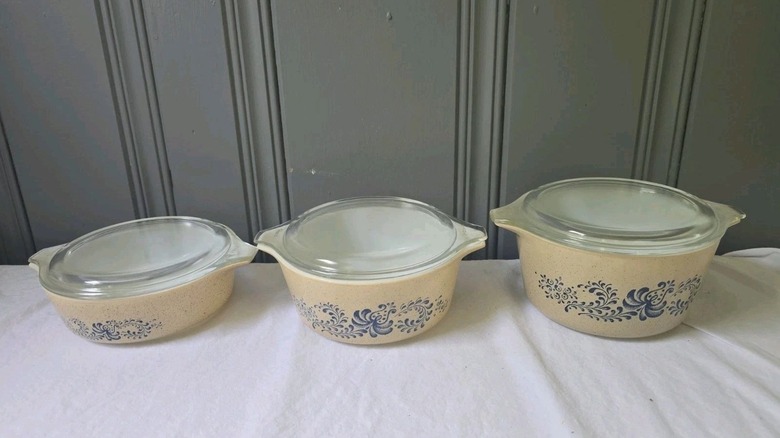
The Homestead line is one I think would do exceptionally well if Corning did a Pyrex revival today. The original dark blue folk-art-inspired design on a speckled beige background only got a four-year run from 1976 through to 1980, when it was replaced by Forest Fancies. It's a genuinely attractive design, and there was a pretty extensive range of pieces as well, including mixing bowls, Cinderella bowls, refrigerator dishes, casseroles, and myriad other pieces. Interestingly, Homestead came about in response to the success of a competitor's folk-art-inspired, handpainted design, as trends in kitchenware began to change in favor of building the perfect country-style kitchen.
Even though the run was short, there was enough variety there that people even today build a proper kitchen collection. Homestead is one of the designs that's aged particularly well. The restrained swirls and speckled neutral background don't feel particularly aggressively '80s or retro. A Homestead casserole or a bowl on open shelving in a nice cottagecore kitchen works just as well today as it did in 1980.
Old Town Blue
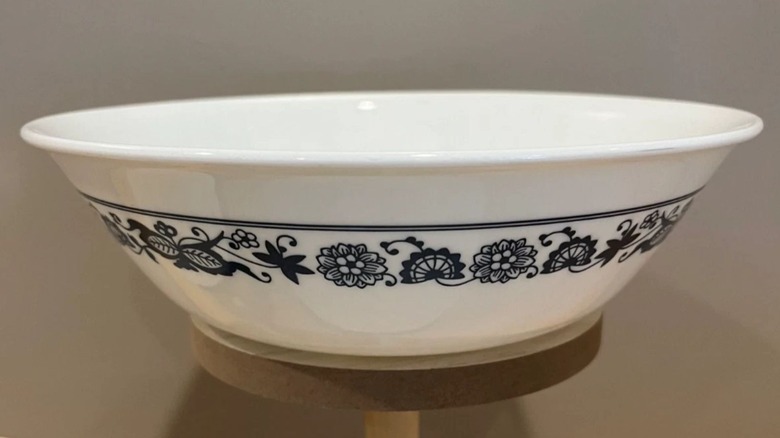
This particular Pyrex pattern is pretty rare. Old Town Blue ran from 1972 to 1982 but there was only one Pyrex baking dish ever released with this pattern. The rest of the collection was a Corelle tableware line that included tea cups, gravy boats, salt and pepper shakers, and other dinnerware. Old Town Blue was primarily released as a Compatible Tabletop range under Corning's Corelle brand, with only the one baking dish released under the Pyrex Opalware line.
It has a remarkably pretty but restrained dark navy floral swirl pattern on white and it still looks contemporary even by today's standards. It looks almost like a sleeker, more modern version of traditional blue and white china. The item that is so challenging to find from this particular line is the one baking dish. Old Town Blue Pyrex is rare, valuable, and worth hunting for at thrift stores. If Pyrex ever did do a revival of this particular pattern, I'd love to see them do a more extensive kitchenware and bakeware range. If they bring back Old Town Blue, they should go all out and put it on casseroles and mixing bowls and all the other wonderful Pyrex basics. The slightly understated dark blue on white is a spectacular pattern. But before you get too excited over your bucket list find, make sure it's actually Pyrex. Turn it over and look for the stamp on the base, as it's the clearest sign of value and authenticity on vintage Pyrex.
Woodland
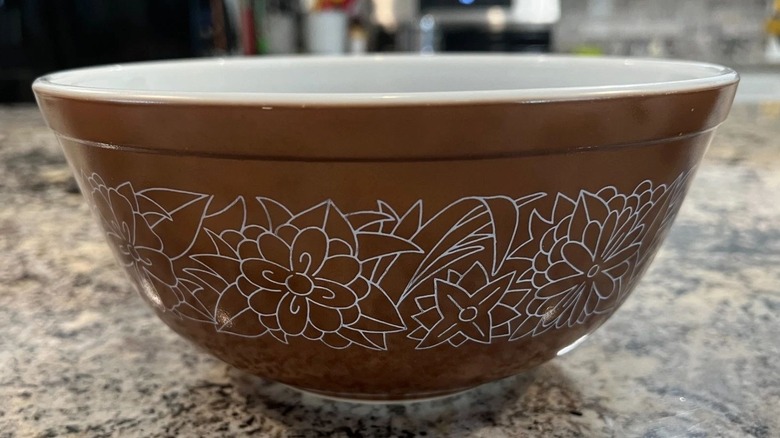
Although TV shows would have you believe that the '80s were all about neon, there was a great deal of brown that was a leftover of the '70s that carried through the decade. I'm not a big fan of brown, so in my opinion most of that stuff should stay in its original decade. I really don't have much brown in my kitchen, but Woodland is a little bit different. It was produced from 1978 through 1983 and it's not the heavy or mottled brown of the late '70s and early '80s that I really dislike. This particular pattern has a lighter feel, with its delicate white leaves and flowers and fern-like botanical shapes all over the brown glass.
This was a full Pyrex range that included mixing bowls and refrigerator dishes as well as casseroles and there were Compatible Tabletop pieces under the Corelle line branded Woodland Brown Dinnerware, which reversed the colors, with a delicate brown design on white milk glass. The idea was that at a dinner party, for example, you could bring out your piping hot casserole or your refrigerator bowl full of salad and it would match the dinnerware, so the whole table was coordinated. The contrast between the brown and the lovely white botanical design is light enough to feel modern and doesn't look nearly as heavy as the darker, drearier pieces that you'd associate with that period. Lots of the brown stuff from that era will quickly make your kitchen look dated, but Woodland just fits into a cottage kitchen without being gloomy.
Butterfly Gold, the 1979 redesign
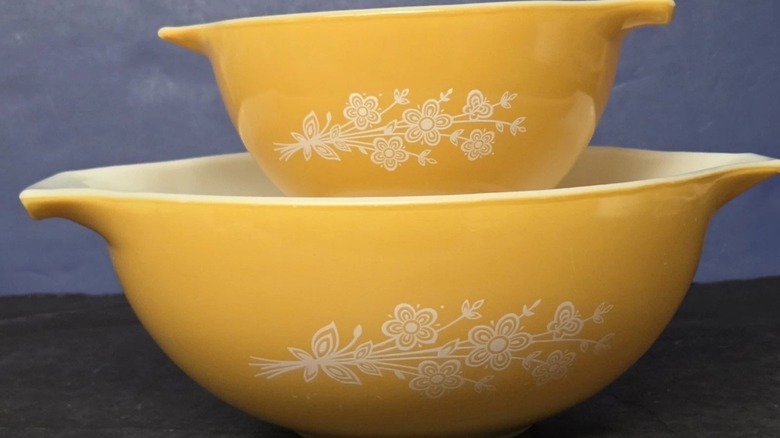
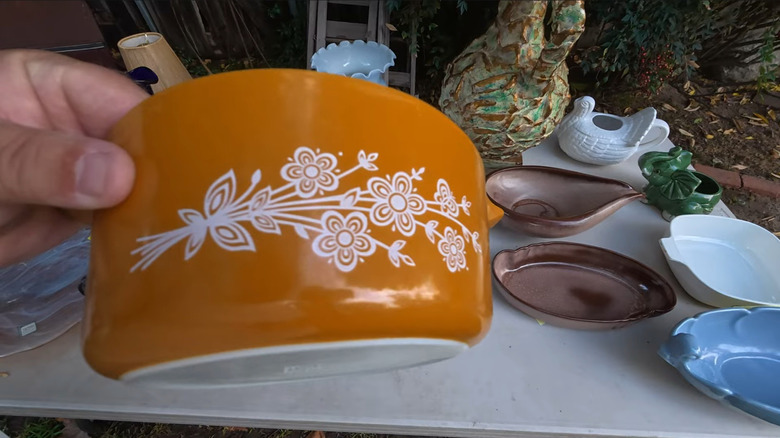
Generally speaking I'm also not a massive fan of yellow, particularly not that ghastly mustard yellow that was everywhere in the '70s and '80s. I make an exception for the 1970 redesign of Butterfly Gold, however. The cheery yellows and oranges of this range are really quite pretty. Definitely better than a lot of the weirdly popular greige nonsense that you see in today's kitchens.
The first run of this design happened in 1972 when it was a bit bolder and brasher, but in 1979 Corning reworked the earlier motif into smaller bouquets of flowers on stems. This particular run only lasted two years, from 1979 to 1981, so it only appeared on a limited selection of nesting bowls and casseroles. The limited number of pieces that were made and the bright cheery coloring mean that the 1979 redesign of Butterfly Gold is highly collectible. Even the Compatible Tabletop matching dish patten is a highly desirable thrift store find. I could easily see Pyrex bringing this one back with great success if they did it as a special fall collection. It wouldn't even really need tweaking for today's market. It would just work exactly as it is, with the same unapologetically retro colors.
Spring Blossom Green, the 1979 redesign
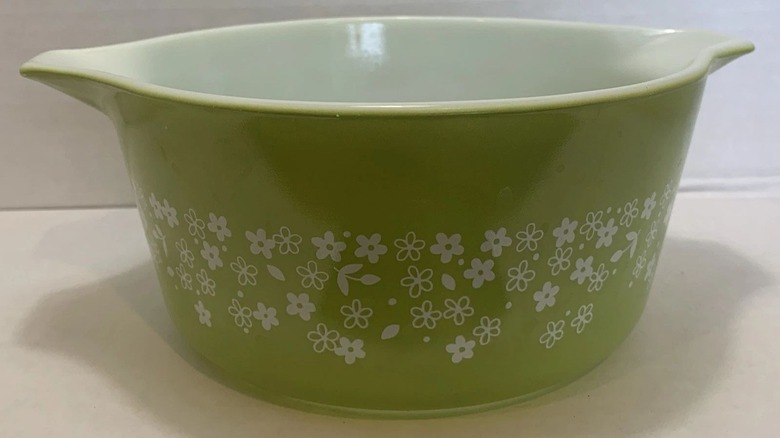
I love the Spring Blossom Green 1979 redesign. It has a distinctive look with smaller flowers, stems, and scattered leaves, still using the avocado and lime green backgrounds of the original design. The redesign of the original, which was also popularly known as Crazy Daisy, was another short run, only lasting between 1979 and 1981. The redesign was a Pyrex Compatible range to go with Corelle's dinnerware pattern also called Spring Blossom. Because of the short production run, as with Butterfly Gold, there are fewer overall pieces and the redesign itself was limited to some of the most popular products, like casserole dishes.
This particular range, even though it was produced in the late '70s and very early '80s, has, to my eye, an incredibly retro 1960s look. While I like green glassware in general, there's something particularly appealing about the bold avocado and lime shades of this design. I'd much rather have a beautiful set of these unapologetically colorful mixing bowls than a washed-out sage reproduction.
Autumn Harvest
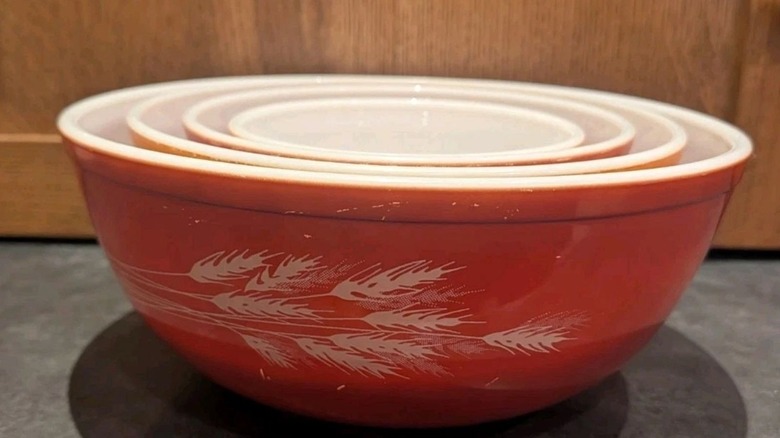
Richard Hora, a designer on the Pyrex team, put ivory wheat silhouettes over a rust and orange background for autumn harvest. This elegant wheat motif proved incredibly popular and ran from 1979 through to 1986, when Pyrex stopped Opalware production. In fact, Autumn Harvest was one of the only four patterns that made it all the way through to the final production runs in 1986. It's also the only Pyrex print that was ever produced on a Store N' See canister set and was the last of the refrigerator dishes of Corning's Opalware operation.
There's also a promotional casserole called Wheat in tan and brown that used the identical silhouette of Autumn Harvest, but was released one year earlier in 1978, as one of Corning's limited seasonal gift pieces. This collectible Pyrex collection manages to ooze fall seasonal warmth without cartoon pumpkins all over it. I personally don't particularly like Autumn Harvest because of the dark brown background. However, the design is light enough that it doesn't look out of place in contemporary kitchens. In fact, I imagine it would be a pretty popular purchase if Corning were to do a limited seasonal run or reissue of this exact style, because it would go so well in a farmhouse kitchen.
Stack N' Snack, also called speckled lines
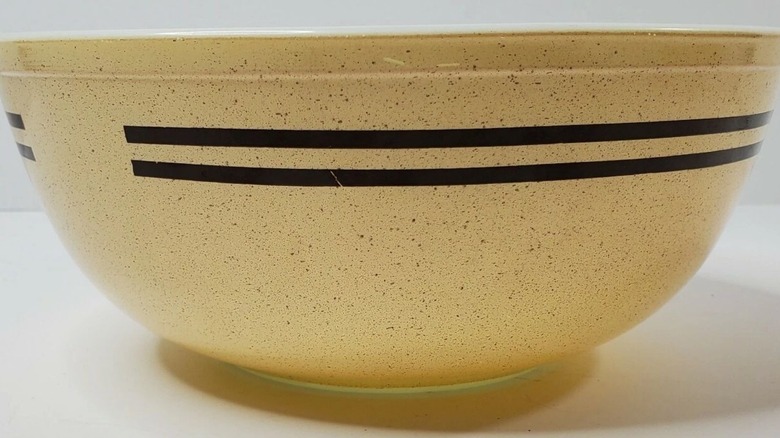
The Stack N' Snack, affectionately called Speckled Lines by collectors, was a promotional item that was part of Pyrex's Hospitality Collection between 1980 and 1983. It was basically Pyrex's own spin on the classic chip-and-dip pairing. The set included a 4-quart mixing bowl and a smaller 10 oz bowl. There was also a wooden platform that clipped to the big bowl's edge to hold the little bowl above it.
Although the pattern of two brown stripes on a pale brown speckled background is pretty dull and very early '80s, the whole setup is kind of cute. It was also eminently practical, which is why this would still do pretty well today if Pyrex were to rerun the line again. It only had one job: to hold dips and snacks, and it did it perfectly in a nice neat arrangement with the small bowl held above the edge of the larger bowl. Either bowl on its own isn't particularly exciting to look at, but to put the bowls together with the little wooden coaster, and it suddenly becomes strangely brilliant. It still suits the way that many people entertain today, especially if you've got folks round for game night or Netflix and you need chips and dip for nibbles.
Trailing Flowers
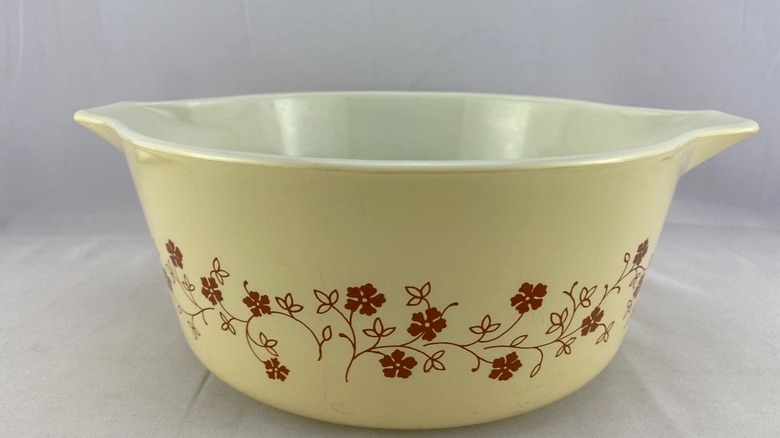
Another short-lived promotional pattern and part of the Hospitality Collection is Trailing Flowers, which is also called Sprig. It was released in 1980 and finished in the same year. It was also the first pattern used for the Bake N' Carry line. The Bake N' Carry line came with a quilted cozy that would protect your hands and keep your food hot on the way over to someone else's table, such as if you were going to a potluck. The cozy featured the same colors and design as the Trailing Flowers casserole dish itself.
The dish, with its clear glass lid, could be stood on the base of the cozy. The cute little quilted cozy had four flaps that you'd raise up and snap together above the top of the lid to keep everything warm and make carrying and unpacking easy. There are a few different versions of the round trailing flowers casserole dishes. While they all feature the same flowers and vine patterns, some have a red background and white or ivory design and some are reversed, so they have a cream background and deep red vines, and in both 1½ and 2½ quart sizes.
Garden Medley
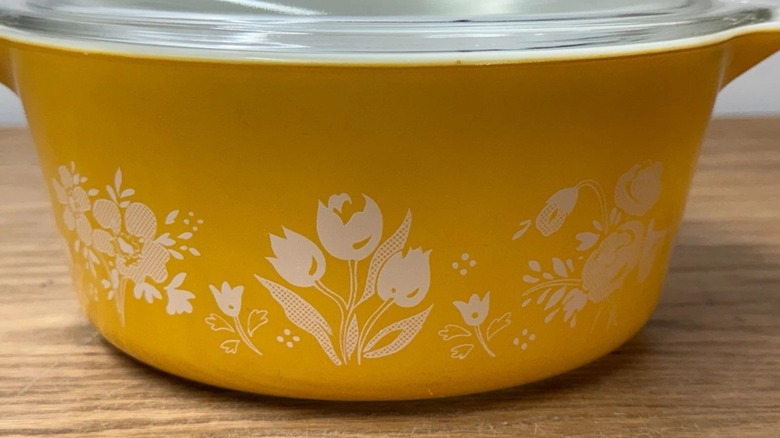
Garden Medley was only offered as a promotional item in 1981, so this is another very short-lived piece. While I did say I don't like yellow, I do quite like this beautiful sunny cheery custard yellow casserole dish. It's a 2½ quart round casserole with a bright yellow background and simple white flowers. The dish features roses and tulips and it is simple but striking. You can see this bringing a bit of cheer to any table that it graced.
This was another Bake N' Carry casserole dish, so as well as the fitted glass lid, it also came with a matching quilted cozy that had four snaps to hold it together at the top. This one is highly collectible because it had such a brief production run and is so pretty. While you often find the bright yellow base, sometimes with the accompanying lid, finding one that also still has its matching cozy is very difficult indeed. I'd love to see Pyrex bring this one back as perhaps a limited spring line with its cozy, just like the original.
Shenandoah
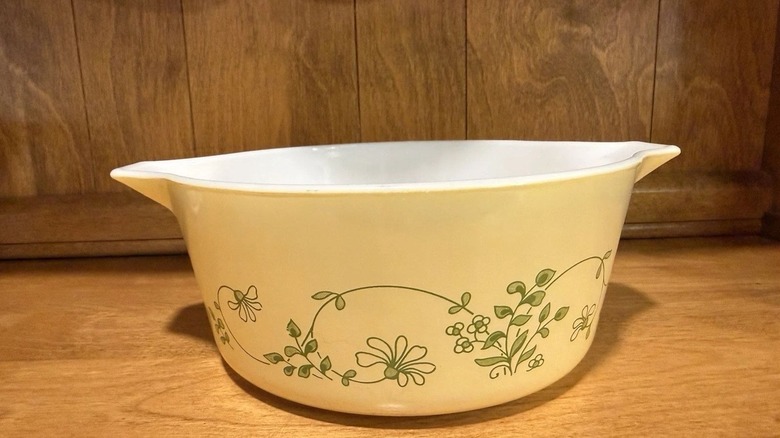
In Canada, Shenandoah is known as the Wintergreen line but in America it's known as Shenandoah and it arrived in 1981. This particular line was popular and remained in production until Opalware Pyrex finished production in 1986. It had a fairly limited range in spite of its popularity though, being confined to mixing bowls, Cinderella bowls, Bake, Serve 'n Store pieces, and a small matching bakeware line.
It's a soft delicate pattern that has an oddly gentle vintage look with a pale yellow background and soft spring green floral design. The soft spring look of this lovely milk glass design, I think, would look fabulous in almost any contemporary kitchen as the design is soft rather than overwhelming, and it's light rather than heavy like some of the other earlier Pyrex pieces. It's light and simple enough that it wouldn't even look out of place in a fairly minimalist setup where most kitchenware and dinnerware is plain and white.
Forest Fancies
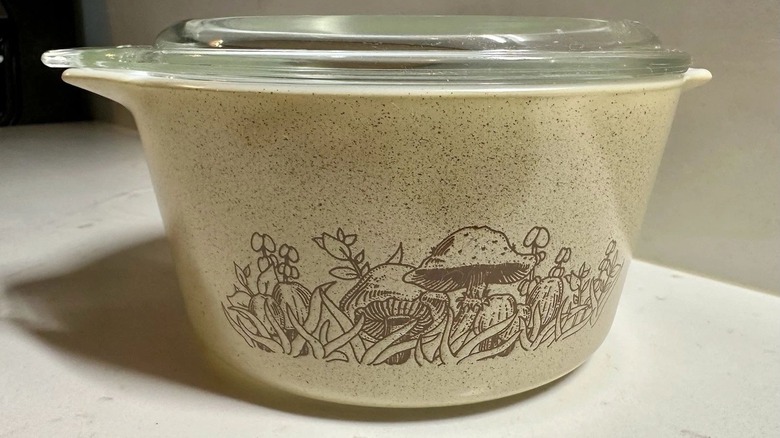
The brainchild of designer Mark G. Rubin, Forest Fancies is probably the pattern most people think of first when you talk about '80s Pyrex. I have to admit it's also one of my favorite designs from this particular decade even though I do not care for brown as a general rule. Forest Fancies is rather adorable with its tiny printed mushrooms, toadstools, and grass on an almond-speckled background. Forest Fancies took over from Homestead in 1981, the point at which the opal or milk glass lids were switched for clear glass ones across the whole line. This is also one of the only four designs that was still in production right until the end, when Pyrex discontinued its Opalware line in 1986. By the time Forest Fancies entered production, classic products like refrigerator dishes had already been phased out. You will, however, find several different mixing bowl sets, Cinderella bowls, some casserole dishes, and a Bake, Serve 'n Store set in the Forest Fancies design.
This pattern speaks to me because I love mushrooms. I forage, grow, and eat them, and I am never so at home as when I'm out walking the dogs in the woods. Forest Fancies lets me bring a little bit of that into the kitchen. If Corning were to reissue Forest Fancies, I imagine it would be incredibly popular as warm neutrals, botanical prints, whimsical woodland decor, and of course mushrooms are already very popular and trending in kitchens. It's a shame this is one of the discontinued Pyrex patterns you can only buy secondhand. I'm pretty certain this would be an easy sell for Pyrex and they wouldn't even need to make any changes to the slightly odd, tiny forest floor motif, as that's really the whole charm of the pattern.
Colonial Mist
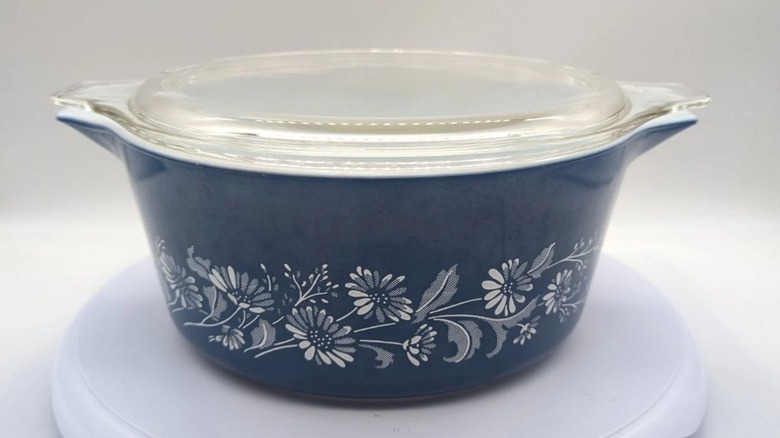
Colonial Mist was the last pattern of the Opalware Pyrex lines. It was released in 1983 and stayed until the bitter end in 1986. When production of Opalware ceased, it had a very limited run. There are only a few different pieces available, including a set of four mixing bowls, which were also sold as individual products. The design was a cornflower-blue background with white daisies running around the bowls. The reverse was also available with a white background and blue flowers. It was sold as an accompanying set to the Corelle dinnerware pattern, which was also titled Colonial Mist.
Outside of the United States, Colonial Mist was sold under the name Blue Mist. Because there are so few different pieces of Colonial Mist, people's collections obviously tend to be quite small. I think, given that the pattern is still reasonably contemporary, that Pyrex would do well if they re-ran this line with an expanded range to include refrigerator dishes, casseroles, and other ovenware. The blue and white coloring goes well in a traditional farmhouse or cottagecore kitchen.