

Every House Had It In The 1800s — The Valuable Cast Iron Pan That Collectors Dream Of Finding
We may receive a commission on purchases made from links.
In the 19th century, there was an important kitchen tool that looked like something you'd see in a potions class at Hogwarts School of Witchcraft and Wizardry. It's no exaggeration to say that this piece, made from cast iron and standing on three legs, looked like a cross between a frying pan and a witch's kettle. Known as the spider (thanks to its legs), it was a skillet designed specifically for hearth cooking, and a good number of homes had at least one in the 1800s. Now, the former arachnid of the hearth is yet another valuable cast iron kitchen tool that collectors dream of finding.
The three-legged skillet design was likely inspired, at least in part, by the earthenware pipkin pot – a piece that was a fixture in early American settlements like Jamestown in the 1600s. This potential influence would explain why some spiders have rounded bottoms instead of flat ones, a design that aligns more with kettles and stew pots than skillets. (Incidentally, given the trio of legs, camp ovens may have also been a design influence.)
While this piece may look magical to modern eyes, it served a very real-world purpose in its heyday. The spider skillet's off-the-ground construction and long handle allowed home cooks to navigate cooking at the hearth with fewer burns. It probably didn't do away with cooking-related accidents completely, but it was safer to use than, say, a plain ol' skillet sitting directly on the fire.
The 19th century's ever-present skillet
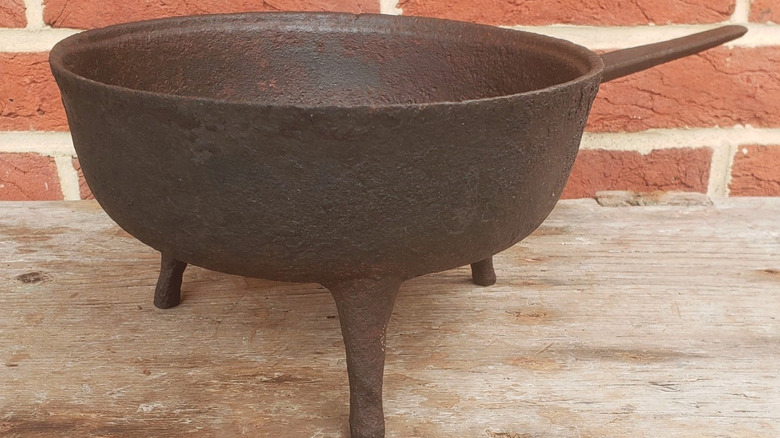
The spider skillet was ubiquitous in the 1800s. Mentions of them in historical documents and books of the era offer clues about the important role they played in home cooking. The spider's earliest known mentions were in newspaper ads from the mid- to late-1700s that differentiated between spiders, iron pots, and baking pans when listing items for sale.
It wasn't just in ads that spiders were mentioned. They also appeared in cookbooks of the era alongside recipes for fried foods like fritters. Poets and novelists such as John Greenleaf Whittier and Adeline D. T. Whitney described them in their writing, too. All of these references to spider skillets in print solidify the fact that they were an important and common part of an American household's cooking arsenal.
The name itself is decidedly American in origin. Even when the proliferation of cook stoves created a need for pans sans legs, the moniker stuck. For a time, spider was just another name for a skillet, whether the pan in question had legs or not.
Collecting spider skillets today
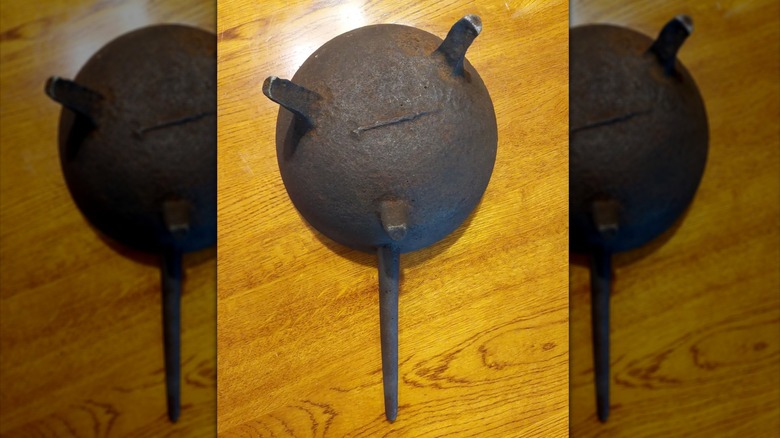
If you're a collector who wants to get your hands on a spider of your own, you'll find them on sites like eBay and Etsy. Out in the brick-and-mortar world, you can spot these cast iron pieces at estate sales, auctions, antique stores, and thrift shops. An array of sizes and styles exists. Some come with lids. Others don't. You may also see a gate mark on some of them, resembling a line or a slash across its underside. The gate mark is the spot where liquid iron entered the mold when it was being made.
Even though some prominent manufacturers of the day, like Birmingham Stove & Range Co., made these pans, a lot of spider skillets you encounter may be unmarked. Many of these unmarked pieces were made by regional foundries. In most cases, spiders from the smaller foundries are of the same quality as the vintage name brands, so don't let the lack of a name prevent you from buying one you like.
Finding one of these cast iron skillets in good condition at a thrift store or auction is truly a treasure — a fact that is reflected in the prices some people are willing to pay for them. You may discover spiders that cost as little as $40 or $50. There are also some that'll set you back several hundred dollars or more, depending on the quality of the piece, what comes with it, and how rare it is.