

Why Does Your Lawn Mower Keep Getting Clogged?

A quality mower is a much-needed tool for any homeowner with a lawn. As necessary as these machines are, they're also the source of plenty of frustration. One common issue you're likely to run into at some point in your lawn mower's lifetime is clogging. Your mower does more than just cut grass; it also has to move it. Mowers are designed to generate airflow — or lift — to suck up the clippings and either shoot them out the side chute or into a catcher at the back of the machine. If something obstructs the airflow, your lawnmower can get clogged with cut grass.
Usually, a mower gets clogged because of insufficient airflow, but the cause can vary depending on the mower's parts and type. The simplest and most likely reason your mower keeps getting clogged is that grass or other debris is blocking the catcher. Without good airflow, the mower is unable to create enough vacuum force to suck grass clippings into the catcher.
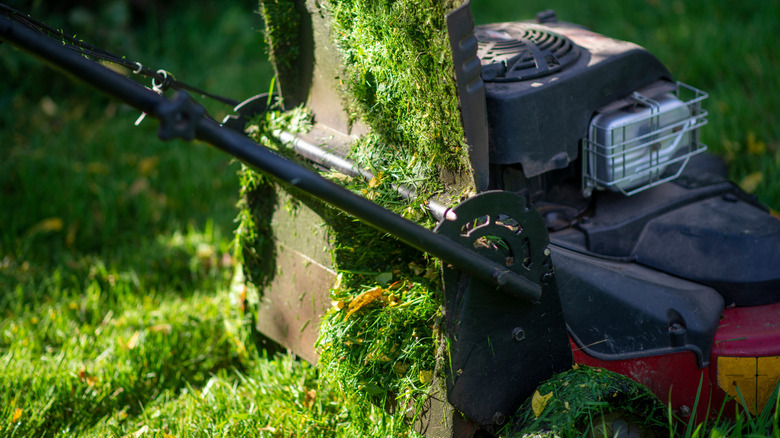
Another common cause of mower clogs is something many owners overlook: the underside. Clippings and other debris can build up underneath the deck of the mower, especially if you regularly cut wet grass. As with a blocked catcher, this buildup restricts airflow, preventing your mower from sucking up clippings efficiently. Uneven cutting and loud sounds emanating from your mower can indicate this problem. Worn-out blades are another potential culprit. They can no longer generate enough lift to suck up grass. Thankfully, the fix for a clog-prone mower is usually pretty simple.
How to keep your lawn mower clog-free
If you have a mower with a grass catcher on the back and you're dealing with clogs, remove and clean the chute and the catcher with a pressure washer or a hose with a high-pressure spray setting. A clean catcher will have lots of light coming through the mesh when you hold it up to the sun. Test your mower to see if cleaning the chute and catcher has fixed the problem. If not, it's time to look at some other possible causes, like debris packed underneath the deck.
To safely clean your lawn mower the right way, start by powering it off completely and removing the spark plug or power supply — depending on whether your mower is gas or electric. Gently turn your lawn mower onto its side, then clean the underside of the deck by spraying it down with your garden hose. Remove stubborn grass with a paint scraper or putty knife. Keeping the deck clean can prevent clogging and is also a simple tip to prevent lawn mower damage by warding off rust.
Frequent mower clogs could also be a warning sign that your lawn mower's blades need sharpening, but another part of the blade might also be causing the problem. Lawn mower blades have an upturned wing — or flute — that helps generate the lift to suck up grass clippings. This part can wear down as the blade dulls. When that happens, the blade may be unable to create enough lift, causing grass to clog your mower. Check your mower for a worn-down flute and, if you spot one, it's time for a new blade. Sharpening the blades won't help because it's a connected system.