

What Happens If You Never Clean Your Stove?

If you've been avoiding the kitchen simply because you don't want to deal with your messy stovetop, listen up. It's time we talk about what's happening around those burners. Maybe you already have a regular cleaning routine in the kitchen, but chances are you've never really spent much time thinking about why you should clean the stovetop, besides trying to have a Pinterest-worthy kitchen aesthetic.
So what exactly would happen if you never cleaned your stove? Well, for starters, all those little splatters of food bits can invite bacteria, which is definitely not listed as an ingredient on tonight's dinner recipe, but will be involved nonetheless if not cleaned up. There are also safety concerns to consider, particularly for gas stoves, where some innocent splashes left over from yesterday's meal can actually catch fire. If bits of food or sauce make their way to the burner, it can block part of the flame. That can make cooking whatever's in the pan impossible to heat evenly or simply take longer because without a full flame, the heat is lower.
But it's not just the gas stovetop that you need to worry about. Your electric stoves can suffer as well. Each spill just adheres more strongly to the burner every time you cook on it without cleaning it first. Eventually, it wears down and won't work as well. Glass stovetops are particularly sensitive to rough cleaning processes, so it's important to keep them clean on a regular basis in order to avoid ruining them with an abrasive cleanup. Keeping them clean is an effective way to make your stove last a long time.
The easy cleaning routine to keep your stove in tip-top shape
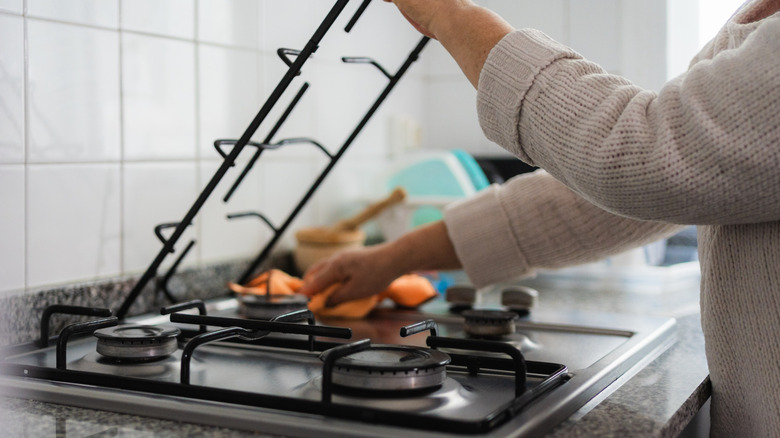
Now that you're sufficiently scared of ruining your stovetop and setting your kitchen on fire, you're probably wondering how to prevent that in the first place. The simple answer is to keep your stovetop clean. Your stovetop is one of the things in your kitchen you should be cleaning every day, or at least after each use (once the burners have cooled down, of course). Committing to this one quick cleaning habit makes things so much easier down the line. If you don't allow the spilled pasta sauce and splattered grease to sit and solidify in the first place, you won't have to work up a sweat trying to scrub them off in a week from now.
Speaking of a week from now, the daily maintenance doesn't mean you can skip a deep clean altogether (sorry, not sorry). How often you need to add a deep clean to your routine will depend on how often you use the stovetop. If you're a cook-at-home-every-night type of chef, you'll want to do a deeper clean once a week. Go ahead and tack that on to your weekly cleaning habits for a cleaner kitchen. For those less inclined to cook more than two or three times a week, you can get away with deep cleaning every other week. And don't worry, deep cleaning isn't as intimidating as it sounds. It simply means removing the parts you can (think grates and drip pans) to give them a good wash and thoroughly wiping down the exterior surface of the stove, including things like knobs and the backsplash.