

Gardener Transforms A Simple Glass Jar Into A Functional Hive For Bees With An Impressive DIY
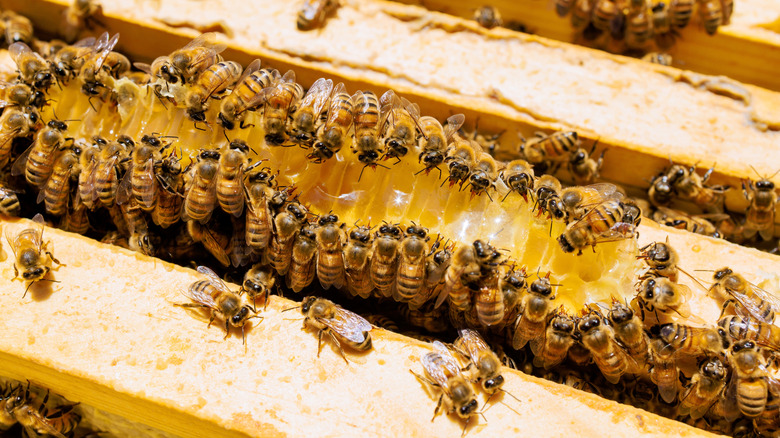
Bees may be unwelcome party crashers at your picnics, but they're also vital to the earth's ecosystem and our economies. As pollinators, bees support the reproduction of plants and crops. They also produce honey and beeswax — a perk for beekeepers who want to earn some income or who simply love honey. For an interesting twist on beekeeping, place glass jars over a hive to give bees an extension to their nest. In turn, you'll end up with containers of honeycomb and a close-up view of the hive-building process.
If you're unfamiliar with the world of honey bees, here's a quick primer. These insects live with thousands of other bees, each with a specific role to keep the hive thriving. At the center of each hive is honeycomb, intricately constructed with beeswax hexagons that serve as a storage system for honey, pollen, eggs, larvae, and pupae.
With a few simple steps, basic materials, and patience, beekeepers can give bees more space to build honeycomb. This is a handy way to reuse old mason jars while supporting pollinators. Either an inner beehive cover or a piece of thick plywood that matches the dimensions of the hive structure can be used as the base of the project. Trace holes on the cover or plywood using the lids of the jars as a template, then cut the holes with a drill or hole saw. These will serve as the openings between the hive and the jars.
How to get bees to fill jars with honeycomb
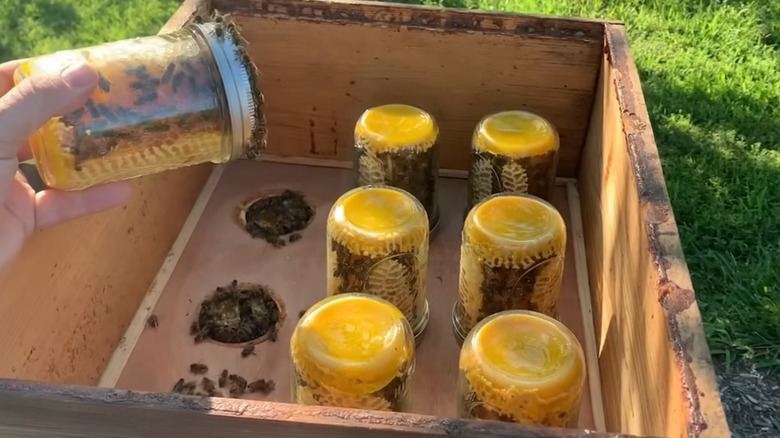
One important note is that the queen bee should not be able to venture into the jars, and using a queen excluder is the best way to avoid this. The excluder is a barrier that allows worker bees to pass through while keeping the larger queen bee and drone bees out. Once this is in place, lay down the cover and put sanitized jars upside down over each hole. To entice bees into the jars, melt a small amount of beeswax onto the bottom of each container.
For extra protection against wind or other disturbances, place a super (a frame typically placed on the main hive structure that has an open bottom and open top) around the jars. Another option is to construct a basic frame with four planks of wood. Within a few days, you'll likely see bees in the jars, making their own wax or using the provided wax to build honeycomb.
Give the bees a few weeks to fill the jars with honeycomb before removing them from the hive structure. Cover the jars and put them in the freezer overnight to kill off pests in the combs, and keep them covered while thawing at room temperature. For extra novelty, fill the jar with honey. If you're interested in more budget- and eco-friendly ways to care for bees, turn toilet paper rolls into a habitat for visiting bees or reuse common household items to make your garden a pollinator haven.