

Removing Weeds? Here's When Not To Spray Roundup In Your Yard
We may receive a commission on purchases made from links.
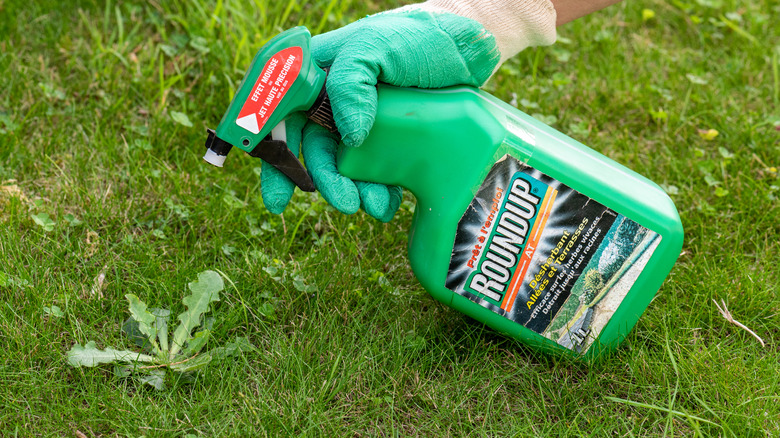
Weed management is one task most gardeners would collectively agree they despise with all their being. Whether you hand-pick weeds for a clean and open lawn or hoe them out (hopefully, without leaving any root fragments behind), this task takes a lot of labor. But when you run out of patience or fail to contain the spread through non-chemical means, you may resort to Roundup as a last-ditch effort. Yet even this systemic, non-selective herbicide may fail to yield effective results. While there can be several reasons for poor performance, such as choosing a formula that doesn't treat the weeds you're targeting or applying it incorrectly, it's also possible that the conditions weren't right for the treatment.
In most cases, you shouldn't spray Roundup outside the temperature range listed on the product label, as recommendations vary depending on the formula. Following guidelines is essential to successfully get rid of weeds in your garden and yard. You must also want to delay herbicide treatment during extreme heat or other conditions that can stress weeds and affect the product's performance. Also, avoid applying Roundup on windy days or before an expected rain.
How temperature impacts Roundup's effectiveness
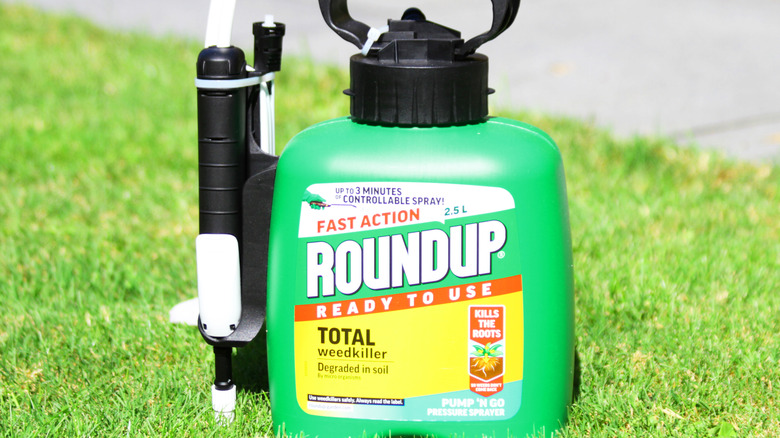
If you actually follow the legal requirement of reading and following the directions listed on the product label, this may not be news. For instance, Roundup for Lawns states it should be applied when you don't expect day temperatures to oscillate beyond 45 and 90 degrees Fahrenheit on either side. In contrast, for Roundup Weed and Grass Killer, the manufacturer advises waiting until it's at least 60 degrees Fahrenheit hot outside before making any applications.
As you may have noticed, temperature requirements vary across Roundup products. That being said, the underlying principle is similar: You should chemically treat weeds when they're actively growing to achieve the best results. The reason? Post-emergence herbicides like these are sprayed directly on the foliage. Once absorbed through the leaves, it trickles down into the roots, helping kill the weed.
However, cooler temperatures can slow weed growth. As a result, the chemical struggles to move to the root system, leading to below-average results. Pairing this with nighttime temperatures under 40 degrees Fahrenheit can make matters worse, as herbicides lose their effectiveness in these ranges. If you expect severe frosts or freezes, it's best to hold off on any application until temperatures warm up to optimal ranges (as stated on the label), or you may be wasting your product and effort. In other words, track the weather forecast for consecutive days before undertaking any chemical treatment.
Avoid spraying Roundup on hot, windy, or rainy days

Roundup may be less effective if your weeds are stressed. Consider a heat wave situation where temperatures easily zoom past 90 degrees Fahrenheit in many areas. Weeds may not be pushing out much growth. Worse, if it's hot and dry enough, any spray you apply may evaporate before it has a chance to penetrate the leaf and translocate down. This action may also fail if weeds are distressed from diseases, dust accumulation, or waterlogging. On the flip side, some weeds have been known to develop thicker cuticles to ward off heat, making them resistant to Roundup treatments.
Moreover, most herbicides — and Roundup is no exception — state a rainfast period. In other words, there should be no exposure to water, through rainfall or irrigation, that may wash off the product before it can effectively infiltrate and kill the weeds. If you fail to follow the recommended timeline, you may have to redo your chemical applications. This gets trickier because performance varies depending on the weed's lifecycle. Uptake of Roundup is faster for grasses and annuals, relative to perennials or broad-leaved weeds.
You must also avoid spraying Roundup in your yard at night. That's because Roundup works better on long, sunny days when it's exposed to intense light. In fact, night applications may require longer rainfast periods, since the product may not have fully percolated down. Another crucial DIY weed killer tip to know before you spray: It's unwise to spray Roundup on a windy day, as it may drift to non-target ornamentals and harm them.