

What Color Should Bird Baths Be To Attract The Most Birds?
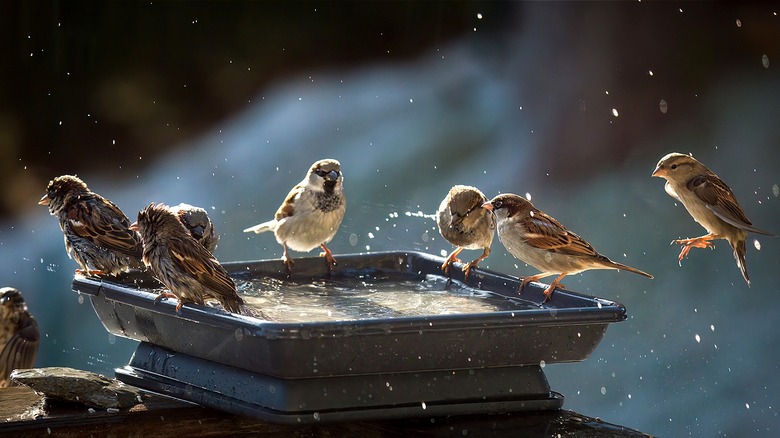
According to a 2024 report by the U.S. Fish and Wildlife Service, 37% of the U.S. adult population in 2022 could be categorized as "birders," or observers of birds. Of course, bird-watching (a home and garden hobby that's making a real comeback, clearly) works best when there's actually a number of feathered friends to spot, and bird baths help in that regard. There are plenty of tips and tricks to attract more birds to your bird bath, but one in particular deserves a green flag. Because, as it turns out, you can catch more robins, sparrows, and swallows with the right color bird bath. Blue and green bird baths are the least likely shades to, uh, ruffle any feathers.
Because blue and green mimic the hues of the water and greenery that birds regularly encounter, birds are naturally attracted to them. As well, earth tones, such as beige, tan, and stone, are also a comforting choice as they tend to blend into the surroundings, making birds feel safer.
But if you're hoping to land a specific species, you can try a more targeted approach. For example, since gray and brown are colors found on the ground, in rocks and dirt, they would be good colors for bird baths meant to attract doves, sparrows, and other species that spend time on the ground foraging. Meanwhile, red, pink, orange, and yellow are the opposite of the muted colors of brown and gray; they're bright and very noticeable. These colors are often associated with birds like orioles, hummingbirds, goldfinches, and warblers, and bird baths in these colors could have a better chance in bringing these species in for a landing.
How to attract more birds with your bird bath
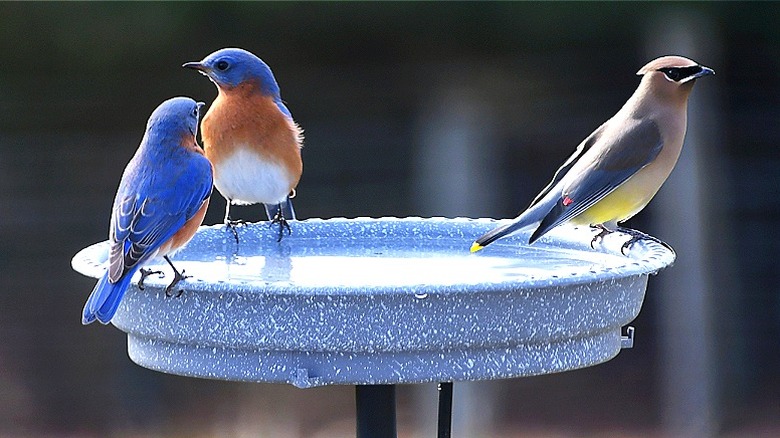
While certain colors can be a calling card for the birds you're hoping to spot in your yard, it's not the only factor to consider when purchasing a bird bath. Since birds generally don't want to make a deep dive, it's best to pick something with a shallow basin – roughly 1 to 2 inches deep. A perch or two where they can actually move around to bathe and preen is also a nice feature (which you can add yourself with rocks that stay above the water), as is a bubbler or dripper that creates movement in the water. Not only does it tend to keep the water cleaner, the sound of splashing can be heard from further away.
As for where to nest your bath, a shady spot is best as it helps the water remain cool throughout the day. Ideally, it would also be somewhere birds can easily see, yet in a space secluded enough to not attract predators. Finally, if you're looking to spy a diverse variety of birds in your yard, fill it with plants native to your area. You can discover which flora to mix in by scanning nonprofit websites such as Homegrown National Park and North American Native Plant Society, or paying a visit to a nearby arboretum or nursery.