

The Pricey Vintage Mason Jar That Collectors Dream Of Finding In Thrift Stores Or Flea Markets
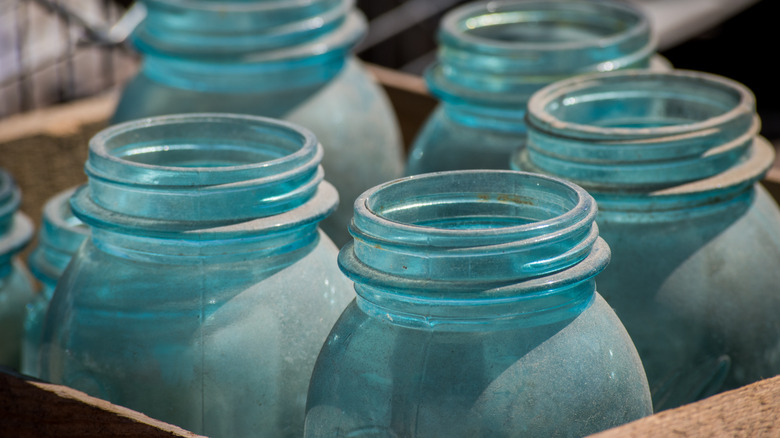
Mason jars serve so many purposes throughout the home that it's easy to forget this humble item has a rich history. Before the Mason jar was invented in 1858, home canning required cork tops and wax seals to keep food fresh, and the process wasn't as safe as smoking, drying, or salting foods. Then John Landis Mason patented a screw-top jar, often made from aqua glass, and history was made. Today, Mason jars, which are trending in home decor, are easily found in thrift stores. Some can be had for cheap, but rare vintage models can sell for hundreds of dollars, like the lightning-closure jar of the 1880s.
In 1882, Henry William Putnam improved on the Mason jar design by introducing his new version of the bail-wire closure device. This hinged closure securely sealed lids with sturdy wire, while a rubber gasket acted as a hygienic seal. This style of jar got its name from its ability to open and close with "lightning" speed. Unfortunately, they actually didn't make good canning jars because the wire could lose tension over time, resulting in leaks and spoilage. By the 1960s, they were mostly phased out in favor of the self-sealing two-piece Kerr Mason jar lids we use today.
Lightning-closure jars are now sought-after decor items. The value of these vintage Mason jars varies depending on the size and color, but rare amber lightning Putnam jars can sell for more than $300. More common clear and aqua jars can be found for less than $50.
How to identify a vintage lightning-closure Mason jar

Modern reproductions of vintage Mason jars are unfortunately common and can be tricky to identify, especially if an unscrupulous dealer is trying to make a reproduction look older. This is particularly true of the rarer colorways, like amber. Jars often say "Trademark Lightning" on the front, with the name "Putnam" and a glass manufacturing mold number on the bottom, but variations exist.
One way to identify a vintage lightning-closure Mason jar is by checking its mold seams. In modern jars, the seams will extend all the way through to the lip of the jar, while older jars were made by mouth-blowing the glass body into a mold, then hand-finishing the lip, so there wouldn't be a seam. Jars made before 1900 may also have a rough lip, resulting from excess glass being ground off. Another giveaway that a lightning-closure jar is actually a reproduction is found in its wire. If a neck wire only has one twist, it's not an original.
Once you've scored your perfect lightning-closure jar, keep in mind it shouldn't be used for canning food. Use modern equipment and techniques for pressure canning. Even if you plan to use vintage Mason jars for decorative storage, there are a few things you should never keep stored in glass jars.