

Not Hydrangea: The Evergreen With Flowers That Are Safe For Allergies

Gardeners prone to seasonal allergies are intimately familiar with how the hobby can take a toll on one's health. One minute you're cheerily tending your garden beds, then the next, a sudden influx of airborne pollen brings about incessant sniffling, wheezing, watery eyes, or even an asthma flare-up. While you can't prevent allergens from entering your property from outside, you should consider planting an allergy-friendly garden within your fence line. Instead of growing wind-pollinated trees, grasses, and shrubs, choose plants that don't produce much pollen or are pollinated by insects.
For example, hydrangeas have a hidden benefit that makes them perfect for allergy-free gardens. The flowers of mophead hydrangeas are sterile and don't produce pollen, while the blooms of other types have sticky pollen that wind is unlikely to dislodge. However, hydrangeas aren't your only option for allergy-free flowers. The flowering evergreen perennial Adam's needle (Yucca filamentosa) is considered a good option for seasonal allergy sufferers.
This dramatic succulent, which is also known as curlyleaf yucca or spoonleaf yucca, keeps its leaves through winter in Zones 4 to 10. It's native to North America and very low-maintenance. Unlike hydrangeas, it prefers dry soil, so you don't have to worry about keeping it well watered. Plus, it will thrive in full sun and semi-shade, making it highly versatile in garden design. It will handle drought, heat stress, and salt with little effort on your part.
What makes Adam's needle a good option for low-allergen gardens?
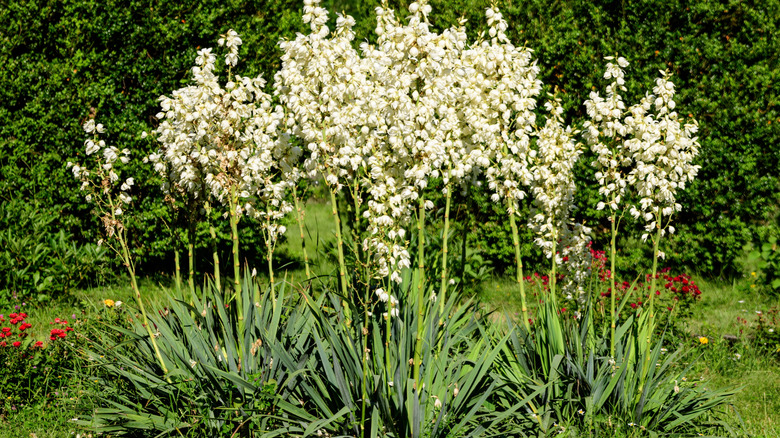
Adam's needle has flower spikes that typically emerge in summer and can grow almost nine feet tall, though blooming can start as early as April in some locations. The flowers are bell-shaped, creamy white, and slightly perfumed, and they grow from the bottom of the spikes upwards. The plant's heavy pollen doesn't go airborne easily, so it's less likely to trigger seasonal allergies. The pollen is also gummy, making it even more likely to stay inside the blooms.
A Pronuba (yucca) moth species called Tegeticula yuccasella exclusively pollinates this plant — this petite white flying insect fertilizes its flowers. In fact, the pollen is so sticky that the moths are unlikely to lose it even if they brush up against something. This dense pollen is what makes this evergreen, which brightens your yard throughout the entire year, a great addition to a low-allergen garden.
Interestingly, the female moths also lay their eggs inside the ovaries of the flowers. Later, the larvae feed on the plant's seeds, ensuring the larvae's survival and cementing the moth's legacy. However, if a moth lays too many eggs in a single flower or doesn't distribute pollen grains onto the stigma during the visit, the plant aborts the flowers, resulting in no seeds. Though such an arrangement makes Adam's needle an ecologically important garden plant, you probably don't want to rely on seed propagation to grow your patch.
Incorporating Adam's needle into your garden design
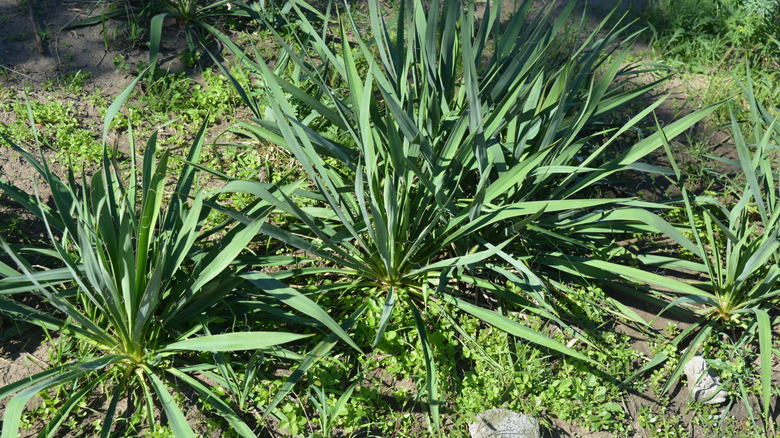
Although Adam's needle relies exclusively on yucca moths for pollination, it's sometimes visited by other pollinators. Its sword-like leaves host the caterpillars of yucca giant-skippers and Cofaqui giant-skippers. The blooms are also popular with hummingbirds. You can add this plant to a pollinator garden.
Alternatively, you can use Adam's needle as a barrier plant. Common home garden herbivores, like deer, squirrels, and rabbits, won't touch it. Plus, its leaves are tipped with sharp spines, making it an effective physical deterrent. Plant it at least three feet away from pathways and patios so family members or unsuspecting visitors don't get pricked. Broadly speaking, you can use yuccas to control erosion on sandy or rocky slopes. Space the plants about three feet apart and carefully plan out their locations. Yuccas have deep taproots, so they can't be easily removed from an area once established.
Bonus: Adam's needle requires little care. It will thrive in any soil type, even clay, as long as its pH-neutral and well-draining. You'll rarely need to provide supplemental irrigation or nutrition. The plants stay upright on their own, rarely requiring staking, and the only pests that pose a problem are black aphids. You shouldn't need to regularly prune Adam's needle. You should, however, remove dead flower stalks at the base of the plant, or they'll remain standing for a few years. Like other yucca species, Adam's needle can cause vomiting in cats and dogs if ingested.