

Say Goodbye To Traditional Mulch: The Fast-Growing Succulent That Can Help Suppress Weeds
Walk through a neighborhood, and you'll likely spot the typical garden showstoppers: the radiant blooms, showy fall foliage, majestic evergreens. However, hardy and low-maintenance sedums rarely get the spotlight. After all, most of the time, they're literally underfoot. Sedums are underrated and often go unnoticed, but they can bring incredible texture and color to your yard. Even better, a sedum like the John Creech Sedum or Stonecrop (Phedimus spurius 'John Creech,' formerly known as Sedum spurium 'John Creech') spreads quickly and roots along its sprawling branches, offering the same purpose as traditional mulch to keep weeds at bay.
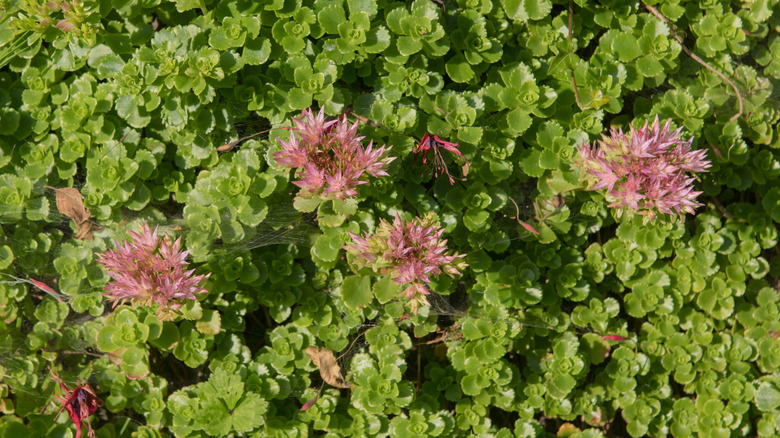
With more than 400 species of sedum to choose from, there are many ground cover varieties to add to your yard. The John Creech Sedum, thriving in USDA Hardiness Zones 3 to 9, doesn't get any taller than 6 inches, yet can sprawl up to 3 feet to form a dense carpet that quickly fills bare spots in your garden. This variety, like many sedums, is incredibly easy to grow, favoring dry, shallow, and rocky soil. Though it needs regular watering during the first season to get established, it prefers to be on the drier side after that.
It's considered to be semi-evergreen, meaning it will lose its older leaves, but the newer foliage near the tips are evergreen. For most of the year, the rosettes are a vibrant green, but they turn burgundy in the fall through winter. While the leaves themselves are dainty and pretty on their own, the plant explodes with spiky pink blooms in August and September.
Planting the John Creech Sedum in your garden
When deciding where to put the John Creech Sedum, find a spot that gets six to eight hours of sun. Also, choosing a well-drained location is key to its survival. Sedums don't like sitting in water, so avoid areas where water can pool. Create a mound, if needed, so that water drains away from the plant.
In addition to using this as a weed-smothering ground cover, the sedum looks especially stunning in a rock garden or cascading down stone walls and slopes. You can also use it along flagstone paths, as long as the plants are regularly trimmed to keep the walkway exposed. To keep your sedum plants fuller and blooming longer, prune wilted flowers to encourage more blooms and pluck old leaves before new ones appear.
Since the John Creech Sedum is a low-growing plant, pair it with towering daylilies, a drought-resistant fall perennial that stuns year after year. Like sedums, they love full sun and well-drained soil. Lanceleaf Coreopsis (Coreopsis lanceolata) serves as a mid-height option between the John Creech Sedum and daylilies, with yellow-orange daisy-like summertime blooms. Another option is to plant more sedums, which will give you an assortment of colors and textures. For example, the dark purple foliage and red star-shaped flowers of the Sedum 'Plum Dazzled' are a stark complement to the brighter tones of the John Creech. For height, bring in Sedum 'Banana Split' for its chocolate-colored leaves and broad heads of ivory-yellow flowers.