

What It Means When Your Lawn Mower Makes A Loud, Metallic Knocking Sound
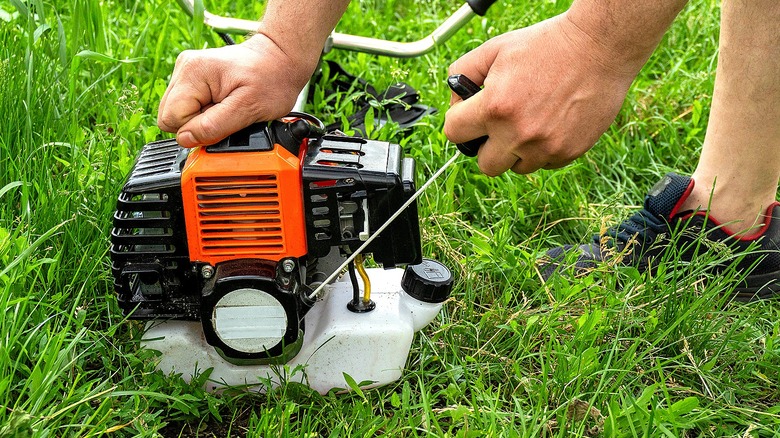
Imagine this: You're mowing your lawn on a calm, cool evening, and all of the sudden your machine makes a loud, metallic knocking sound, like something is banging around inside. Sounds worrisome, right? Well, it is, and it's something you should take seriously. That's because such a sound coming from inside a mower can mean you're dealing with a broken or badly worn connecting rod, which can sometimes also lead to a blown engine.
If you've never heard of a connecting rod before, it's a metal component inside the engine that connects the piston to the crankshaft; it transfers power. When a connecting rod bearing wears, the clearance between it and the crankshaft journal (the center of rotation) can increase, and that extra clearance (or "play") allows the connecting rod and crankshaft to impact one another, producing the distinct metallic knocking sound known as rod knock.
The situation becomes even worse if the connecting rod breaks. Once it snaps, then it's no longer controlling the movement of the piston properly, and the loose rod can slam into other parts inside the engine and can even cause the engine to blow. Put simply, don't take these metallic knocking sounds lightly, and also don't try to fix such a lawn mower at home. It's not a simple fix, and you should take these sounds as signs that your lawn mower needs to go to a professional to be fixed.
What causes a broken connecting rod
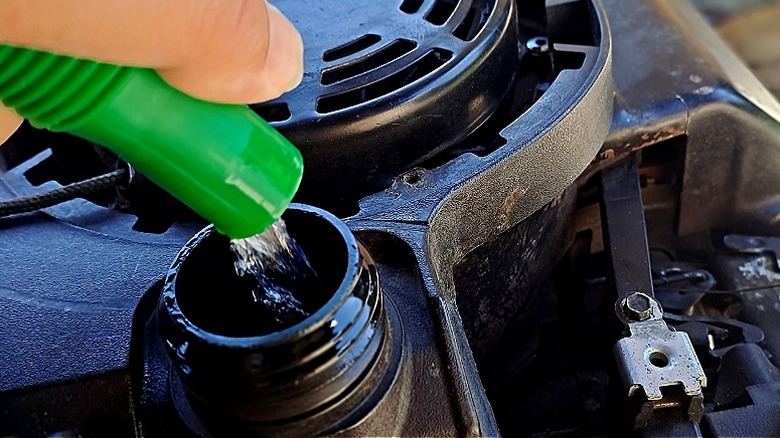
One of the biggest culprits behind a worn or broken connecting rod is poor lubrication, as many mower engines don't have a separate bearing between the rod and the crankshaft. This means the connecting rod relies completely on a thin layer of oil to keep it from grinding against bare metal. So, when the oil runs low, metal-on-metal friction wears the rod down fast. Combine that with old and dirty oil, and it's just a matter of time before the connecting rod breaks. So, make sure you change the oil in your lawn mower regularly, and also pick the right oil for your lawn mower.
Other than poor lubrication, hydrolock is another reason why a mower's connecting rod can break sometimes. This happens when water or coolant enters the engine or when a mower gets tipped the wrong way during maintenance and lets oil or fuel drain into the cylinder, causing the piston to slam into liquid that doesn't get compressed. That sudden force can bend or even snap the connecting rod.
Lastly, don't put too much strain on the mower engine; that can also sometimes lead to a broken connecting rod and a blown engine. So, instead of forcing your mower through extremely thick or overgrown grass that can make the engine work harder than normal, raise the cutting height, or mow more slowly. Another trick is to make several passes through very tall grass. This doesn't let the mower engine get stressed and reduces the chances of mower issues down the line.