

Everyone Owned It In The Victorian Era — Now It's Elegant Table Decor We Want To Find
We may receive a commission on purchases made from links.
Perhaps you're a fan of eclecticism in interior design. Or maybe you've been inspired by our ultimate guide to Victorian decor and want to bring dark luxury and inherent maximalism into your home. Whatever the case, there's a particular style of vintage vase you need to add to that ornately carved parlor table or hulking oak bookshelf to complete the look. While the shape of some vases is determined by the trending aesthetics of their era, most of the time, they're designed around their intended contents. Contemporary bud vases hold just one or two fresh-cut blooms, while other vases are designed to enhance the arrangement and display of a bouquet. Victorian fan vases fall into the second category.
A fan vase has a narrow base and a wide mouth, creating the eponymous hand fan shape. When you pop cut flowers into the vase, the stems naturally fall outward instead of bunching together, creating a whimsical, somewhat haphazard display. Though fan vases were popular with Victorian homeowners, the style actually predates the 19th century. For example, Delftware fan vases, typically made from tin-glazed earthenware, date to the late 1600s. By the time the Victorians fell for the style a few centuries later, fan vases were being made from porcelain, glass, and silverplate. Some fan vases have a flat back, particularly those made as the Victorian era gave way to Art Nouveau. Others are designed to be viewed from every angle. Either way, the wide, flat sides of these vases provided a canvas for ornate detailing, making them statement pieces of decor with or without flowers.
How to authenticate a Victorian fan vase and what to expect to pay
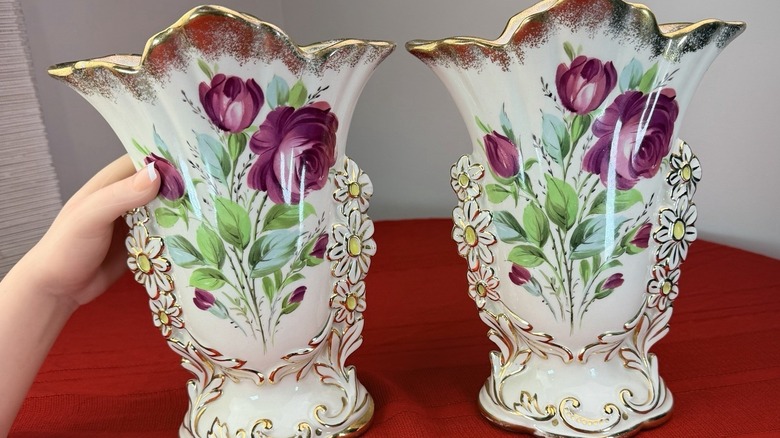
To find an authentic Victorian fan vase, familiarize yourself with the manufacturing techniques of the era. British-made transferware, especially pieces featuring blue and white Chinoiserie-style patterns, was popular throughout the 19th century, as was iridescent lusterware. Glass was also a widely used material, with everything from Burmese glass and milk glass to satin glass and applied trailing making a statement. Look for fan vases made by 19th-century makers like Thomas Webb & Sons, Stuart & Sons, Stevens & Williams, and Richardson. Find a manufacturer's mark, impressed signature, or pattern number and use it to help you track down the vase's origins.
Fan vases come in a nearly endless array of shapes, materials, and patterns, and that's what makes them fun to hunt down in thrift stores, estate sales, or online marketplaces. Whether you bought one online or at a thrift store, these vases can turn out to be quite valuable. Victorian fan vases typically sell for around $20 to $150 on eBay, depending on the material, maker, size, and condition, while some sell for considerably more on antique auction sites. For example, there's a tall 19th-century cranberry glass vase with a $460 price tag on Charish.
Once you have this piece of Victorian decor, you need to style the vase in the home. To keep with its antique aesthetic, fill your find with fresh-cut flowers — roses are a must-have. The Victorians also loved using foliage, like ferns and ivy, to soften the blooms. The combination will add drama and color to any room. Pot-et-fleur, where cut flowers in vases are arranged alongside potted houseplants, was also popular during the Victorian era. It's an antique-inspired arrangement that's easy to recreate in your home with a fan vase.