

Not WD-40: There's A Better Way To Fix Sticky Door Locks

At the end of a long day, the last thing anyone wants to deal with is a stuck lock that won't open. Tempting as it is to reach for your trusty can of WD-40, door locks are actually an essential part of the home that shouldn't be lubricated with WD-40. Oil sprays, like WD-40, form a gunky film that attracts dust and debris. And while dry graphite powder may be recommended, it has caveats as well, like not using too much, not resorting to it too often, and only using it on locks that won't get rained on (i.e., wet, as residue can turn into a glob). Instead, you could try a different dry lubricant that goes on clear and dries quickly, leaving behind no residue: a PTFE-based one, such as 3-in-One Lock Dry Lube (Lowe's, $7.08).
PTFE is short for polytetrafluoroethylene, a synthetic polymer with nonstick properties. A brand name you may be more familiar with is Teflon; a PTFE-based dry lubricant brings the same nonstick technology you rely on in cooking to help keys turn smoothly again. Specifically, 3-in-One Lock Dry Lube is formulated to "loosen, lubricate, and protect any home or commercial lock."
As with all PTFE lubricants, it reduces friction inside the lock. It also "dries to the touch within minutes," per the brand, so there isn't residue to clean up or worry about becoming clumpy down the road. At the Lowe's website, most customers report using 3-in-One Lock Dry Lube to unstick their locks, but a few mention using it for other stuck mechanisms, including door hinges and adjustable car seat tracks. Said one reviewer from March 2026, who gave the product five stars, and used it on their front door and truck: "It was not greasy. Worked with only one try."
How to use a dry lubricant on locks effectively
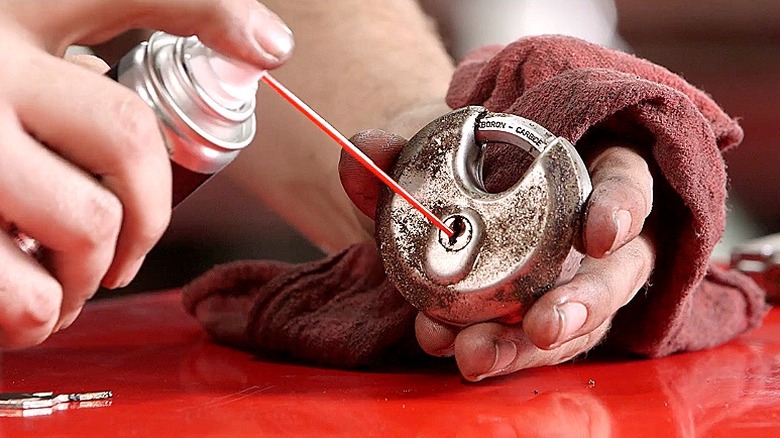
When it's time to clean your door's lock to stop sticking, grab your dry lubricant and keys. Using the straw, aim the lubricant into the lock and spray. Let it dry, which again, should only take minutes to dry completely. Try the key; you might insert and remove the key in the lock a few times to ensure the product reaches all the lock's internal parts. While a PTFE-based dry lubricant like 3-in-One Lock Dry Lube goes on clear, it leaves behind a thin coating or barrier as well; because it's dry, it won't become a magnet for dirt and debris.
Experts recommend applying a dry lubricant to your locks once or twice a year. When you start using a PTFE-based dry lubricant, you may need to flush out the lock first. To do so, use a no-residue solvent like a brake cleaner, and let it fully dry before using your dry lubricant product going forward.
Finally, if you've cleaned and treated a stuck door lock but it still isn't cooperating, then it may have a more serious failure. While a jammed door latch can be fixed quickly, it could also indicate an internal latch failure. Note that the average lifespan of a doorknob lock is about seven years, while a deadbolt typically can last between seven and 15 years.