

Ditch Concrete Blocks: The Long-Lasting Alternative For Retaining Walls With Superior Strength
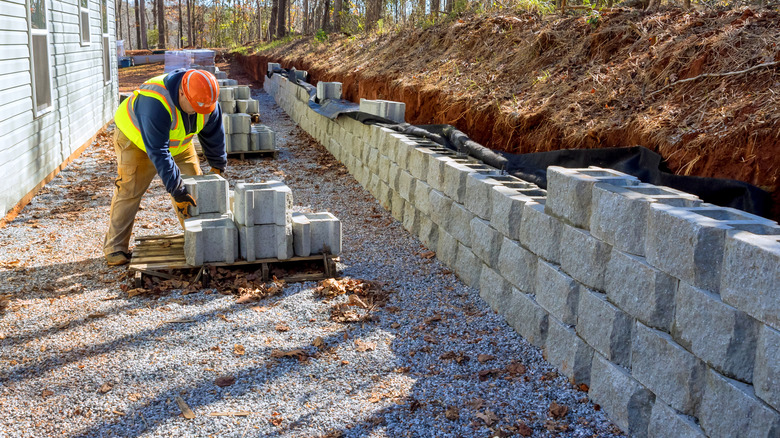
There probably isn't a more budget-friendly way to build a retaining wall to protect your landscape than using some form of concrete blocks. Unfortunately, unless you coat the wall with some kind of textured finish or cover it in cladding (which adds to both cost and time), they aren't really very attractive. There is a better-looking, longer-lasting, and stronger alternative that is becoming increasingly popular: basalt boulders.
Basalt is what is called an igneous rock, meaning it is made of solidified magma that was formed by volcanic eruptions millions of years ago. The result is a material that is very hard-wearing, more or less unaffected by even severe weather, highly resistant to erosion, and won't break up like concrete does eventually.
Using irregular-shaped boulders, rather than rectangular blocks, gives a completely different and much more natural aesthetic. Basalt boulders add interest because they are never one single color but typically variations on dark grays, blues, or black. They can also be marked with brown, tan, or rust-colored patches. Also, the production of concrete generates high emissions and has a severe impact on the environment. By contrast, quarrying basalt requires minimal processing, so its use is considered more sustainable. Sourcing as locally as possible also helps.
How to build a basalt boulder retaining wall
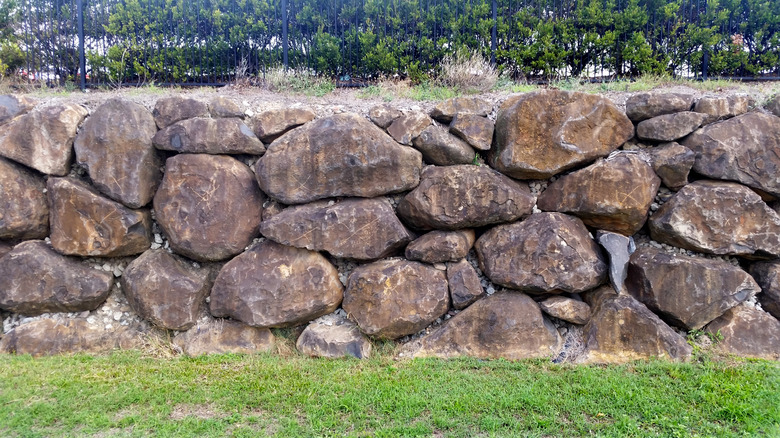
If the size of your retaining wall is likely to exceed 4 feet, you need to check with your local planning department whether you need a permit. You'll then need to estimate the tonnage of boulders required. Fortunately, there are online calculators to help you do this. Boulder size needs to be decided, too. Large, heavy boulders are great if you have ideas to transform a sloped backyard, but maneuvering them is difficult and could require heavy equipment. Check with various suppliers to see what options they offer.
Construct your basalt boulder retaining wall by digging a trench of the overall dimensions to about a foot deep and half-filling it with gravel. Position the largest boulders at this level, then carefully select those that lock together as you build upwards in order to retain stability. The wall should lean back slightly. Use landscape fabric behind the wall to stop soil washing through, insert lengths of drainage pipe through the base of the wall, and backfill with several inches of gravel so water can drain and pressure won't build up on the backside that might eventually push boulders forward.
Although natural stone walls can look amazing in your yard, basalt boulders are challenging to work with. They are large and heavy, and constructing a retaining wall that is secure and safe requires skill and experience. You might want to tackle the job yourself, but it's worth getting quotes from a couple of professionals before you decide.