

How To Test If Your Vintage Glass Vase Contains Lead

You know that beloved vase you always reach for when you treat yourself to a bouquet? Well, in addition to those lovely peonies, lilies, hydrangeas, or tulips, it could also contain something that's no bed of roses. Along with considering the possibility of having lead in your cookware and vintage glasses, you should also be aware that it can linger in vases.
First, a quick history lesson: Before the United States introduced regulations in 1978, lead was used in glassware to give it a nice heft and make it easier to shape during production. At the time, lead crystal specifically referred to glass that contained a minimum of 24% lead oxide. The chemical compound refracts light better, giving it more clarity and an extra sparkle. What manufacturers weren't necessarily anticipating was that exposure to the heavy metal could also cause neurological issues, mental illness, or potential hypertension.
Having a lead vase displaying your florals of choice doesn't carry the same risk as, say, drinking from lead-laced vintage glassware. But if you were looking for the piece to pull double-duty — perhaps as a decanter or candy holder — there are ways to test if it contains lead. While you could pay a professional to test the lead levels using an X-ray fluorescence spectrometer or purchase an at-home test swab kit, there are a number of checks that you can do yourself for free. The answer to whether your go-to vase is standard glass or crystal lies in how it looks, feels, and even sounds.
How to determine if your glass vase has lead
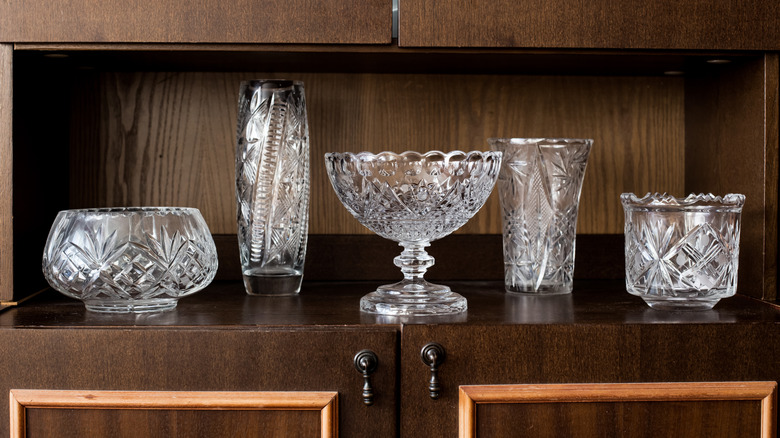
An experienced antique shopper might be able to tell quickly if a thrift store find is crystal or cut glass. Generally, crystal pieces will have thinner rims than lead-free pieces because the glass can be heated at lower temperatures, allowing it to be stretched further. Similarly, they can feature more intricate hand-cut details. And due to the heavier metal, they will often feel weightier in your hand. Another obvious indication would be if the vase happens to bear the mark of a known crystal-maker such as Waterford Crystal, Baccarat, Riedel, or Lalique.
One notable difference between crystal and lead-free glass is the clarity. Though cut glass can be a bit foggier in appearance, its lead-containing counterpart will be more, well, crystal clear. As such, you can perform a prism test on the piece in question. If you hold it up to a light, you'll notice that crystal glassware will create a strong rainbow prism that you won't see with regular glass. You can also try the sound test, giving the vase a gentle tap with your fingernail. While standard glass will create more of dull noise, crystal will give a slightly longer sound, like the ring of a bell. Of course, if you're looking for a clear answer, you can spring for a set of lead test swabs that you can use at home.