

Say Goodbye To Traditional Mulch: The Perennial Grass With Deep Roots That Slows Weed Growth
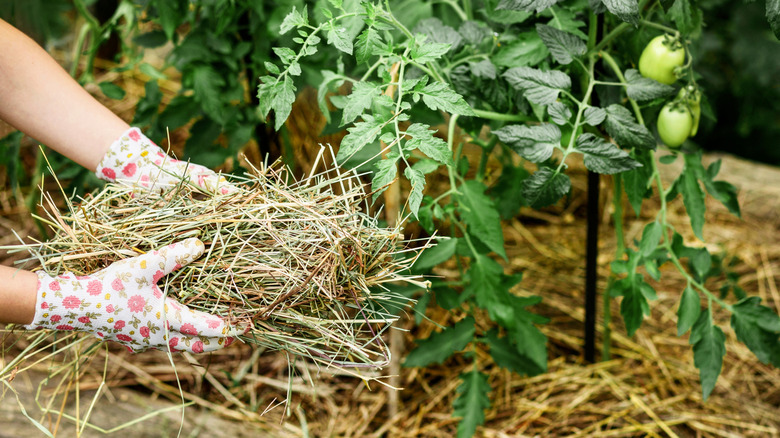
Without a doubt, one of the top priorities and headaches for gardeners is figuring out how to get rid of weeds. Unless you have time every day to stay on top of them, it's inevitable that they'll pop up. There are many great strategies for removing weeds, but there's always room in your toolbox for more options. Rather than using traditional mulch to suppress weeds, plant sunshine vetiver grass (Chrysopogon zizanioides 'Sunshine'), a robust perennial bunchgrass that creates a thick barrier and sends out deep roots, effectively squeezing out weeds.
If sunshine vetiver grass were a person, it would be the jack of all trades. In addition to its weed-suppressing abilities, the plant also helps to control erosion (serving as a windbreak), attract helpful insects while keeping termites out of the garden, and decontaminate the land by absorbing heavy metals in the soil. Sunshine vetiver has even been used for food, medicine, and essential oils used in luxury perfumes — is there anything this grass can't do? And if those traits aren't impressive enough, the plant grows quickly, is low maintenance, and easily adapts to all soil types.
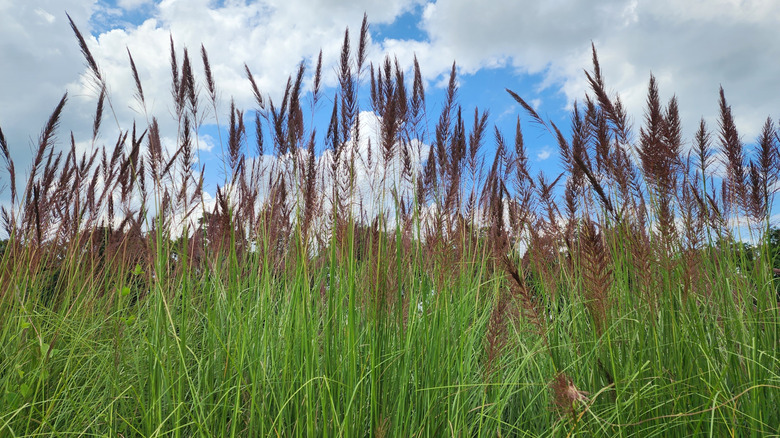
In the garden, sunshine vetiver grass is not shy. It commands attention as it towers up to 8 feet tall and spreads 4 feet wide. It sends up stiff, narrow blades topped with wispy brownish-purple panicles in the summer, adding color and textural interest to the yard. The plant thrives in USDA Hardiness Zones 8 to 10, with a preference for spots that get partial shade to full sun.
Using vetiver grass to suppress weeds
There are many advantages to growing ornamental grasses in your yard, but a primary benefit of sunshine vetiver grass is that it slows down the growth of weeds in a few ways. For starters, its dense, compact growing habit literally crowds out weeds. Underground, the roots extend down more than 8 feet, with a sprawl of about 2 feet, leaving little room for the roots of other plants to take hold. This extensive system is why the plant is so effective for erosion control, too.
Another way to use Sunshine vetiver grass for weed control is to cut it and spread it around plants, as you would with a typical mulch product. This requires growing the grass for a year first. During this time, water it regularly to establish its roots. Divide the plant into several bunches about 2 to 3 inches thick and tie each bundle with biodegradable string. Cut each bunch, leaving about 4 to 6 inches of the plant from the ground.
Lay the bundles around trees, adhering to the 3-3-3 rule for applying mulch: 3 inches thick, 3 inches from the tree trunk, and in a radius of 3 feet around the tree. You can also layer the bunches over wet cardboard in garden beds to form a weed-smothering carpet. Although the grass can simply be cut and scattered around, laying down bundled stalks is less messy and ensures a thicker layer, which is necessary for effective mulching.