

Stop Tossing Old Lawn Mower Blades: Turn Them Into A Helpful Garden Tool
We may receive a commission on purchases made from links.
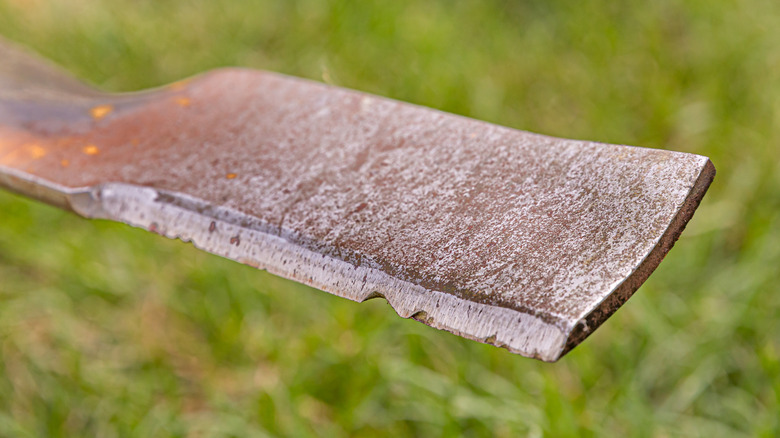
Even with frequent use, a lawn mower blade should last several years. Regular sharpening will be necessary, and there are plenty of tools that let you sharpen lawn mower blades safely. Eventually it will wear down, though, and need replacing. When it does, rather than tossing the old lawn mower blade, you can turn it into a helpful garden tool that looks a lot like a machete. Over on YouTube, Average Iowa Guy shows us how.
At first, the project might seem a little intimidating, but there aren't any special skills here that are beyond someone comfortable with general DIY. The thing you need to be prepared for is that the process involves forging metal when it's red hot. There are obvious dangers involved when working with steel at what could be around 1,000 degrees Fahrenheit, and care is required. It would be easy to burn yourself or set fire to the place. There are things to know before buying a fire extinguisher, but that's probably something you'll want to do at the outset.
The key piece of equipment is some kind of forge. Average Iowa Guy made his own, and it's possible to create one from an old grill. However, the easiest approach is to buy one, and they aren't particularly expensive. The two-burner Vevor Portable Propane Forge is currently $122.90 on Amazon. The single-burner model is around half the price but has limited capacity. Great for small blades, but perhaps not for this one.
Assembling your tools and starting to forge the knife
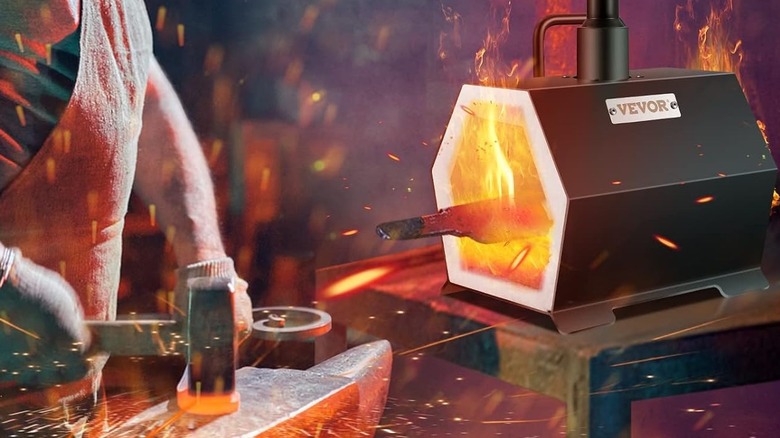
You'll need something to hammer on. People suggest various ideas, including bits of railroad track and a sledgehammer head, but they need to be fixed securely, and striking a small area accurately can be challenging for beginners. Ideally, you'll have an anvil. Lightweight hobby models are designed for things like jewelry making and are not recommended for forging. It should be 75 pounds or more.
You'll also want a hammer of at least 2 pounds, forge tongs, welding gloves, and eye protection. Average Iowa Guy has a workshop full of other tools to make this knife. We'll deal with each of those (and alternatives), as we get to them.
Before you start, it's a good idea to run through the video to get a feel for the various steps. Then fire up your chosen forge, and get to work. The first stage is flattening the lawn mower blade by heating it to red hot and beating it with a hammer. As it cools, the hammer is less effective, so you may need to return to the forge several times. Next, decide the overall shape, including the tang (the bit inside the handle), and cut it out. A rotary tool like a Dremel is ideal, but a cheap hacksaw will do in a pinch.
Now the blade has to be marked out and hammered thinner. Doing so also adds a curve to the blade. Once again, each time the metal cools and the hammer isn't making an impression, return the blade to the forge.
Finishing the knife blade and adding a handle
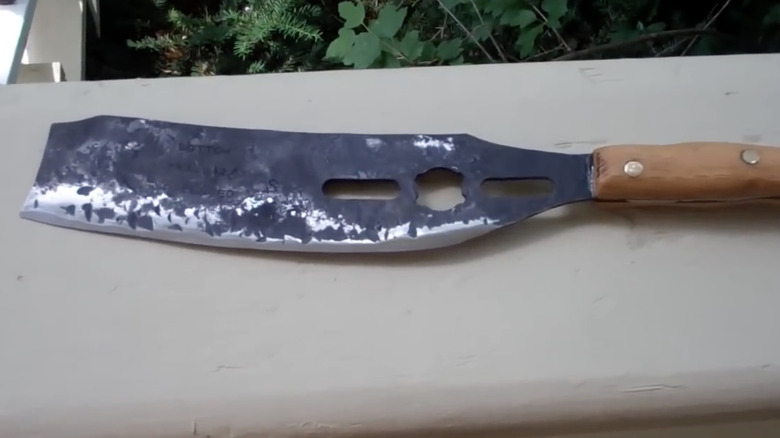
At this stage, the metal has actually become comparatively soft and needs to be hardened. Before that, holes should be drilled to fix the handle if you're going to rivet it together. An easier alternative is to harden the blade, then glue the handle on using a specialist 2-part epoxy like J-B Weld once it has cooled.
Hardening involves heating the blade in the forge until it is non-magnetic, then quenching it in warm oil (not water). In the video, he uses peanut oil, but other vegetable oils and motor oil work too. You'll need a magnet, held in the tongs, to test it. As soon as it stops being attracted to the blade, take it out of the forge and lower it carefully into the oil. Be prepared for flare-ups, although it shouldn't light completely.
After assembly, following the video instructions or by gluing, the final stage is sharpening. This can be done on a belt sander, as shown, on a bench grinder, or by hand on a whetstone. And there you have it: an old lawn mower blade that would have been tossed in the trash turned into an essential gardening tool – and perhaps the start of a whole new hobby.