

How Many Passes Should You Make With A Lawn Aerator For The Best Results Every Time?
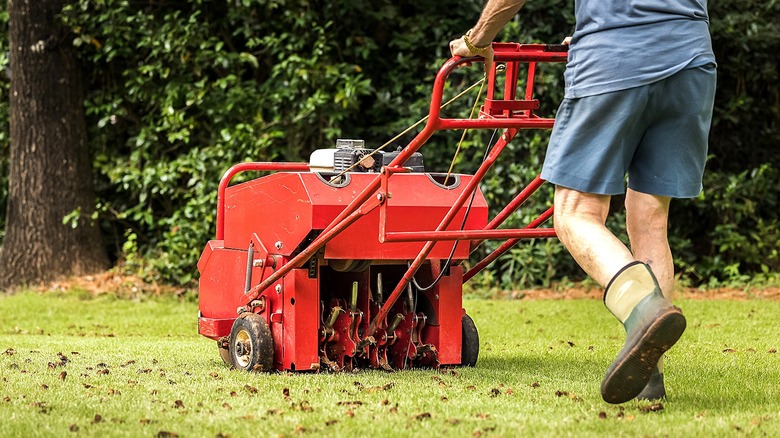
Perhaps nothing is more frustrating than bringing home an aerator, dragging it across your lawn, completing the job, only to then wonder if you've actually done enough. Just how many passes should you make with a lawn aerator? This actually largely depends on the aerator and the lawn conditions. In general, though, one pass should be enough for lightly to moderately compacted soil, while two passes (at least) are recommended for soil that's heavily compacted.
With that said, how many passes your lawn needs may come down to reaching another target altogether: enough holes in the soil. According to Iowa State University Extension and Outreach, you should be looking to make 20 to 40 holes per square foot. If a lawn aerator can't reach that number in one pass, then you'll need to make another or several more — depending on the size of your lawn, and its configuration.
Further, for the best results, you should start by choosing the right type of aerator to use on your lawn and to make those passes. In most cases, this will be a core aerator. As experts explain, spike aerators, which use metal spikes or tines to create small holes in the ground, can actually end up compacting the soil more. By contrast, core aerators pull up entire plugs or cores from your lawn.
How to make each pass count when aerating
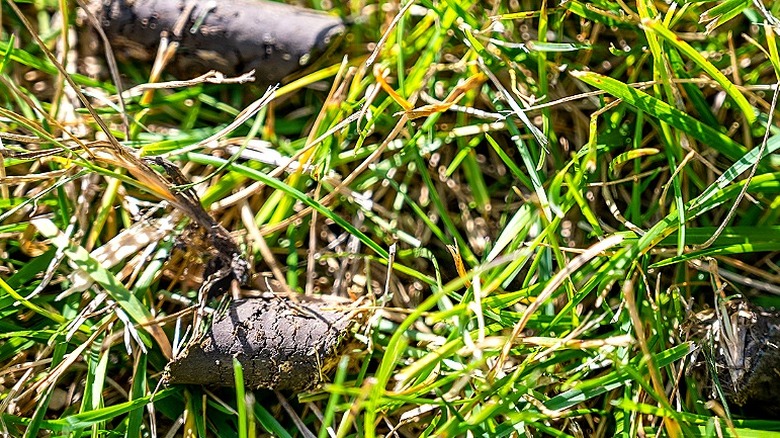
Note that when aerating, a lawn shouldn't be dry, but moist, to allow the aerator tool to more easily go into the ground. So, before making your first pass, moisten the soil or do so after it rains. However, make sure that the soil isn't soggy either, as this could result in a mess.
When you aerate, for the first pass, go in the same direction you normally use when mowing. For lightly compacted soil, again, one pass should be enough (and you may be on the lower end of the 20 to 40 holes per square foot guidance). If, however, your lawn needs more passes, make the second pass perpendicular to the first. Following the same track on your second pass is one of the mistakes that everyone makes when aerating their lawn; by taking an opposite angle on the subsequent pass, you reach the spots missed the first time through.
As for what to do with those soil plugs scattered across your lawn after an aerating session, rest assured they'll break down naturally on their own. You could use a rake to break them up, but it's not necessary. Also, when the cores do decompose, they will add nutrients back into your lawn's grass and soil. Leaving them be is double the benefit.