

Not Mums: The Hardy Perennial You Could Be Planting In September For Fall Color
Plants that provide autumn color in the garden are highly desirable: a last burst of beauty before winter's dormant season. In my work as a professional gardener, designing with plants to provide maximum seasonal color is a priority, and I love plants that offer colorful foliage as well as flowers. For sensational color in autumn, one reliable perennial is amsonia, also known as bluestar, which produces vivid gold, orange, and yellow leaves in the fall, and which can be planted in September.
I've grown these lovely shrub-like perennials for years, both for myself and for clients. They grow up to 3 feet tall and wide, and can be divided in fall or spring like most hardy perennials. There are several types of amsonia, and all of them produce pale blue star-shaped flowers in mid- to late spring, and have foliage that turns showy with warm colors in autumn. Some have broad, lance-shaped leaves, while others have spiky leaves. Planting in September means the leaves haven't yet begun their autumn color transition, which usually starts around mid-October in colder zones, after nights have begun to dip down into the 40s.
For gardeners in the Midwest and Southwest, there's an excellent native amsonia perfect for these areas. Threadleaf amsonia (Amsonia hubrichtii) is also called Arkansas bluestar. It's hardy in USDA zones 4 to 9, thrives in most soils in partial to full sun, and is drought tolerant. The leaves have a spiky, fuzzy texture and provide spectacular color for your fall garden. The 'Butterscotch' cultivar, meanwhile, is a newer introduction that features warm shades of golden orange and rust leaves.
Different types of amsonia for fall color
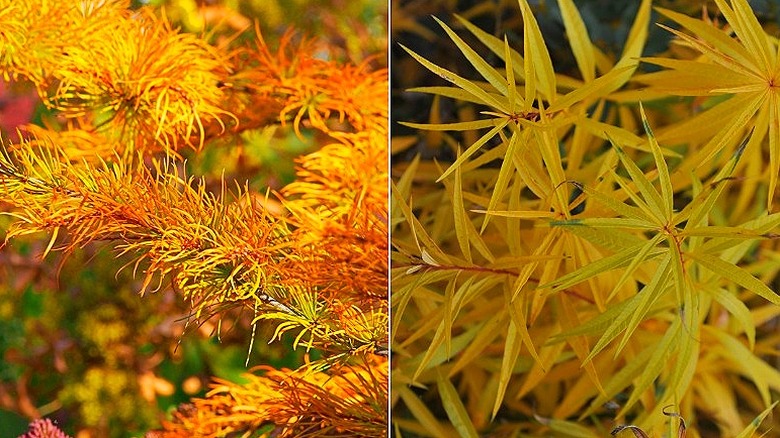
The most commonly grown variety of amsonia is Amsonia tabernaemontana. These are vigorous native plants with slender leaves that bloom a bit later in spring than threadleaf varieties (left image above). The leaves tend to fall off just as winter arrives, though you can cut back the plant before this happens. Amsonia can be planted in spring or fall, and September is a great time to plant them while the leaves are still vibrant and green. After planting, I usually mulch them with a natural mulch like shredded pine bark or a shallow layer of wood chips.
I planted the newer 'Storm Cloud' cultivar a couple of years ago in September, and it's thriving in my partly sunny garden. This one grows just under 3 feet tall and has attractive dark green stems that look almost black, with deep olive green leaves, highlighting the periwinkle blue flowers in spring. In mid-autumn, the foliage turns a pale golden yellow.
For smaller spaces, there's a compact cultivar called 'Blue Ice' that grows only 12 to 16 inches tall and 18 to 24 inches wide at maturity. This makes it a perfect size for the front of the border or in a sunny rock garden. This one is also very cold hardy, suitable for USDA zones 3 to 9. Another smaller variety is the fringed bluestar (Amsonia ciliata), with slender leaves that form a starburst shape (right image above). Like all amsonia varieties, these are low-maintenance, deer-resistant plants. They only need dividing every three or four years, in spring or fall. The root ball can be a bit woody, but it can be split gently with a shovel or garden knife.