

Better Looking Than Concrete: The Durable Material For Driveway Edging

We may receive a commission on purchases made from links.
Whether you're upgrading your driveway borders to boost curb appeal or need a reliable, long-lasting way to make your grass behave itself, concrete is often considered as an easy win. However, it's not always the most attractive solution. It curries favor among homeowners for its durability and longevity. Not only that, but it's often much cheaper than more premium materials. But if your goal is to enjoy the way your property looks whenever you arrive home from work, while also ensuring that your lawn sticks to its side of the driveway, then something more decorative might be in order.
One popular material for driveway edging is granite, which can be purchased by the pallet from home and hardware retailers like Home Depot. Of course, it sounds like a luxury, not least because granite is known as one of the most luxurious and durable kitchen countertop materials. The thing is, it's those traits that make it so effective around your driveway, too. Visually, it helps to enhance the appeal of your front garden in a way that concrete simply struggles. Not only that, but as one of the hardest natural stones you can buy, even the most recalcitrant lawn will struggle to break through a barrier that's built from solid granite. As for durability, there are few materials better suited to long-term edging than granite.
What makes granite such a good choice for driveway edging?
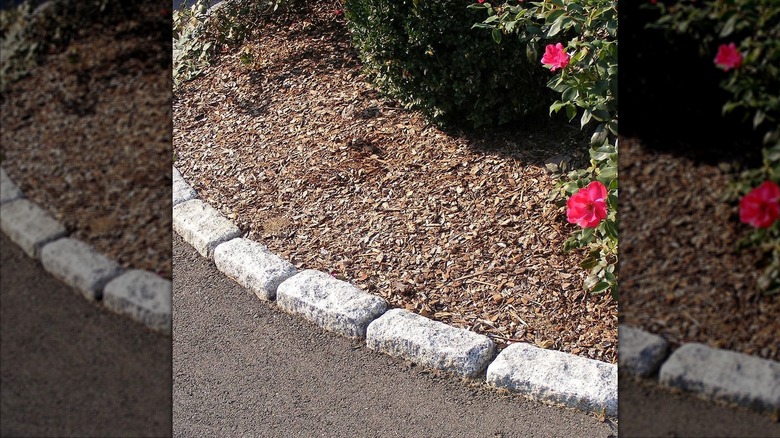
Not only is granite an excellent stone for a stunning driveway, but it's also resistant to harsh environmental conditions — the sort that can cause concrete to come unstuck. For example, it's fairly unflappable in the face of extreme freeze-thaw cycles. Concrete, on the other hand, can become damaged if cracks form and water is allowed to seep in and freeze. Another tick in granite's favor is its chemical resistance. Even if your soil is on the acidic side, it'll make little difference to granite, compared to concrete, which can deteriorate in acidic conditions. In actual fact, granite can last for hundreds of years in an outdoor setting, provided that it's properly maintained and sealed.
As for aesthetics, whereas concrete usually comes in a uniform gray color, granite comes in various shades. It's also a natural material, and so features textures, patterns, and imperfections that make each piece unique. At Home Depot, you can buy it in various tones of gray, as well as black, rose, and a sandy-gray color called "buff."
Really, the main prohibitive factor when it comes to edging with granite is the cost. For example, to buy a pallet of these 50 10x7x4-inch gray granite edgers from Nantucket Pavers, you can expect to pay $599. That price increases if you opt for other colors, sizes, or larger amounts. Compare that to concrete, which can be sourced at Home Depot for $6.47 per 80-pound bag, and if you're on a tight budget, granite may not be the best choice in the short term. But if you're able to invest in a material that will both last and look good for decades (perhaps longer), then it could well be worth the investment.