

How To Quickly Sharpen Your Knives With A Powerful Tool

Tomatoes squashing. Onions slipping. Simple cutting jobs suddenly taking more effort than they should. A dull kitchen knife can turn a normal dinner prep into a wrestling match. Now, you can use a file or a whetstone for blade sharpening, but these tools take a lot of time. This is especially true if you are sharpening several knives. If you're looking for a faster way to bring a dull blade back to life, there's a powerful tool that can make quick work of the job: a belt sander.
If you have never used or heard of a belt sander, it's a power tool with a motor that spins a continuous loop of abrasive belt, which is commonly made of aluminum oxide, ceramic, silicon carbide, and zirconia-alumina at various grit levels. Lower grit levels are used to remove more material and reshape or repair damaged edges, whereas higher grit levels are better suited for refining and polishing an edge. That range of grits is part of what makes a belt sander so versatile, letting you move from reshaping an edge to giving it a smoother finish.
Keep in mind that the speed of a belt sander is a double-edged sword. Sure, it lets you sharpen knives quickly, which is great if a knife is very dull. However, it can also remove too much material too quickly or overheat the blade if you are not careful. Controlled passes and a light touch are essential, as is wearing appropriate eye protection and keeping your hands clear of the moving belt while working. Also, remember that not every dull knife is worth saving or sharpening. So, make sure you know when it is time to replace your kitchen knives.
Using a belt sander to sharpen knives the right way
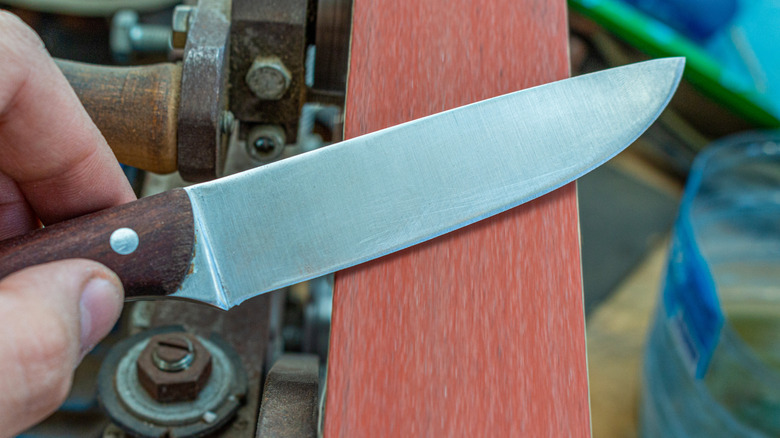
If you want to get the most out of a belt sander when sharpening a knife, make sure you pay attention to a few things rather than aimlessly grinding. Take, for instance, the edge angle. You need to follow the manufacturer-specified edge angle, which is often available on the packaging or product website. If you can't find what your blade angle is, follow the existing bevel when using the belt sander. This is not to say, though, that you can't change your knife's blade angle. You can, but it often takes more time and removes more material.
Once you have the angle figured out, start sharpening your knife with a lower-grit abrasive belt. Also, don't use a lot of pressure. Keep your hand light, as the moving abrasive belt on the belt sander removes material quickly on its own. Similarly, don't sharpen the knife in one long pass. Instead, make short, controlled passes and check the edge frequently to avoid removing too much material or overheating the blade. Then, once you've shaped the edge on both sides, switch to a higher-grit abrasive belt on your belt sander to refine and hone the edge.
Also, if your belt sander has a speed adjustment, start sharpening the knife at the lowest speed. It gives you more control. Lastly, don't limit your tool to ordinary kitchen or garden knives. If you know how, it can also be used to sharpen lawn mower blades quickly and efficiently, as well as to sharpen a serrated knife.