

Before You Compost A Wine Cork, Check This One Thing
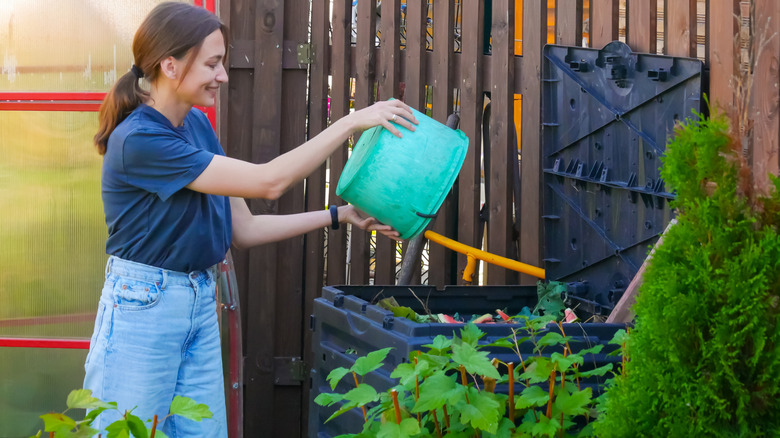
If you consume a few bottles of wine each month, you might want to start adding leftover corks to your compost pile. This will allow you to take a positive step (however small) towards reducing your household's waste. Plus, you get to enrich your compost pile with brown material. That being said, not every kind of cork deserves room in your organic material heap. This is because not every stopper on a bottle of wine is derived naturally. Some are made of synthetic materials, like low-density polyethylene (LDPE) or thermoplastic elastomers (TPE). As such, they won't decompose even if you leave them in your pile for decades, no matter what kind of composting method you use.
However, that's not the case with natural ones. Since they're made from the bark of cork oak trees, they naturally break down over a period of time. The duration will depend on how you compost them — whether you put them in whole, chop them up into small pieces, or grind them in a food processor. The temperature plays an important role, too. When subjected to a hot heap with temperatures over 140 degrees Fahrenheit, your corks will break down faster than if you add them to a cool pile.
How to know whether your wine cork is natural or synthetic?
You can't determine whether your wine cork is natural or synthetic based on their looks alone. Sometimes, you might see a brand name, like Nomacorc or NeoCork, in tiny script on one side of a cork. As these companies are known for manufacturing plastic stoppers, you can simply find other ways to repurpose these wine corks around your house and keep them out of your compost pile. Give the ones with terms like "polymer" or "synthetic" imprinted on them a similar treatment.
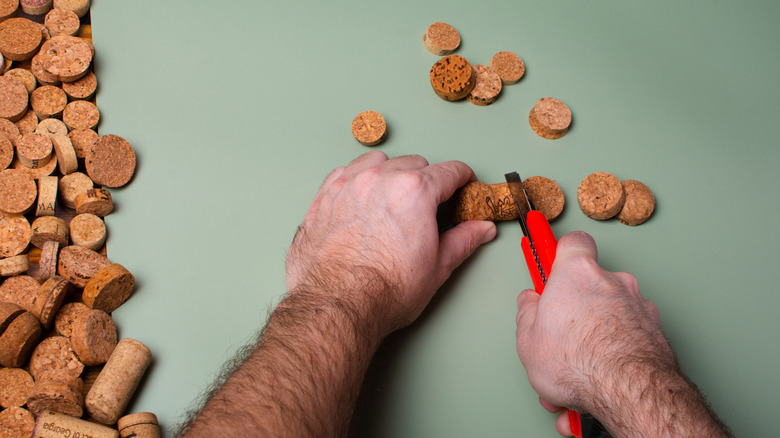
But if the corks you have are unbranded, get a sharp knife and cut one open to test whether it's natural or synthetic. If it's real cork bark, its interior will look porous and grainy. When its inside appears smooth and feels foamy, you're likely dealing with a plastic stopper. Though the cut pieces of natural cork degrade faster in a compost pile, this method can be a bit time-consuming, especially if you have hundreds of corks waiting in your junk drawer. An easier method is to press each one between your index finger and thumb, and make note of how easy it is to compress and how well it recovers. Being fibrous, natural corks are easier to squeeze and take a few seconds to bounce back. But ones with a foam core aren't as easy to press down. Consequently, they don't require much time to regain their original shape. Moreover, natural cork stoppers are lighter as compared to synthetic ones. Plus, they're usually not available in bright colors.