

Is A Heated Towel Rack Worth The Cost?
We may receive a commission on purchases made from links.
There's nothing quite like a steamy shower on a chilly winter day — until you step out and your first encounter is a cold, damp towel. That's where a heated towel rack comes in. The problem? Heated towel racks come in a range of prices. Basic models cost around $100 to $200, and while some economy versions cost less, larger and more premium options can run you several thousand dollars. This makes many people wonder whether a heated towel rack is worth the cost. Short answer: Yes, if you'll use it daily and you're okay with a basic plug-in heated towel rack.
Plug-in heated towel racks cost less, and they can be used with standard electric outlets that probably are already present in your bathroom. Better yet? Installing a plug-in heated towel rack is really easy, and anyone who has tackled a few DIY home projects can likely do it on their own. Hardwired heated towel racks, on the other hand, cost more. Plus, you need to hire a licensed electrician to connect the rack to your home's wiring, and that labor adds to your bill.
Now for the part that surprises many people: running a heated towel rack costs very little. Small ones only use about 40 to 60 watts, so even if your heated towel rack stays on for six hours a day, it will only consume about 0.24 to 0.36 kilowatt-hours of electricity per day. And if you knew how many ways there are to repurpose a towel warmer rack, spending $100 or $200 might not seem like such a splurge.
Choosing between plug-in and hardwired heated towel racks
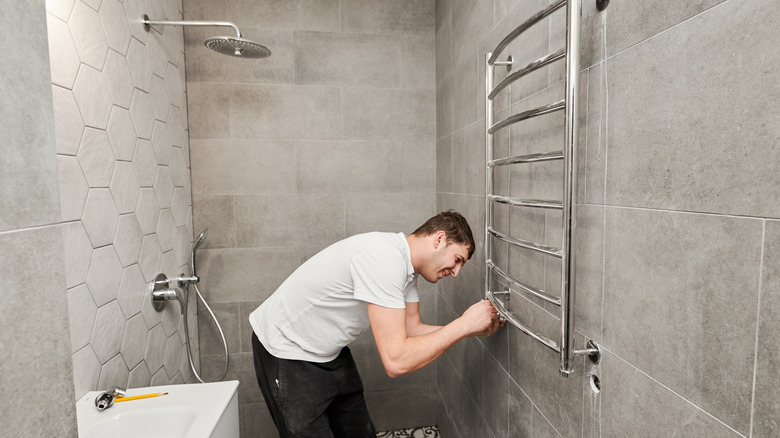
A plug-in heated towel rack is often the best choice for people who are renting and don't want to bear the cost of making a permanent change to a bathroom they don't own. Renters can go with a freestanding heated towel rack like the Warmrails freestanding classic towel warmer. With them, you don't need to drill any holes — all you have to do is find a suitable spot and plug the rack in. Just keep in mind that with freestanding and wall-mounted plug-in towel warmer racks, you don't get that cleaner, finished look.
If you want that, you'll have to go with a hardwired model like the Amba radiant towel warmer. They costs a bit and only make sense if you own the place and don't mind spending extra money on the towel rack and its installation. You can justify spending extra on a hardwired towel rack if your household regularly needs several warm, dry towels at once. However, if the goal is only to have one warm, dry towel after a shower, a large hardwired heated rack is probably not worth the cost.
Lastly, other than cost, two things definitely worth considering before installing a towel drying bar or rack in your bathroom are safety and placement. You need to make sure that the electrical outlet you are using with heated towel racks is protected by a ground fault circuit interrupter. GFCI-protected outlets shut off when they detect an unintended path — such as your body — between power and a grounded surface. Likewise, make sure that the place where you install the heated towel rack is away from direct water spills and splashes, as electricity and water should never mix.