

Attract Hummingbirds To Your Fall Garden With This Fragrant, Purple Herb (It's Not Sage)
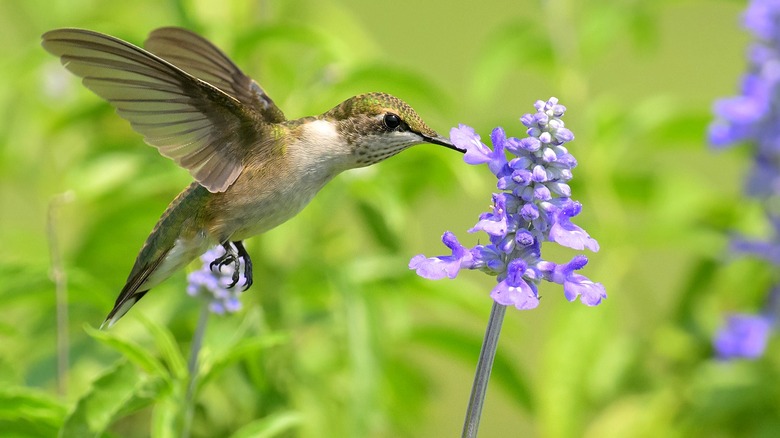
In gardens across the country, migratory hummingbirds traveling south for the winter rely on fall-blooming perennials that offer plenty of nectar and the sort of tubular flowers they love. In southern zones, gardeners often turn to show-stopping plants, such as Mexican sage (Salvia leucantha) and 'Amistad' sage (Salvia 'Amistad'). But unless you garden where the winters are mild, these stunning purple relatives of garden sage are too tender to grow as perennials. Yet, they're not your only options; for example, there's always hardy 'Walker's Low' catmint (Nepeta x faassenii 'Walker's Low'), a low-growing perennial with blue-purple blooms that pollinators love.
An award-winning member of the mint family, 'Walker's Low' is named for a garden in England. It grows in compact clumps about 24 to 30 inches tall, with blue-purple, tubular flowers and fragrant silvery leaves. It's a sterile hybrid, so it won't reseed or spread the way most plants in the mint family do. Bees, butterflies and hummingbirds all love it, and it's hardy down to zones 3 or 4. Deer and rabbits, meanwhile, aren't interested, and most cats ignore it, too. Its leaves can be used in tea, so it's naturally at home in herb gardens and other edimental landscapes.
There are a few more good reasons to plant 'Walker's Low' in fall gardens. For one, it tolerates air pollution, so it can be used if your home is located on a busy intersection. It's also drought tolerant, heat tolerant, and less prone to flopping over than taller catmints.
Growing 'Walker's Low' catmint for purple fall blooms
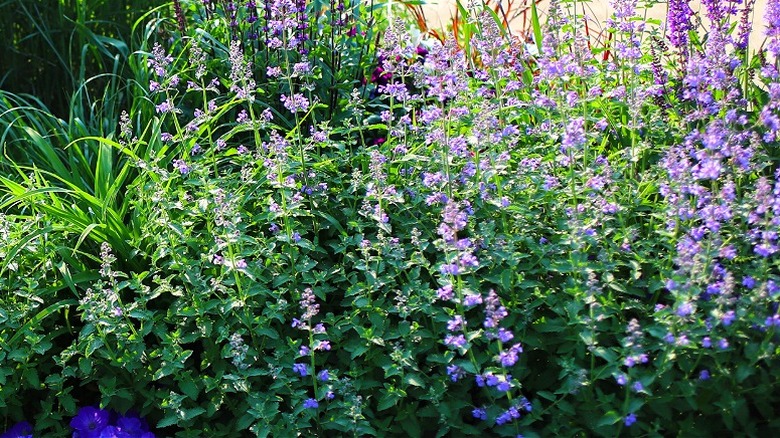
For most plants, location is everything. When you're growing 'Walker's Low' catmint in zones 3 to 8 to attract more hummingbirds to your yard, give it full sun for abundant fall blooms. It thrives on dry, rocky soil and can handle clay, loam, or sand. As long as it drains, it will even tolerate a range of soil pH. Note that 'Walker's Low' struggles with humidity.
Give 'Walker's Low' catmint plenty of space to reduce problems with powdery mildew, and water the plant regularly until it gets established and starts thriving. It works well planted in borders, mass drifts, and containers. It looks beautiful with roses, (complementary) yellow flowers, and Shasta daisies, and shares similar growing requirements with black-eyed Susans, anise hyssop, and coreopsis.
To keep its compact mound shape, trim it back in spring. It blooms in early summer, and like many plants you deadhead in August, you'll get even more blooms in the fall if you cut 'Walker's Low' back after its first full bloom. Remove at least one-third; doing so in midsummer will give it plenty of time to rebloom into fall, and the haircut will also make it less vulnerable to falling over. To propagate 'Walker's Low,' division is the best method.