

Not A Rod: The Handheld Sharpener For Razor-Sharp Kitchen Knives
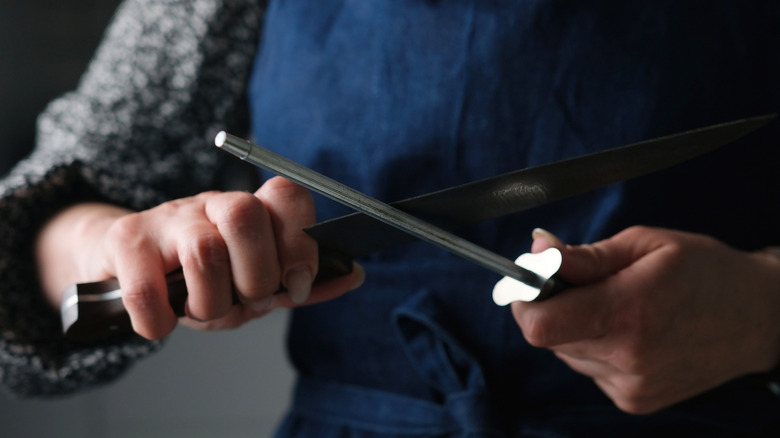
Ragged cuts, squished tomatoes, dull slices: few things annoy you more in the kitchen than trying to cut with a knife that has lost its cutting edge. Worse yet? Dull kitchen knives are a safety risk, too. Now surely you could grab a sharpening rod, and it will sharpen your kitchen knives just fine, but the problem is that a sharpening rod requires you to hold the blade at the right angle yourself. This can be a bit tricky. Do not worry, though. That is where a rolling knife sharpener can help. Just like the sharpening rod, it is a handheld sharpening tool. However, its angle guide makes it slightly easier to use.
If you have never heard of a rolling knife sharpener before, it is basically a small rolling cylinder with a block of magnetic angle guide, and to use it, you rest the knife against the guide and then roll the sharpener back and forth. The sharpening surface of the cylinder is mostly made of diamond or ceramic. These materials are abrasive, and they grind away material to create a razor-sharp edge. As for the angle guide, it mostly comes in 15- and 20-degree options, which are standard blade angles for most kitchen knives.
Just keep in mind that while a rolling sharpener is compatible with most kitchen knives, it will not work with everything. For instance, if you want to sharpen a serrated knife, you will need to find something else. Also, since rolling sharpeners are handheld manual tools like the sharpening rods, they are not much help if you are looking to sharpen your knives quickly.
How to use a rolling knife sharpener properly
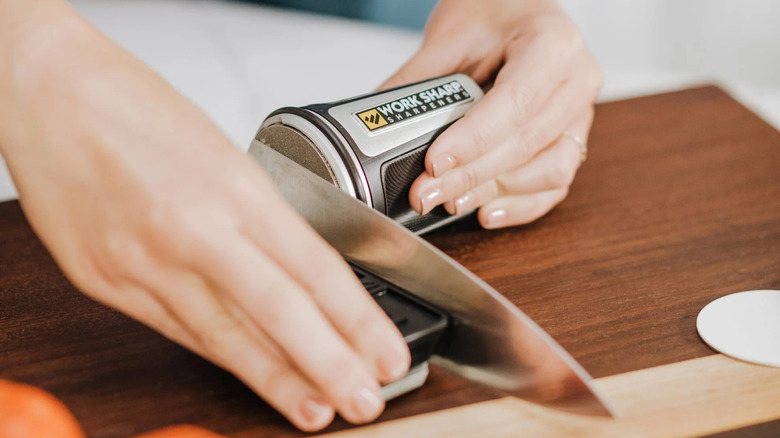
Start by putting the magnetic angle guide on a flat and stable surface. Then, pick the angle recommended for your knife if the sharpener offers the choice between 15- and 20-degree settings. Do not automatically choose the smaller angle because it sounds sharper. You must use an angle that matches the blade and the manufacturer's instructions. That is not to say you cannot change the angle. You certainly can if you do not like how your knife cuts. Just keep in mind that changing the blade angle will take more time and also require you to remove more material.
Nevertheless, once you have figured out the angle, place the knife against it with the cutting edge facing upward and start grinding it with the coarse sharpening disc of the rolling sharpener. When grinding, use light pressure. There is no need to push down hard, as extra force can remove more metal than needed. Plus, it can also make it harder to keep your strokes smooth. After several passes, flip the knife and repeat the same number of passes on the other side till the edge feels consistent.
At this point, shift to the finer honing or ceramic disc and make several light passes on both sides of the blade to refine the edge, and the knife should be ready to use. Keep in mind that not every knife needs to go through the coarse side of the rolling knife sharpener. For instance, if the knife is only slightly dull and still has a decent edge, you can skip the coarse disc. Plus, remember not every dull kitchen knife is worth sharpening. So, make sure you know when it is time to replace your kitchen knives as well.