

Everyone Owned It In The '70s — The Kitchen Appliance That Makes Trash Practically Disappear
While the average municipal solid waste consisting of paper, plastic, food, and household goods was 88.1 million tons in 1960, by 1970, that figure rose to an annual 121.1 million tons. A growing population coupled with mass plastic production helped increase waste tonnage generated. Enter the trash compactor: A built-in machine crushing household waste, reducing its volume by up to 80% to fit more in a bag. While the industrial compactor was invented in 1941 by M.S. Wells, John A. Boyd patented the technology for home use, introducing the first residential trash compactor in 1972.
Trash compactors started in industrial spaces, but appliance makers quickly made them a part of new kitchens. The idea of residential trash compactors was simple. Rather than filling trash bags with everyday waste like boxes, cans, and paper, you put it into a motorized ram that pressed everything within it down to a much smaller size. By reducing loose debris and sealing waste, trash compactors could be good deterrents to insects and rats.
Investing in a home compactor wasn't cheap. For example, Heathkit's Minimizer was marketed as being able to fit a whole week's trash from a family of four into one plastic garbage bag, retailing for $179.95 in 1972. Adjusted for inflation, that's $1,452 in 2026 dollars. For a time, the trash compactor seemed to be just as popular as the dishwasher. Having a trash compactor also helped families keep kitchen spaces organized by reducing how often you needed to take out the trash.
The installation and operation of a trash compactor
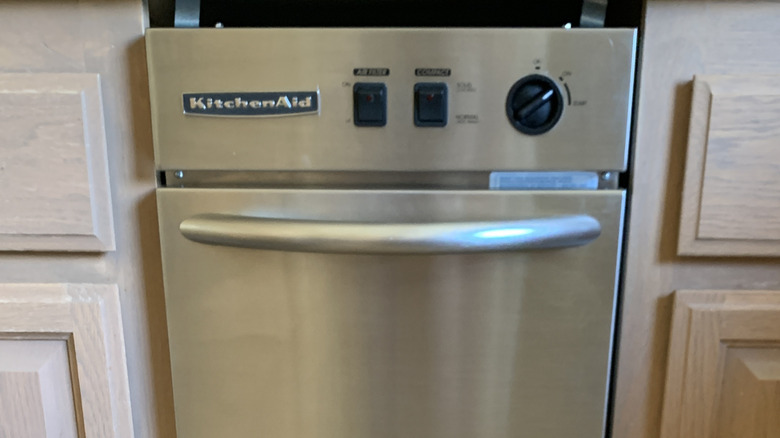
Trash compactors were typically installed beneath the counter, which made them a more permanent kitchen feature than a standard trash can. While that built-in design made appliances feel cohesive, it also wasted a substantial part of your kitchen if you didn't use it. As trash compactors were made to hold garbage for a long time, without proper maintenance, the food and other garbage buildup could attract pests. Growing interest in recycling and government backing of municipal recycling programs over time also meant that households had less trash to compact, which may have led to diminishing compactor interest. By 2009, only 3.5% of homes had one, a stark contrast to the 243,000 sold by U.S. manufacturers in 1988. Eventually, the trash compactor went the same way as the ice box, the old-school kitchen appliance nobody uses anymore.
Most people may have gotten rid of these appliances when remodeling a dated 1970s kitchen. However, modern technology has made the machines more attractive, and that's why they are the once-popular kitchen appliance that deserves to make a comeback today. Today's machines can be mobile on wheels, and they offer charcoal filters to reduce unpleasant trash odors emanating. Manual trash compactors also don't require cabinetry or attachment to your home's plumbing. They simply sit over the garbage can, and all you have to do is push the trash in and press down on the handle. Plus, trash compactors can help reduce landfill-bound trash.