

Not Forsythia: The Old-Fashioned Arching Shrub Gardeners Still Love To Grow
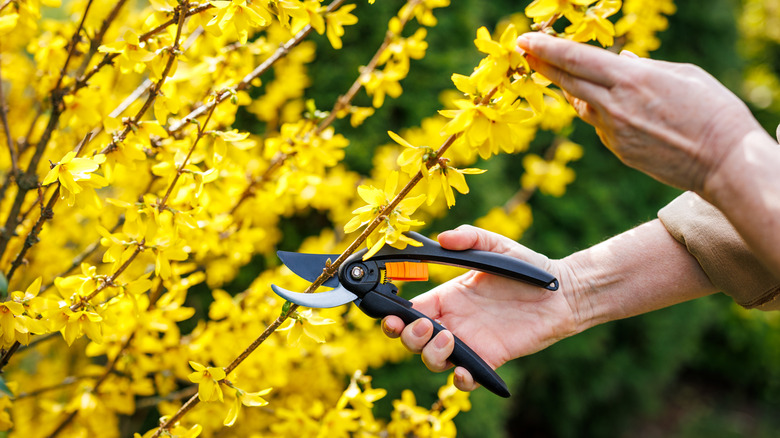
As a master gardener and permaculture practitioner with 20 years of experience, I have a real fondness for non-conformist plants. I love those slightly unruly old-fashioned leafy shrubs that just do their own thing and don't want or need to be cut into tidy green domes. Rough-leaved deutzia (Deutzia scabra) fits this description perfectly. It's a bit old-fashioned and doesn't get as much attention as it should because it needs plenty of space as it can reach 10 feet tall and 8 feet wide in ideal conditions. It does a great job of filling in gaps in hedges, acting as a screen, or working at the back of a border.
As its long, slender stems grow upward and outward, they eventually get top-heavy and arch over under their own weight, giving this hardy woody shrub an interesting shape and form. In spring, rough-leaved deutzia gives you endless amounts of small white star-shaped flowers. Some cultivars also have a pink or light purple blush on the petals and the whole thing has a slightly wild, unruly energy that looks fantastic in a cottage garden. It is deciduous, so it does drop its leaves when the weather cools. Even then, this perennial, which is hardy to USDA zone 5, is pretty interesting, as it develops peeling bark as it matures, so it still leaves you with some interesting texture in the winter landscape. Before you go ahead and plant, be aware that deutzia scabra is considered invasive or weedy in some parts of the United States. Check your local invasive plant guidance before you add this plant to your garden.
Rough-leaved deutzia puts on a proper spring show
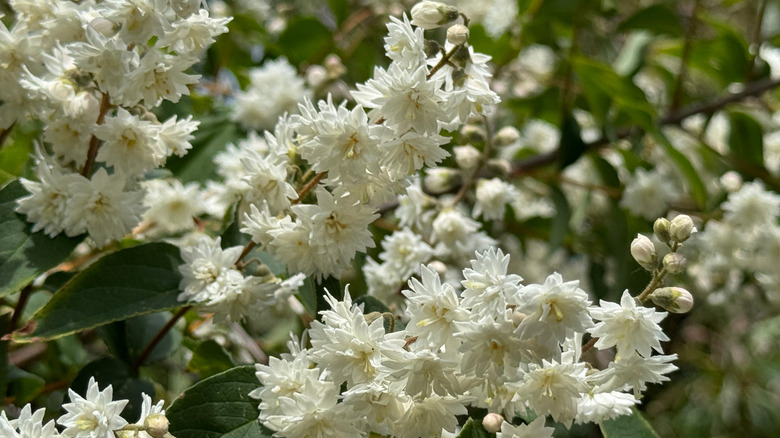
The serrated leaves of this deciduous perennial are slightly hairy and rather coarse, hence the name. They are pretty interesting all by themselves, but in late spring this plant really comes into its own, as it produces a fantastic show of endless clusters of little star-shaped flowers. Flowering only lasts for a couple of weeks, which is another reason, I think, that this plant has slightly fallen out of favor, much like mock orange. Those two weeks of late spring color still make rough-leafed deutzia a worthwhile plant.
Remember that rough-leafed deutzia is not a compact plant and trying to keep it pruned and in check won't do much beyond weakening the plant and reducing or stopping flowering altogether. Learn to love its loose, arching, slightly chaotic growth habit instead. There are also some other interesting and showy cultivars, such as 'Pride of Rochester,'which produces double flowers that are pink on the outside and white in the middle and is more scented than the straight species. 'Plena' is another example that has lovely double blooms with purple-to-pink coloring on the outer petals, and only reaches around 6 feet.
And if you want the look of rough-leafed deutzia but don't have a large space or don't want such a wild and unruly look, you can get a compact shrub like Deutzia x rosea, which reaches just 3 feet tall and wide and has pretty pink flushed petals. Other worthwhile compact deutzia options include 'Raspberry Sundae' and 'Mont Rose.' You'll also end up with a beautiful plant that attracts hummingbirds.
Give this large shrub room instead of constantly cutting it back
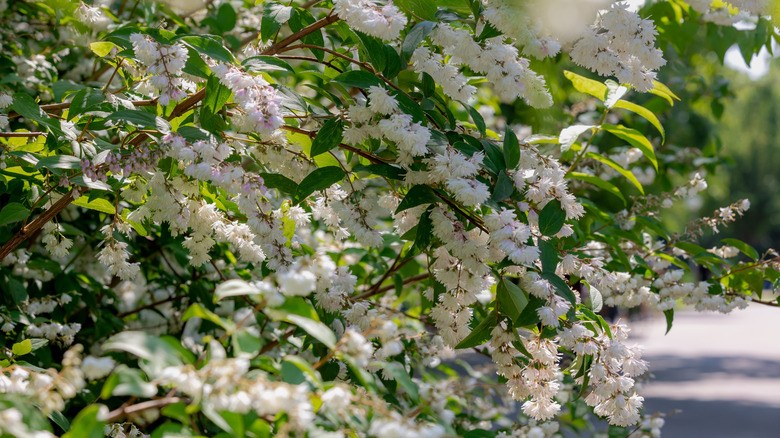
If you've decided to go with Deutzia scabra, make sure you give it plenty of room. It's not overly fussy about its growing conditions although it does prefer full sun and it needs decent drainage. Above all else, this perennial needs plenty of space. Remember that it can get up to 10 feet tall and 8 feet wide. Even if the plant you buy at the nursery is fairly well contained and looks nicely compact and tame, it won't stay that way. Make sure when you are putting it in its final position that you account for just how big this plant is going to get. Avoid planting it where it will overwhelm smaller plants or will encroach too much on pathways. Pretty much just leave it alone to reach its full, gloriously chaotic mature state.
Over-pruning will see you end up cutting off flowering stems and will eventually weaken the plant. It will be all awkward lumps of stem at the base and not much else. Deutzia flowers on second-year growth, so you want to prune them only when necessary and only after the flowers have finished. This is a perennial that needs pruning in summer to preserve the new growth. Make sure you only prune what's necessary and, unless damaged or diseased, only prune back the old wood that's just finished flowering. If the plant is old and overgrown, you can also thin it out a little by taking out up to a third of the oldest stems close to the ground.