

Add Privacy To Your Backyard With The Help Of An Easy-Care Fragrant Shrub
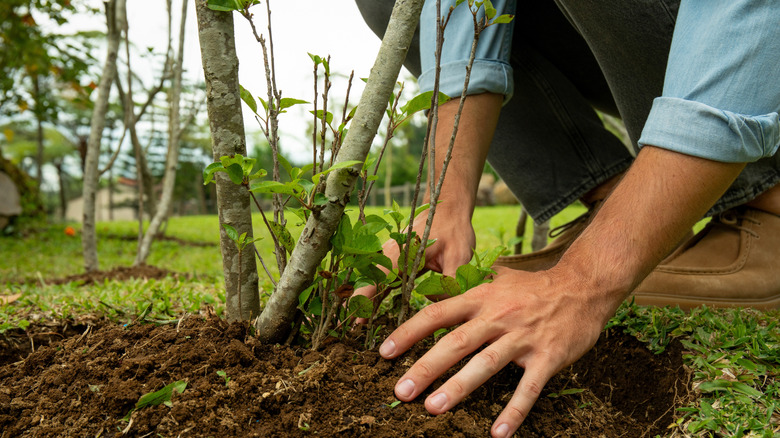
Tell a plant nursery employee you're trying to create a more secluded property, and they'll likely point out the thuja 'Green Giant' trees — a fast-growing solution for backyard privacy. Sure, they'll do the job quickly, but they're a little dull. If you want a show-stopping privacy plant, consider cultivating a seven-son flower (Heptacodium miconioides) or three instead. This shrub's dazzling flowers and lovely fragrance will add beauty to your yard, while its dense foliage and height will conceal your backyard from prying eyes.
Living screens may require more maintenance than a fence or wall, but using plants for cover adds much-needed organic color and texture to your yard. When considering plants for residential seclusion, keep your goals firmly in mind. Are you hoping for complete privacy, or would a few strategically clustered plants suffice? Do you need cover right now, or are you willing to wait a few years for plants to grow? If you decide plants are the right option, will you grow them in the ground or in containers?
How you want — or need — a shrub to grow is an important consideration when looking to add privacy to your yard. The seven-son flower, which is a member of the honeysuckle family, offers flexibility. You can choose to let it grow loosely and wildly, or prune it into a small tree. It's also a rapid sprouter, adding 1 to 2 feet a year until it maxes out at 10 to 20 feet. Expect it to grow about half as wide. It's the ideal height and spread for blocking a neighbor's line of sight over a fence. Thriving in USDA Plant Hardiness Zones 5 to 9, this shrub performs best in full sun and well-drained soil, but it will tolerate partial shade.
Characteristics and care of seven-son flower for privacy
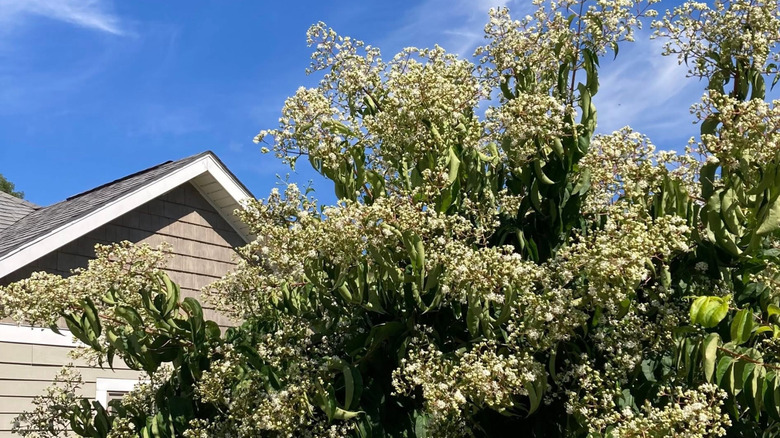
Although the purpose of planting a seven-son flower may be to keep neighbors and passersby from peering into your yard, don't be surprised if this shrub actually attracts attention. After all, it has year-round visual appeal. The leaves of this deciduous plant return in May, followed by six-inch stems that explode with clusters of fragrant white blooms in September. Seven-son flower is arguably one of the best fragrant plants to include in a butterfly garden — it attracts monarchs and other species. In early fall, the tree performs its encore, producing tiny, bright red or purple fruit tucked into leafy cups that complement the drooping, heart-shaped foliage. In the heart of winter, when most shrubs match the gloomy skies, this tree's grayish-brown bark peels off to reveal a lighter-colored bark.
Seven-son flower gives a lot to a gardener seeking privacy and requires minimal care in return. Trim the branches between late winter and very early spring, before the new buds form. Just remember the three-D rule to properly prune your plants: remove dead, damaged, and diseased branches before moving onto other areas of the shrub. Once that's done, it can be beneficial to thin the interior of the seven-son flower to improve air circulation and reduce the likelihood of diseases. If you want this privacy shrub to grow in a tree-like shape, prune only the lower branches and keep the upper branches intact. Complete shaping over several years to minimize stress on the plant.