

Do Hummingbirds Remember People Who Feed Them?
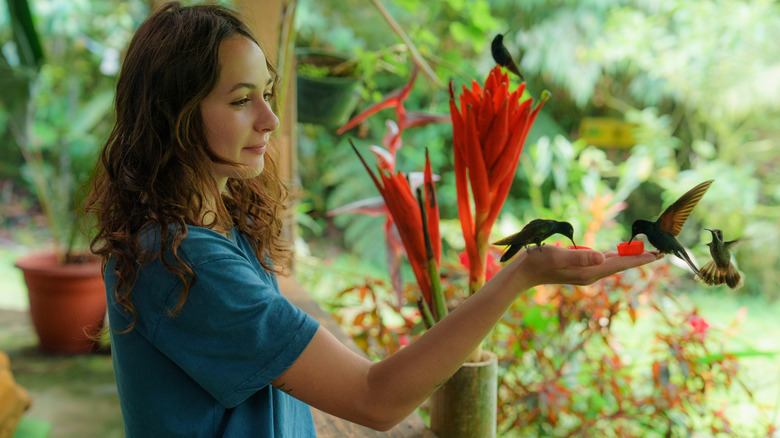
On your mission to draw more hummingbirds to your yard, it's easy to get lost in arcane details. From determining the best place to put your hummingbird feeder to finding the most dazzling self-seeding flowers that'll attract hummingbirds to your yard, there's plenty to do and discover. But as you're — yet again — mixing up sugar water and adding it to your bird feeders, you may wonder whether these dainty jeweled birds even recognize you? Seems like it's highly plausible.
Although there aren't any citable scientific studies, there's some observational evidence that hummingbirds may remember the people who feed them. During her stint as an assistant researcher at UCLA, Melanie Barboni, set out multiple hummingbird feeders right outside her office and lured in about 200 of these flying jewels. While she had tells for about 50 of them, she noticed that they recognized her, too, with some eventually becoming familiar enough to eat out of her hand. "They are just so cute, and so smart! They remember you. They get to know you, and then they interact with you," is how she encapsulated her experience with them over two years in the UCLA magazine.
Other anecdotal evidence similarly suggests that hummingbirds can, in fact, become demanding once they learn that you're the "human with sweet nectar." People have recounted experiences of birds knocking at their windows, following them inside their homes, or even just staring at them and zipping back to the feeder, driving home the point that the feeder needs a refill. Surely, they're going off some visual cues to hone in on feeder keepers.
Can hummingbirds distinguish individual faces?
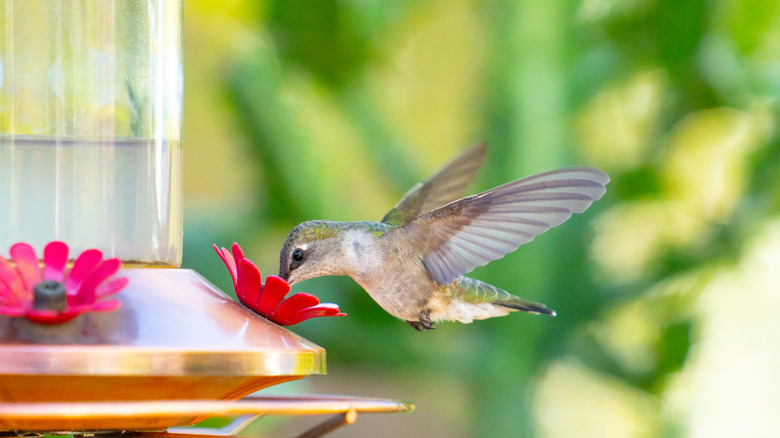
Here's where things become tricky. If you're curious about the avian world, you probably know that corvids are excellent at facial recognition. Crows can pick out different faces from a milling crowd, remember them for 17 years (and even pass this information on to their descendants), and unashamedly dive-bomb the people they hold a grudge against.
However, such scientific studies are rare for hummingbirds, save for a brief mention by wildlife biologist Terry W. Johnson in his blog Backyard Wildlife Connection. According to this study, after hummingbirds learnt that a certain human could offer them food, they'd make for the being, ignoring everyone else. And in a way, it makes intuitive sense. Hummingbirds have a strong spatial memory, as a 2013 research published in the Proceedings of The Royal Society notes. This helps them keep track of and return to the same feeding spots, flower beds, bird feeders, nests, and areas year after year. After all, given their higher caloric requirement to fuel their hovering and migration, they'd prefer not to waste much time searching for new sources.
Another peer-reviewed study published in 2014, examining behavioral differences among green-backed firecrown hummingbirds, found that male birds successfully tracked their staked food territory, though females weren't as on point. Still, given this argument, it's possible that hummers have the mental capacity to recognize humans. Sadly, answering this with certainty isn't possible. Sure, they'll come find you when they need more sugar water, but would they identify you in a crowd without other familiar visual cues? It's hard to say.