

The Rare, Antique Ball Jar With A Unique Logo Design That Collectors Wish They Could Thrift

Invented in 1858 by John Landis Mason, the Mason jar is a kitchen staple — so much so that today the term "mason jar" is used for nearly any canning jar, including those made by Ball, a manufacturer once known as Ball Brothers Company. These jars are made for canning and food preservation, yet not every jar is the same. They vary in size, color, and embellishments, which is why serious collectors and thrifters consult guides on the value of vintage mason jars by year, particularly if they're seeking a specific jar. Food storage isn't all they're good for, but if you're considering handy ways to use old mason jars in your yard and garden, make sure you aren't holding onto a rare Ball jar known as the Triple-L jar.
After Mason's patent exclusivity expired in 1870, Ball quickly started producing similar jars in the U.S., using its Ball-Bingham glassblowing machine to shape thousands of vessels. One of the more sought-after pieces from its production history has been the Triple-L Jar, so named because of the way the cursive L in the word Ball forms what looks like a third L. Manufactured between 1900 and 1910, Triple-L Ball jars were made in pint, quart, and even half-gallon sizes. They're commonly found in aqua or clear glass, but olive green jars and green jars with amber swirls also exist, though they're harder to find. Clear and aqua Triple-L Ball jars commonly sell for about $15 to $25 on the resale market, while rare colors go for more. The green swirl versions can fetch $175 to over $300, depending on the size, condition, and whether they feature their original lids.
Identifying a Triple-L Ball jar when thrifting
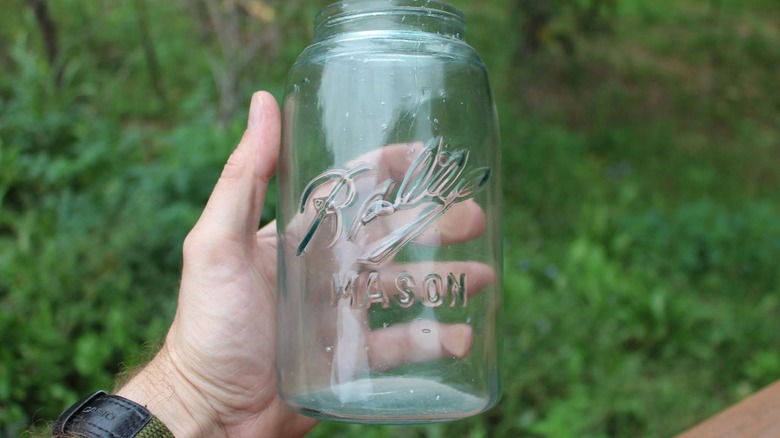
To confirm that what you just picked up from the thrift store shelf is a coveted Triple-L Ball jar, first look at the jar's logo. The last L in Ball will have a loop that swoops backwards underneath the word, appearing almost as if it's a third L. The word Mason may also appear underneath the logo, though not always. You can also check the color. As mentioned, most Triple-L jars were made of aqua or clear glass, so a jar with unusual coloring, like olive streaked with amber, is a rare find. A jar with a manufacturing mistake, such as a misspelled word, may also be especially collectible among some jar enthusiasts.
Be wary of modern lookalikes being sold as rare vintage jars. Check for anniversary markings or a trademark symbol next to the Ball name; either can indicate a newer jar rather than a genuine antique. New collectors also sometimes mistake the embossed numbers on jar bottoms for manufacturing dates, but these numbers actually indicate the mold number.
Next, look at the jar's mouth. Original Triple-L jars have a ground-down rim with a slightly rough finish and threads for a screw-on lid made of zinc. Modern jars have noticeably smoother rims. Vintage Ball jars may also have other hallmarks of glass made decades ago, such as tiny trapped air bubbles. Even if you end up with a newer Ball jar, it's still worth bringing home if the price is right. Their versatility is why mason jars are trending so much in home decor. Use it as a vase, pencil cup, or bathroom storage for cotton balls.