

Quickly Sharpen Your Japanese Pruning Saw With A Compact, Easy-To-Use Tool From Amazon
We may receive a commission on purchases made from links.
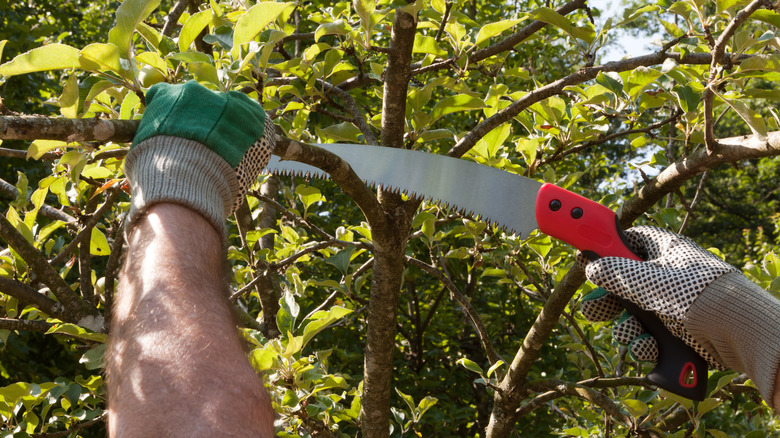
Pruning is essential for healthy growth in many trees and shrubs, and it's worth understanding how to choose the best pruning tool for specific tasks. Small branches can be removed with shears or loppers, but once they get above an inch and a half, a pruning saw is usually recommended. Some arborists prefer to use a Japanese pruning saw, which typically has a thinner blade and produces a cleaner cut. Unlike western saws, they cut on the pull stroke. This means more force can be applied without the blade buckling, and they can be easier to use at awkward angles. The drawback is that sharpening them requires a different tool and technique. The Samurai Kanzawa Japanese Saw Diamond Sharpener from Amazon can help with this, and it's currently available for $19.00.
Frequently, the best method for sharpening hand saws involves the use of a triangular file. However, the teeth on Japanese saws are normally made from hardened steel and have different geometry, sometimes with multiple sharp edges on each tooth. A standard file is not only the wrong shape, but it probably wouldn't make much of an impact either. The surface of the Samurai Kanzawa sharpener is encrusted with a diamond powder that delivers fast, clean sharpening of these special blades. It also has a diamond-shaped profile for better precision between narrow teeth. While it has been designed for the Samurai company's own pruning saws, customers report it also works well on other blades and tools from competitors.
How to use the Samurai Kanzawa Japanese Saw Sharpener effectively
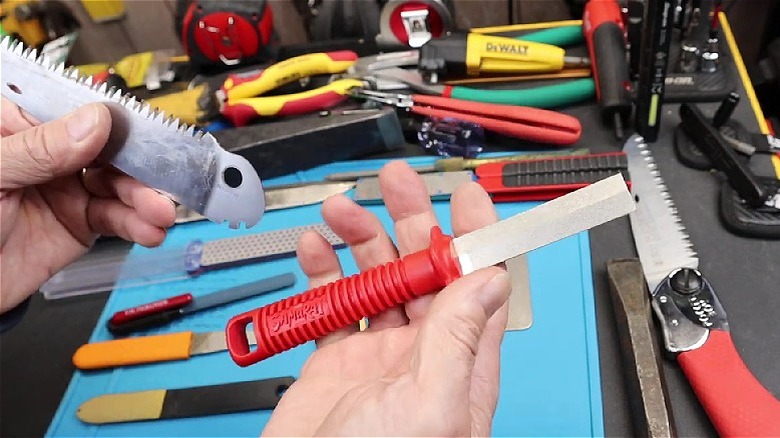
While using the tool is easy, sharpening a Japanese pruning saw properly takes a little patience. You may find it easiest to clamp the blade in a vise between two pieces of wood that are close to the bottom of the teeth to provide support. Without this, you could damage the thin blade. Use the sharpener gently. The diamond powder does the cutting, so there's no need to apply a lot of pressure. It should only take a couple of rubs on each tooth. Because the tooth edges alternate on a Japanese saw, every other one will have a flat side facing you. To work around this, you'll need to sharpen one side, then turn the blade around and sharpen the other. Focus on following the existing cutting edge angle and running the sharpener right into the bottom of each diamond-shaped tooth groove, sometimes called the gullet.
It's clear from customer reviews that a few people found this process difficult to master. However, one reviewer on Amazon noted, "The second half of the blade is easier than the first [and] so on! Practice, as with all things, makes them easier." The majority of those who own this tool feel that it can quickly return Japanese pruning saws to the razor-sharp performance they are known for, and they believe it's a good value for the cost. Using blunt tools is one of the key mistakes to avoid when pruning, so if you have a Japanese pruning saw, the Samurai Kanzawa Japanese Saw Diamond Sharpener could certainly help you keep a keen edge, making your work easier and preventing damage your plants.