

4 Disadvantages Of Mulching Lawn Mower Blades
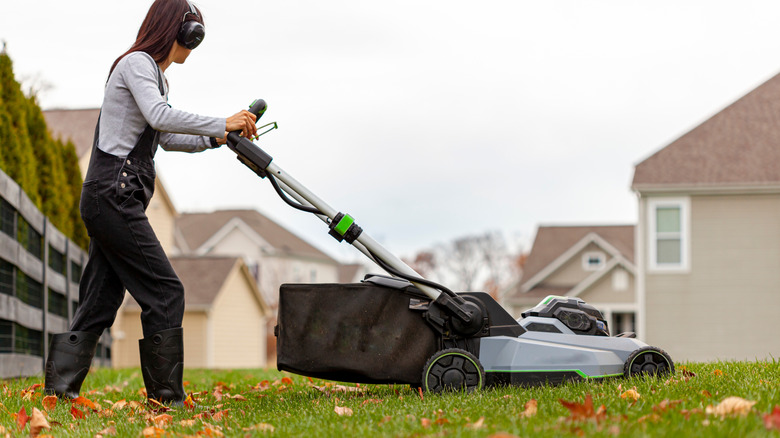
If you're a homeowner who is fond of green expanses, you've probably grappled with this age-old question: what type of lawnmower is worth buying for your yard? If you don't like how most common side-discharge mowers leave your lawn strewn with grass clippings that take days to decompose, but you also don't want to fuss with bagging attachments, you may have considered mulching blades. Some lawn keepers might opt for mulching mowers or retrofit their existing equipment with mulching blades. This certainly has many advantages. Because mulching mowers return grass clippings to the soil after slicing them into tiny pieces, they help restore nutrient levels and minimize the need for additional fertilization, a process sometimes called grasscycling. You can also use a mulching blade to chop down fall leaves as they collect on the ground.
However, mulching lawn mower blades aren't without their disadvantages. For a start, they aren't as reliable where grass is too tall, thick, dense, or wet. So if you usually allow the grass to grow long and irregular between mowing sessions, a mulching blade might not be ideal for your lawnkeeping habits. Mulching mowers can also require more power and care in terms of cleanup and keeping the blades sharp. Besides, the finished aesthetic may not be as clean or pretty as a standard mower cut.
You won't get the prettiest cut with mulching lawn mower blades
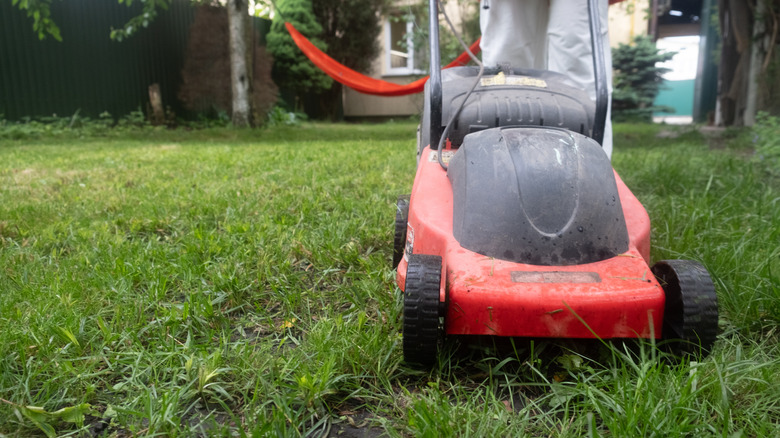
If you crave a regimented, manicured, pristine look for your lawns, you're unlikely to achieve it with mulching blades. To understand why, you need to know a bit about their shape. A standard mowing blade, also called a 2-in-1 blade, has a straight edge and a comparatively higher lift. As a result, it creates greater suction that pulls grassy blades taut while trimming them. That way, you get an even, level appearance.
Mulching mower blades, in contrast, have a curved edge, so severed grass pieces will cycle around the chamber a couple of times before dropping at the canopy level. Mulching blades don't offer as much lift, and so they can't deliver the cleanest cut. Besides, it's possible that they may leave behind occasional clumps that you'll have to mow over again or blow out into the surroundings for a cleaner, more dispersed aesthetic.
Curiously, a peer-reviewed study published by the North Carolina State University in 2019 found that grass clippings aren't necessarily made shorter by every mulching blade; the mower's horsepower and deck design also play leading roles. In other words, the grass must stay in the deck chamber long enough and the blades must rotate fast enough to effectively splice the clippings. Otherwise, the results may actually be worse than a decent side-discharge mower. Because of these factors, if you're looking for lawn mowing tips to make your yard look as good as a golf course, you may be better off bagging your clippings for that professional touch, rather than mulching.
You must mow frequently with mulching blades
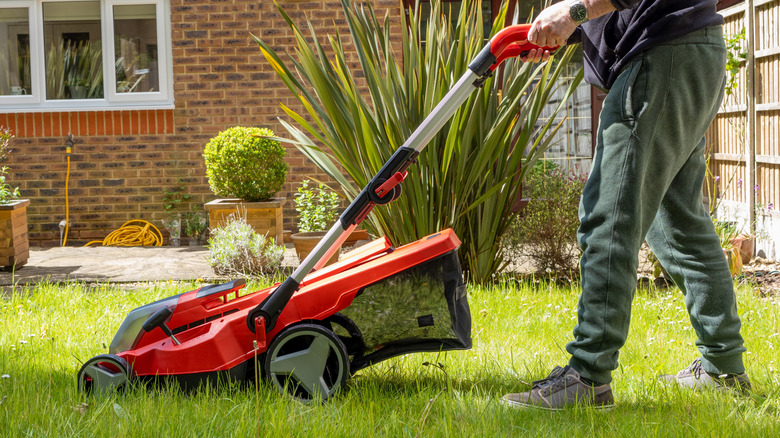
If you explore the simple habits of people who keep their lawns lush and well-manicured, you'll discover that they mow consistently. However, this habit becomes a near-compulsion with mulching mower blades. Their core idea is to take a grassy blade and cut it several times within the deck so it's reduced to a size small enough that it isn't noticeable among the remaining turf.
However, if the grass is overgrown, a mulching mower must contend with taller clippings that can eventually gum up the deck and overstrain the engine. If your mower struggles to effectively tear up the long blades of grass, you might wind up with thicker clipping clumps strewn around the yard, which can prove detrimental to lawn health. That's because they may suffocate new growth.
In other words, grasscycling is only beneficial within certain limits. For it to work, you shouldn't cut more than ⅓ of the total length in one pass. This means staying on top of your mowing schedule is non-negotiable if you want to use a mulching blade. For the best results, expect to trim your lawn frequently, every four days or so. If you keep a busy schedule, tend to go on vacations frequently, or struggle to keep up with the lawn due to health or other reasons, a mulching blade might not be the answer.
Mulching blades perform poorly in wet sites or thick turf
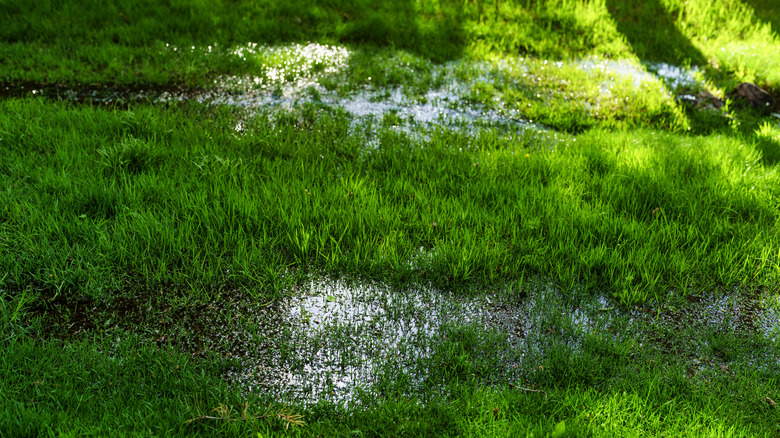
Generally, you should mow your grass only when it's completely dry. But if you live in an area where rain spells are frequent or heavy, it can be difficult to find that sweet spot. Unfortunately, this is another area where mulching lawn mower blades are typically unreliable. It goes back to their mechanism. They must slice grass segments repeatedly, but when grass is wet, it can easily bend and clump up. Besides gunking up the mower deck — good luck scraping them off afterward — such clumps don't land well on the lawn.
They look visually unappealing, for a start, but more than that, these dense clumps won't easily decompose and return nitrogen to the soil the way dry grass clippings would, which defeats the purpose of a mulching mower. In other words, it's best to wait until the grass doesn't feel slick before using these blades. You'll feel this problem more acutely when the wet turf in question is also thick and coarse, as it may prevent the blades from rotating properly. The aforementioned North Carolina State University study similarly postulated that mower performance flagged for denser grasses, like zoysia.
Mulching mower blades require frequent sharpening
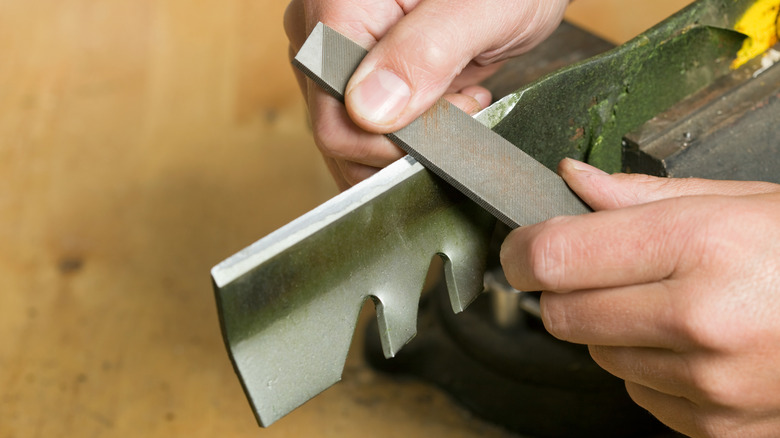
Let's be honest. Most yard owners aren't on the dot about sharpening their mower's blades. The typical advice is to re-hone and balance them after 20 to 25 hours of mowing, which, depending on your grass type, frequency of mowing, and lawn size, could last you the full season or only half of it. If you don't keep mower blades sharp, the grass cuts won't be clean. Dull mower blades can leave your grass looking damaged, and those imprecise cuts also invite a myriad of diseases.
But because mulching blades are putting in extra work, given that they're chopping at the same grass pieces several times in a single mower pass, it's imminent they'll require sharpening at shorter intervals. In some cases, you may have to sharpen them as often as every month. To make matters worse, the sharpening process is more complicated. Remember, mulching blades have curved edges and some also have teeth, known as Gator blades. Unlike normal blades that can be polished only on one straight edge, you'll need to take extra steps to shape the inner curves on 3-in-1 blades, or they won't trim the grass effectively.