

Warm Up Your Basement During Cold Months With A Simple Solution That Won't Raise Your Energy Bill

It's a problem every winter. The ground floor of the house is warm and cozy, but the basement feels like walking into an old-fashioned icebox. Over the years, you've tried everything from plugging in space heaters to bumping up the thermostat again (and again). But with energy bills creeping up, you're stuck between a rock and a hard place ... or rather, a high bill and a cold basement. But there's an easy way to warm up your basement during the chilly months without raising your energy bill: switching your ceiling fan's rotation.
If you have a basement, you know: they are typically colder than the rest of the house, especially in winter. Most homeowners think that the basement will stay warm from simply being in the ground, but in reality, poor or no insulation could lead to heat leaking out. And the lower the temperature, the more energy your heater has to use to warm up the space, leading to higher energy bills. But switching your ceiling fan from counterclockwise to clockwise, warm air is forced down and away from the ceiling (where it likes to hang out) and moved throughout the room, making the basement feel warmer without a space heater.
The proof is in the pudding — or, rather, in your energy bill. Generally speaking, ceiling fans use about 9 kilowatts a day and around 270 a month. In comparison, space heaters use about 360 kilowatts a month and electric furnaces around 790. Meaning, the ceiling fan is an easy — and cheap — way to make your basement feel cozier during wintery days.
How to use your ceiling fan to warm your basement
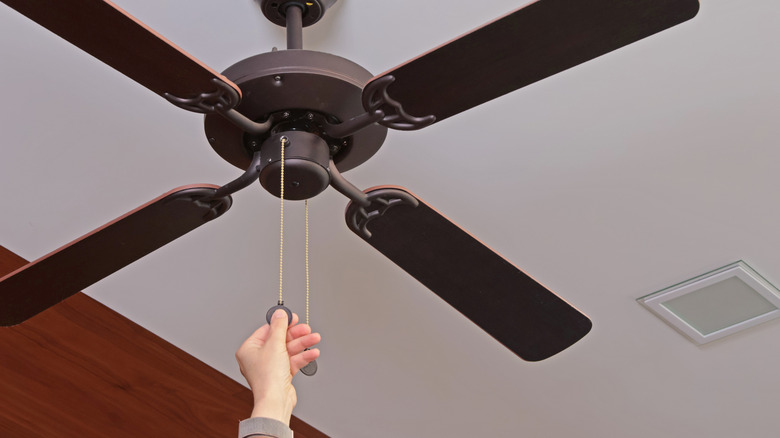
To use this little-known ceiling fan trick, start by checking out what way your fan is currently turning. Then clean your ceiling fan. A quick way is to turn it off, dampen the inside of an old pillowcase with equal parts white vinegar and water, slide it over the blade, and wipe clean. Then find the little switch, typically located on the bottom or side of the fan's motor housing, and flip it in the opposite direction. Turn the power back on and set the fan to its slowest speed to start. It may take a little tweaking to find the right speed that makes your room feel warmer, but once you find the right speed, you're good to go. To keep the power bill low, make sure to turn the fan off when you leave the basement.
Don't have a ceiling fan in the basement? It may be worth installing one. With fans starting in the low $40 range, it's generally more affordable than your monthly power bill. Just note that a ceiling fan doesn't actually heat the room, but it does make those inside feel warmer — much like a cozy blanket.