

It Used To Be In Every Bank And Library: The Pricey Glass Lamp You Should Be So Lucky To Find
We may receive a commission on purchases made from links.
Old-fashioned desk lamps, particularly the ones with heavy brass bases and gorgeous glass shades, have so much more character than most modern plastic desk lamps. They're also a really simple way to add a little vintage charm or retro vibe to your home office or a reading nook. There are plenty of modern reproductions out there that don't cost too much, but there's something extra special about the originals, some of which have become highly collectible in recent years. In fact, there are quite a few valuable vintage lamps you should be looking for at thrift stores, and surprisingly some of the most desirable ones aren't particularly flashy or ornate. They are often just classic.
One that's particularly sought after is an original Emeralite banker's lamp. It's got a distinctive green glass shade and a shiny brass base. You've undoubtedly seen them in movies and on TV shows where they're often used to signify wealth, old money, luxury, and heritage. These beautiful lamps were once a familiar sight in banks, libraries, and offices everywhere. The curved shades directed light onto desks and paperwork rather than glaring into the user's eyes. They were even advertised as being kinder to your eyes, although that was more marketing claim than actual scientific fact. The basic style and design has been copied countless times over the years, but genuine early Emeralite lamps are considerably harder to find. They can sell for hundreds of dollars, so if you manage to find one at a thrift store for considerably less, it could be a rather exciting secondhand find.
Why original Emeralite banker's lamps are so valuable
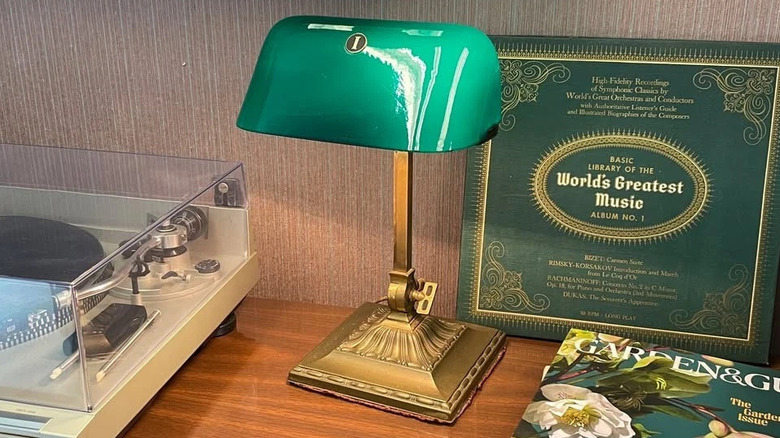
H. G. McFaddin & Co. released the original Emeralite lamp in 1909, based on a lampshade design patented by Harrison D. McFaddin. They called it Emeralite because it combined the words emerald and light, which seemed rather appropriate given the now-iconic green shade. The most recognizable versions have brass or brass-plated bases and distinctive curved green glass shades. These original shades were made using a technique called cased glass, which is where white opal glass was fused to a layer of green glass. They used the white opal interior to help reflect light downward onto the work surface. The unusual way they were made is one of the reasons the originals are so popular and collectible.
In the right condition at the right sale, these lamps can be pretty valuable. An early signed Emeralite lamp with its original green glass shades sold for $795 in 2020. Even individual original shades can command significant prices. A particularly unusual Emeralite glass shade with a lightning bolt design sold for $300 in May 2025. Condition matters a huge amount, though. For example, a genuine early Emeralite lamp that needed rewiring and that showed some minor damage and wear sold at auction for just $130 in January 2026. Even if you do stumble upon one at the thrift store, you need to contain your excitement and give it a thorough going-over before you make the purchase.
How to identify an original Emeralite lamp
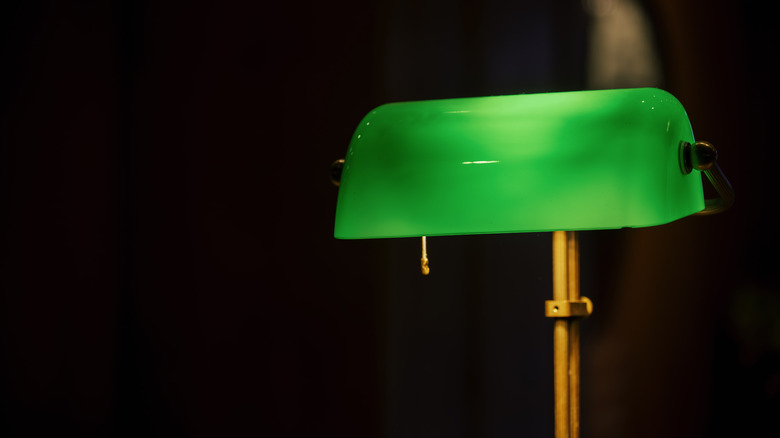
Because there are so many reproductions, spotting an original can be tough. Genuine Emeralite lamps usually have the manufacturer's name and patent information marked on the metal shade holder. If you're lucky you may also find an original label or stamp on the glass shade, but given their age, these haven't always survived. Originals have bases that feel substantial and heavy. The shades have that characteristic green outer surface and a milky white interior. There are some remarkably good reproductions, though, which can be very convincing.
Just to make matters a little more complicated, there are also differences between the originals. The earliest lamps, dating from 1909 to 1916, had shades with holes through the side for attaching them to the supporting arms. The later 8734 series had a different mounting system, with the shade held in a specially designed channel so it didn't have the holes in the side. These little details can help you tell if a thrift store lamp is worth anything, particularly if you're lucky to find one that appears to be an original.
For an old lamp, having had its electrical wiring replaced isn't necessarily a bad thing, particularly if you intend to use it, as you'd want to rewire a century-old lamp anyway. However, mismatched original and reproduction parts will decrease value and collectibility because it's not a true original. If you've found one still in its original state, don't go and plug it straight in. Have it checked by a professional, who will probably tell you that it needs rewiring to be safe. If you're trying to find the perfect vintage lamp for your space, an authentic emerald light is a gorgeous choice.