

How Long Can Bleach Last Before It Goes Bad?
Whether you're whitening your laundry, disinfecting kitchen counters, or wiping down your toilet bowl, you probably have a bottle of household bleach lying somewhere handy. But can you truly trust it to do its sanitation job? That depends on how long you have had it and how you stored it. Household bleach is basically activated sodium hypochlorite, but it's unstable. So, whether you leave the bottle sealed or not, it'll start to degrade almost immediately, mainly into water and salt. It's for this reason household bleach is sometimes overfilled to maintain efficacy for longer.
When stored according to label instructions, bleach can last a year, counting from production, before going bad. However, it may lose about 20% of its strength after six months, so you may have to rework the proportions while diluting it to achieve the same potency. Diluted bleach, in contrast, has an exceedingly short life. After it has been mixed with water, the bleach solution is only good for 24 hours and must be made fresh after a day. Luckily, there are many other uses for bleach around your home beyond everyday cleaning, so as long as you can muster up strength and find the time to carry out these tasks, you can get rid of the diluted batch without wasting it.
Figuring out your bleach's expiration date
As mentioned, bleach loses its potency a year from production. So, if the bottle has been gathering dust under your sink or in the garage for years, chances are it has already expired. While manufacturers don't explicitly mention an expiry date, they stamp a production code on the packaging. Typically stated on the neck of the bottle, it's a long alphanumeric sequence, which also mentions the precise production date. Of particular significance are the numbers placed at the third and fourth position, which highlight the production year. So, if it's been over a year already since then, your bleach has severely deteriorated.
However, if you're still in the running and it's a current-year make, you can further hone in on the manufacturing date by looking at the next three digits (which follow the year). Manufacturers follow the Julian dating system, where days are counted from 1 to 365 (or 366, if it's a leap year). You can count one year from that date (this Calendar link states Julian dates), and mark it on the bottle with a Sharpie at the time of purchase or whenever you perform this task, so you can use it within that time. For example, if the code states A826239..., the A8 is for the production plant, 26 refers to the year 2026, and 239 is the date of production, which would be August 27. This means you should use up the bleach before August 26, 2027.
Storing bleach correctly and determining if it's deteriorated
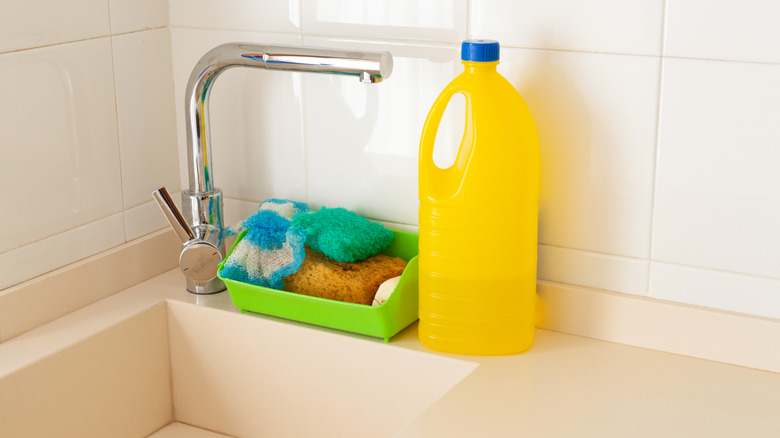
If you fail to adhere to proper storage guidelines, you may as well throw the one-year expiry rule out the window. Bleach doesn't react well to heat and UV exposure and may release toxic fumes after such exposure. You may have noticed that the bottles are opaque to keep the light out, and it's best not to transfer bleach to other bottles.
You should also strive to keep it in a cool, dark area (bonus points if it's climate-controlled). Look for places where the temperature stays between 50 and 70 degrees Fahrenheit; any place over 77 degrees Fahrenheit is a no-no. Although bleach doesn't deteriorate from freezing, the bottle holding it may explode after thawing. That's why bleach is one of the worst things to store in your outdoor shed; keep it in an interior storage closet or kitchen cabinet instead.
Also, examine the packaging. If the bottle appears swollen or releases a hissing noise when you uncap it, your trusty bleach has likely had a breakdown. Contrarily, if your nose doesn't instantly recoil from that bleach-like smell, it's probably turned into salt water and should be disposed of at a hazardous waste collection site or down the drain after diluting it. Remember, inhaling bleach vapors can irritate your respiratory organs, so keep your distance and wear a mask as a precautionary measure. You can also tell that bleach has expired if it has turned a dark yellow. That being said, know that you can still clean with expired bleach. Though it won't disinfect, it can help with surface-level cleaning, like around toilets.