

Forget Granite Countertops: 11 Less Expensive Alternatives For Your Kitchen

If you're embarking on a kitchen remodel and feel like your only choice for toughness and durability is granite, then we have news for you. There are various types of countertop that you should know about before remodeling your kitchen. Not only are many of these highly durable and heat resistant — both key in the kitchen — but some of them are considerably cheaper than those gorgeous granite slabs you've been eyeing.
Some, like quartz, may set you back similar amounts to granite, but will require less ongoing maintenance to keep them looking pristine. Others, like laminate, are both considerably cheaper than granite, and provided that you choose the right material, can both look great and last for decades. You could choose to lay your counters with ceramic or porcelain tiles, which each come with several benefits — lower costs included. And some, like butcher block, can save you a significant buck provided that you're willing to properly care for them. We've highlighted 11 alternatives to granite countertops that are worth considering. All have their pros and cons, and all bring something unique to the table. Importantly, if you're trying to maximize your kitchen renovation budget, you'll find that the materials below can help save money, as compared to splurging on real granite.
Porcelain offers a custom look for less than granite
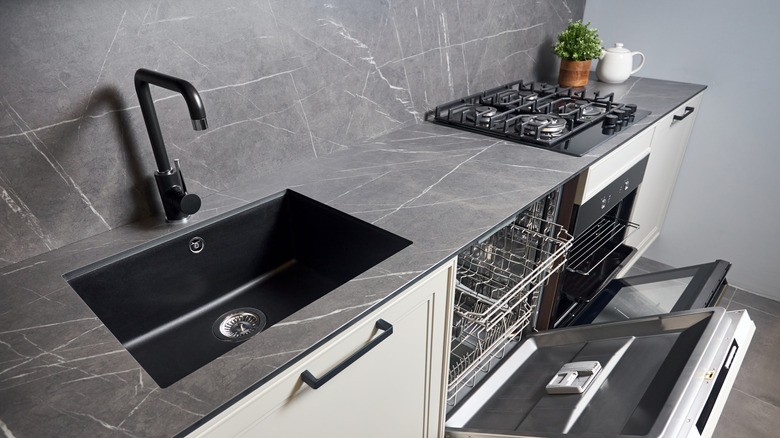
Tiled countertops lend a classic look to your kitchen's work surfaces — one that's much more customizable than granite. In the case of porcelain tiles, they're also much cheaper to install than granite. For example, reading through HomeAdvisor's average cost for kitchen countertop materials, granite clocks in with an average price range of between $15 and $140 per square foot. Admittedly, that's the cost for the materials and installation. However, for the same level of supply and service, the platform ranges the cost of porcelain tiles between $3 and $28. That's quite a difference.
Now, there are some things to keep in mind when installing porcelain countertop tiles. The first is that, while it is durable, it's often more prone to cracks and chips than granite, which is revered for its rock-solid durability. Another consideration is that, since these types of countertops are made from individual tiles, they have grout lines, which will need to be maintained and even replaced over time. However, that maintenance — along with the installation itself — is decidedly more DIY friendly than fabricating and installing granite. There are also myriad porcelain colors to choose from, which, from a design perspective, makes it easy to customize your kitchen in a way that suits you and your particular tastes.
Slate suits a modern aesthetic and costs less than premium granite installations
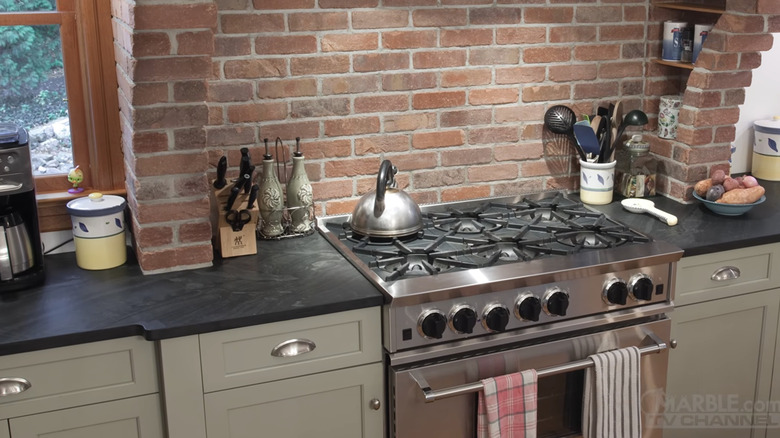
There are many benefits to having slate countertops in your kitchen. It's highly durable, and it brings beautiful texture and natural color into a kitchen quite unlike any manmade material is capable of. However, the same can be said for granite. What we really want to know is whether slate countertops are expensive, and if so, are they cheaper than granite? Sort of. As of 2026, the average cost to have slate countertops supplied and installed ranges between $20 and $60 per square foot, according to HomeAdvisor. Remembering that granite costs between $15 and $140, at the lower end, granite is actually potentially cheaper. However, once you start climbing into the higher end of the spectrum, perhaps with rare slabs or awkward installation demands, granite becomes significantly more expensive.
Now, like porcelain, slate is more prone to damage, like surface chips. The edges can also be sharp if you choose not to have them rounded by your installer. And while it may look beautiful, slate typically features a more uniform appearance versus the highly texturized appearance of granite. These traits may not matter, though, especially if cost is a big factor. Not only that, but slate is highly heat resistant, easy to keep clean, and since it's less porous than granite, it's also more resistant to staining.
Butcher block is a classic choice, and it's cheaper than granite
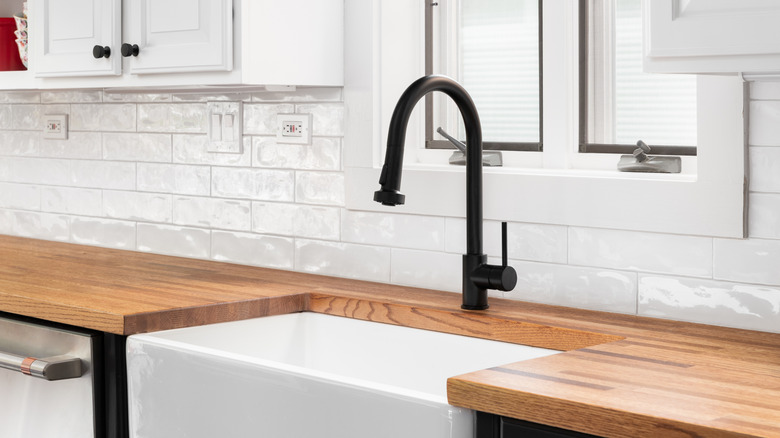
If you're actively looking for alternatives to granite or stone worktops, then wood is probably near, if not at the top, of your list. It's a traditional choice — wooden countertops have been a go-to for kitchen makers for more than a century. Wooden butcher block counters, like oak, are also much cheaper than granite. As of 2026, HomeAdvisor ranges the cost of wood or butcher block counters between $10 and $38 per square foot, installed. That's cheaper at both ends of the scale than granite. In fact, at the highest end of the average, granite has the potential to cost over $100 more than butcher block per square foot.
Of course, one of the main advantages of granite is that it's durable. After all, it's granite! With that in mind, the big question is how long do butcher block counters last? The answer is nuanced, but they have the potential to last anywhere between 20 and 50 years. During that time, they can be sanded and resealed numerous times, which means you won't spend decades staring at a dilapidated work surface. Maintenance is key to longevity, and as an example, you'll need to oil your counters every two to three years to protect them from spills and food. Then again, you'd also need to keep your granite sealed to prevent it from staining. Not only that, but should your wooden worktop become chipped or even burned, repairing it is far simpler than remedying damaged granite. You can simply sand the counter down and then re-seal it.
Laminate counters are much cheaper than granite
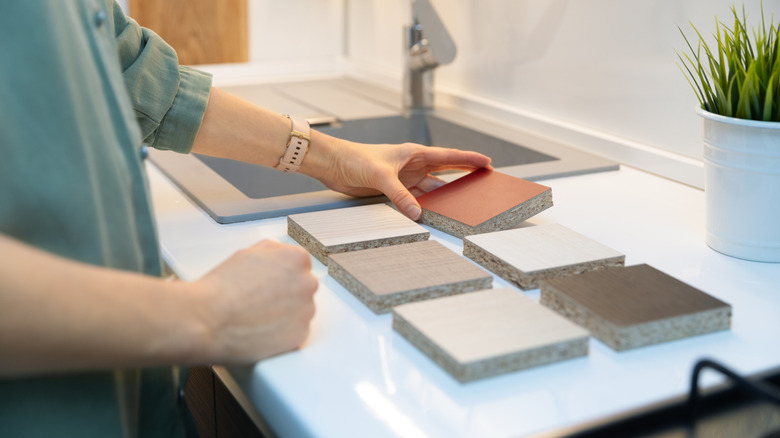
Again, as an alternative to granite, laminate is among the most popular and obvious choices. Certainly, it's one of the cheapest, in fact, per HomeAdvisor, costs can range between $8 and $27 per square foot of installed laminate countertop. That is dramatically less — particularly at the higher end — than the $140 you could spend on each square foot of granite. So, what are the drawbacks? Well, it's easy to make certain mistakes when buying laminate countertops. For example, if you don't test a sample first, then your finished kitchen can look quite different to how you imagined it when you viewed the laminate online. It's also easier to choose laminate based on looks alone, since homeowners often want it to replicate more premium materials, like granite.
However, if you avoid those mistakes, you should find it's entirely possible to create a high-end kitchen with laminate countertops. Not only that, but it's also quite practical. It's waterproof, for starters, which means it's very easy — and not risky — to clean. It won't need sealing periodically to prevent staining like granite does. It comes in myriad colors and patterns, making it highly versatile, and, compared to granite, it's also much more DIY friendly to install, meaning you can potentially cut costs even further. Now, it's not as heat-resistant as granite, and if you damage it, it can be very tricky to repair. However, even if you needed to reinstall a new laminate counter in a few years' time, you may still find that you spend less overall than you would on a single installation of granite.
Quartz may not save money upfront, but it should pay for itself over time
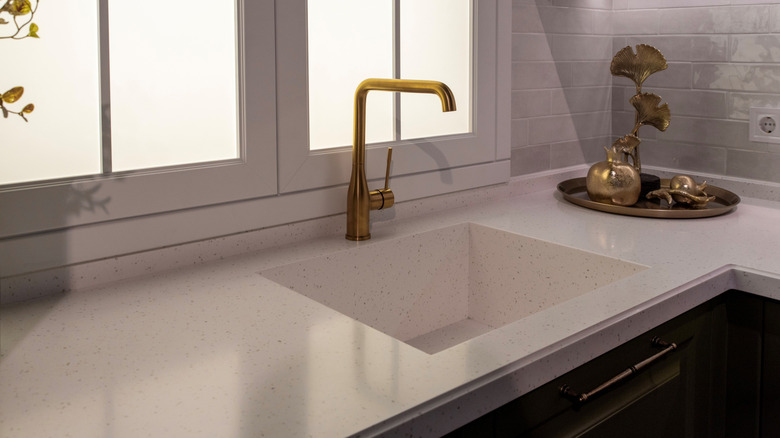
One of the big things to consider before installing quartz countertops is that it may actually be more expensive than other materials — granite included. At least, it might cost you more in the short term. Again referring to HomeAdvisor, the cost for quartz countertops can range anywhere between $50 and $200 per square foot, including the materials and installation. At the higher end, that's $60 per square foot more expensive than granite's top-end cost. However, in the long term, quartz has several advantages over granite.
For example, granite, which is porous, is much more prone to staining if you're not fastidious with your sealant. The sealant needs topping up periodically, too, and if you forget to do it in time, you could find yourself with stains from food that are very, very tricky to remove. Quartz counters, on the other hand, are non-porous. That means they don't need sealing, and nor will they stain very easily. Indeed, the main reason that people end up replacing quartz is simply that they want to refresh their kitchen — not because their countertops are damaged beyond repair. With this in mind, if you're in it for the long haul and want to minimize your ongoing maintenance costs, quartz could well be the more cost-effective choice.
Limestone is beautiful and cheaper than granite, but it requires maintenance
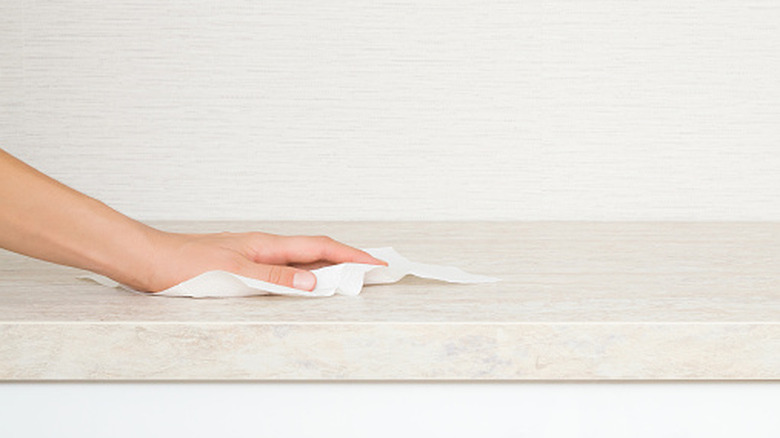
If you baulked at the upfront cost of quartz, even despite the ongoing, cost-saving benefits, don't worry. You could always look to limestone to bring natural beauty to your kitchen counters. As of 2026, the cost to install limestone countertops averages between $10 and $70, per HomeAdvisor. That's half the cost at the higher end versus the most premium granite installations, which, if cost is your biggest concern, should inspire a "phew" and a wiped brow.
The next thing to consider is whether limestone or granite is better for your kitchen. The answer to this question will be different for everybody, but limestone has a few traits that are worth factoring in. Like granite, it's porous, making it prone to staining, along with damage from corrosive cleaners and acidic foods. This means you need to keep it sealed — ideally on an annual basis — to ensure it retains its original, lustrous look. The upside is that limestone, just like granite, is beautiful. It typically features a soft, earthy palette, which is very much on-trend in the interior design world right now. It brings a more delicate sense of texture and pattern than granite, and it's available in a surprising range of shades and patterns.
Travertine is typically cheaper than granite, although cost varies by type
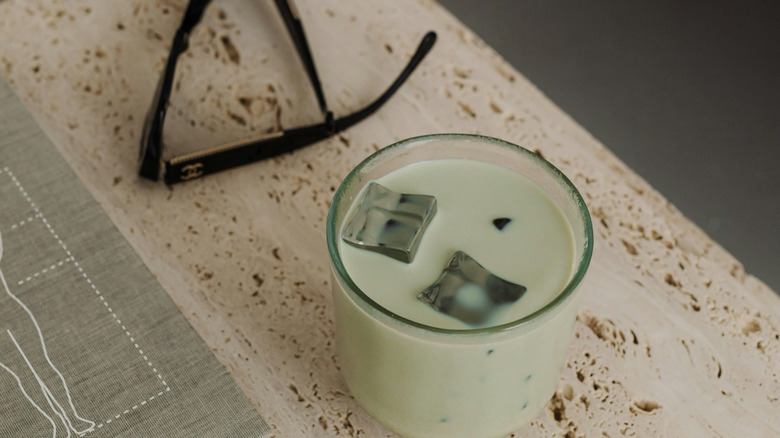
With an average price range of $11 to $35 per square foot (installed), travertine represents an attractive alternative for thrifty kitchen remodelers who'd prefer to forgo the cost of granite. It's a type of limestone (just like marble), and hails from areas with mineral-rich waters. It forms when calcium-rich spring water evaporates, which lends it both strength and warm, intricate beauty. It's typically earthy in tone, and just like granite, few two slabs are exactly the same, lending countertops of this material a sense of rarity.
Now, as you might expect, there are both pros and cons to installing travertine countertops. Yes, they're beautiful. But they are also porous, meaning they need regular sealing. You have to be careful cleaning them, ensuring that you don't use corrosive cleaning products. They're also one of the hardest countertop materials to keep clean, unless you're on the ball and clean up spills immediately to prevent staining. The upside is that, having been formed in hot springs, travertine is highly heat-resistant, just like granite. And depending on which type of travertine countertop you choose, you could seriously save when compared to more premium materials. Large travertine slabs typically command a higher price tag, ranging between $25 and $50 for the materials alone. Smaller travertine tiles, on the other hand, can cost as little as $5 to $25 per square foot.
Paper composite countertops are hardier than they sound, and cheaper than granite
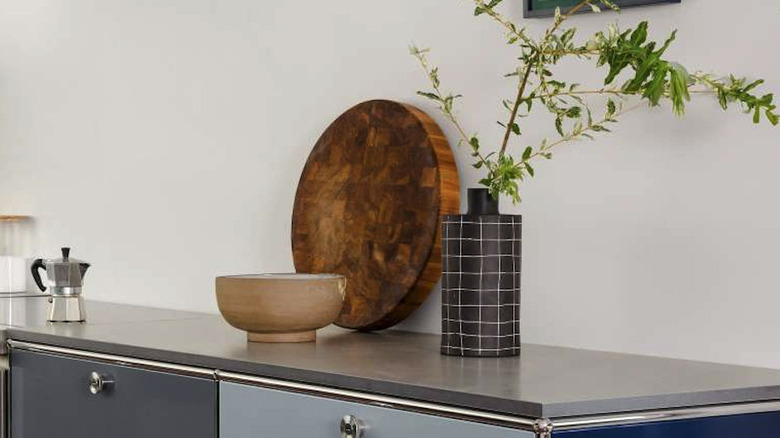
If it sometimes feels like sustainable products cost more, then ditto. But it's not true in all cases. As an example, paper composite countertops — which are made from recycled materials — could cost much less than a granite countertop installation. Now, it depends precisely on which type of granite you have in mind. At the lower end of the price range, with entry-grade granite slabs, you might only pay $15 per square foot installed. At the low end of the range for paper composite tops, you can expect to pay $45. However, at the higher end, these sustainable countertops typically peak at $70 per square foot, versus granite, whose top-tier cost average is twice that amount.
So, what are paper composite countertops and what are their pros and cons? Well, first, they're tougher than they sound. Manufactured by brands like PaperStone, they're made from recycled materials (like paper), which are then bound in tough resin. In terms of aesthetics, they're comparable to materials like slate or soapstone. And interestingly, while it's a manmade product, the paper content actually helps these countertops to age in a similar way to hardwood surfaces. They're non-porous, so you don't need to worry about staining them, and as for durability, they're on a par with laminate. In other words, they won't damage easily, but nor are they overly heat resistant. This shouldn't be a problem, especially if you install trivets or are careful to use heat mats with your cookware. Even if you do accidentally damage them, they can actually be sanded — much like butcher block — to remove any burns or scratch marks.
Corian counters are cheaper than high-end granite
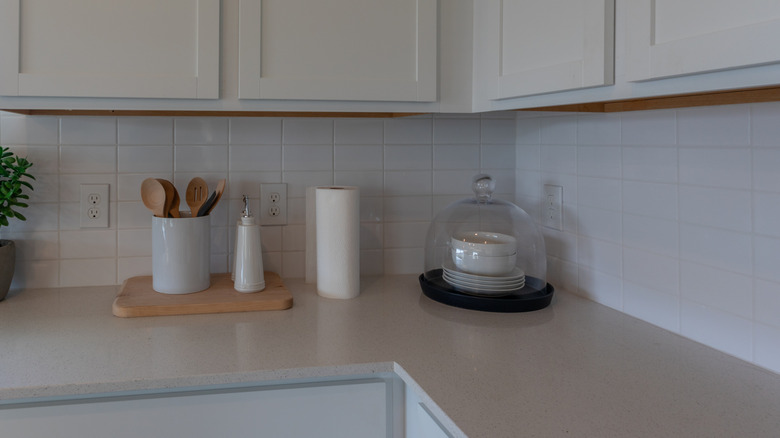
There are several advantages to installing Corian kitchen countertops instead of granite. They're virtually seamless once installed, and should anything go wrong, they're fully repairable. So, what are they? We'll get to that shortly. Right now, we want to highlight another advantage, and that's the cost of solid-surface counters from Corian versus natural granite. Slabwise averages a typical installation between $45 and $100 per square foot — materials, labor, and all. Again, at the cheaper end, that's a touch more expensive than granite. But once you reach higher-end installations, you could be looking at a like-for-like project costing twice as much with premium granite.
Like paper composite countertops, Corian Solid Surfaces are also made from an aggregate of materials and resin. Only, instead of paper, the materials bound up in the resin are usually natural minerals. Once formed, the material is then cured and hardened (which means it's super durable), before final finishing. Now, while it is indeed durable, Corian can be prone to scratches. Hot pans also risk damaging the surface, and it's generally advised to use trivets or mats. But, it's easier to repair than granite, and provided that it's not damaged, it requires virtually no maintenance.
Ceramic is one of the cheapest alternatives to granite countertops
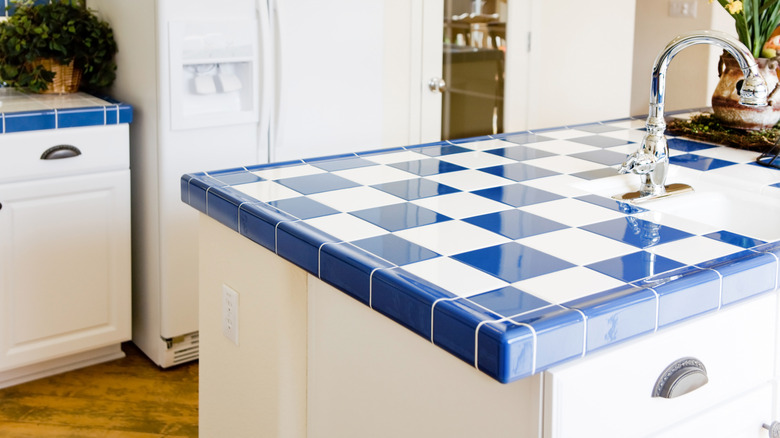
There are several reasons to let ceramic take granite's place on your kitchen moodboard. First, and most importantly, it's much, much cheaper. At the lowest end of HomeAdvisor's average price range, ceramic tile counters are 10 times cheaper than granite, at $1 per square foot installed. At the top end, you might pay $10 per square foot of installed ceramic — 14 times cheaper than the top-end $140 you would pay for granite.
That, alone, will be reason enough to earn ceramic a place on the shortlist of budget-minded countertop buyers. Not only that, but from a practical perspective, ceramic is one of the best types of tiles for kitchen countertops. For starters, they come in myriad colors and styles, which means you have plenty of stylistic options to play with. As for durability, ceramic is impermeable, meaning no need to worry about stains or having to seal it. It's very hard-wearing, resists mold and mildew (provided that you maintain the grout lines properly), and overall, is nice and easy to maintain. Of course, a countertop made up of individual tiles may not have the sleek, seamless appearance that you've had your heart set on. If that's the case, then there are plenty of other options to consider. But if the price point is attractive, and you're ready to get creative with your countertop design, there's much to be said for ceramic tile counters.
Concrete counters are durable and cost-effective
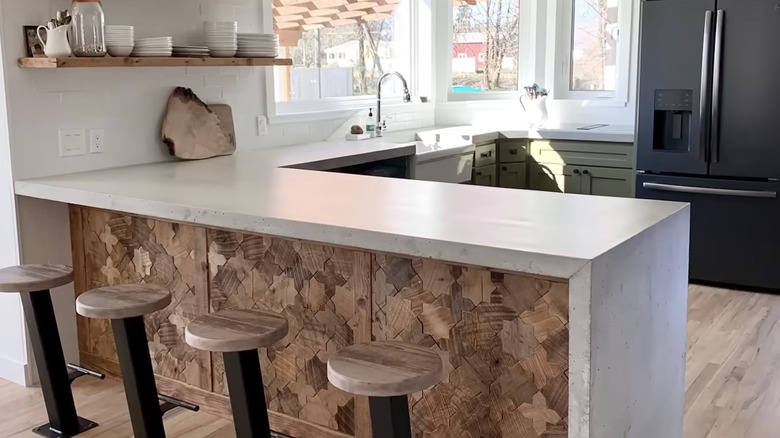
For those of you who were able to resist opening a tab and adding ceramic tiles to your basket, thanks for sticking with us! Our final entry to this guide, concrete countertops, are unfortunately not as cheap as ceramic. However, they're still one of the most affordable countertop materials, and could potentially save you money versus premium granite installations. They generally cost between $50 and $100 per square foot (installed), which, at the upper end, is cheaper than high-end granite. However, since concrete counters are more DIY friendly, you could potentially achieve a high-end finish without needing to hire a contractor, which would mean even greater savings.
Comparing the two materials for practicality, concrete holds its own fairly well. It's highly durable, and while it is more prone to cracking than granite, those cracks are quite easily fixable. Both materials are porous, which means that you'll need to seal your concrete to protect it from stains. Interestingly, while you might think granite has the edge in terms of aesthetics, concrete is actually very versatile. You can achieve a glossy finish by waxing your concrete countertops, for example. Even if your heart is set on a granite aesthetic, concrete can actually be finished to resemble the marbling and imperfections of natural stone.