

What To Do Before Storing Your Grill Tank Away For Winter
We may receive a commission on purchases made from links.
With winter fast approaching, you're likely gearing up to stow away your BBQ grill and put summer cookouts behind you until next year. But what should you do with the grill tank? The first thing to do is rotate the supply wheel or valve clockwise until it's firmly off. In case you're wondering how long propane can sit in your tank before it goes bad, now that it doesn't degrade over time like gasoline does. So, you don't have to make any extra efforts to empty the tank, stabilize the fuel, or max it out (unless you're planning to brave the snow for some winter grilling).
After shutting off the valve, take time to examine the tank for gas leaks, even if you haven't noticed any foul odor reminiscent of rotten eggs or a skunk gone rogue, just to be on the safe side. To do this, perform a bubble test in a well-ventilated space, away from any ignition sources. In a spare container, mix water and dish soap in a 1:1 ratio. With a paintbrush, apply this mixture to the valve and regulator connections, then slowly open the tank's valve and watch for bubbles. You can alternatively use a leak detection solution, like ComStar's Leak Bubbles Blue. If you notice any bubbles, your tank may have developed a leak. If bubbles appear around the regulator connection, close the valve, tighten the connection, and repeat the test. If the leak persists, leave the valve closed, don't use the tank, and contact your propane supplier. If everything checks out, close the valve again and proceed with storing the tank.
How you should store your grill tank for the winter
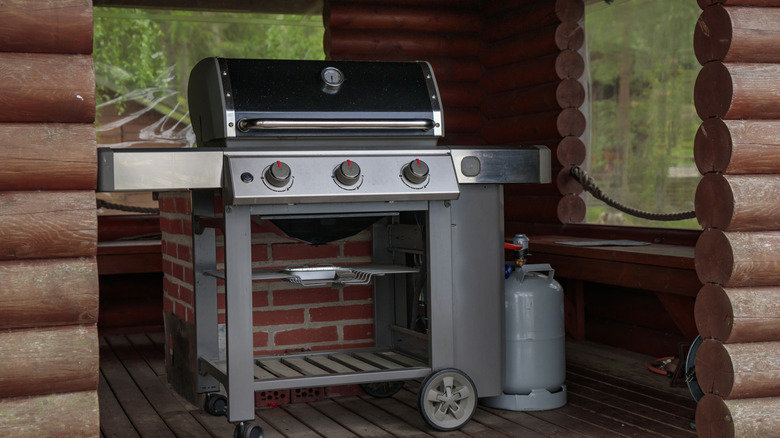
Since propane is flammable, you should never store it in living areas, including basements and crawl spaces. That's a common mistake to avoid when storing propane tanks at home. Even garages aren't a safe storage option for your propane tank, as they may contain ignition sources and aren't always properly ventilated. The same goes for enclosed sheds. The best thing to do is to leave it outdoors, in an unenclosed space. Make sure the tank is placed 10 feet away from your home, or farther.
Now, if your propane tank is connected to the grill, you don't need to disconnect it if you don't mind keeping the unit together. The tank can stay underneath the grill, and a grill cover can offer protection from the elements. But if you're hoping to store the grill indoors, disconnect the propane tank and keep it outside in an area that doesn't get hit directly by sunlight. Don't worry about freezing temperatures. Heat is actually a bigger concern than cold, as temperatures of 120 degrees Fahrenheit or higher can cause excessive pressure to build inside the tank, potentially releasing propane through its pressure relief valve. In fact, propane can withstand temperatures as low as minus 40 degrees Fahrenheit, although the cold can make it harder to fuel your grill. Technically, propane has a freezing point of minus 306 degrees Fahrenheit, and a boiling point of minus 44 degrees Fahrenheit. Below its boiling point, propane doesn't vaporize readily enough to supply a grill with fuel.
Ensure you keep the grill tank upright and stable
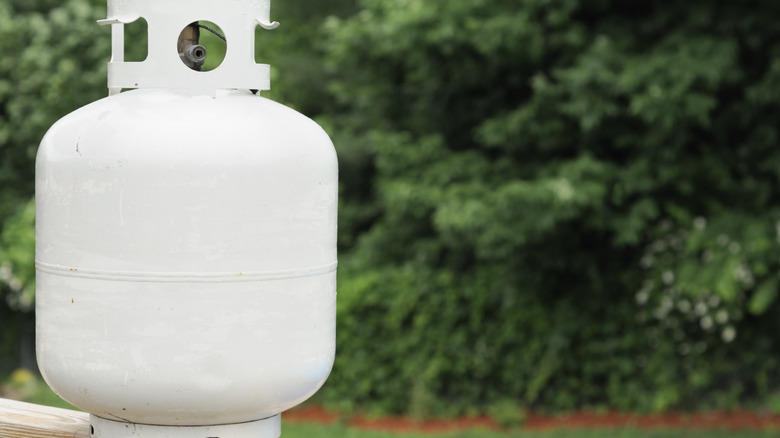
When stashing away your grill tank for winter, ensure that it's fully upright. If it's on its side, the pressure relief valve may not function as intended, increasing the risk of a propane leak. In case your area experiences strong gusts, consider stabilizing it with brackets or getting dedicated tank feet, like the Wadeo 3 piece 20 pound Propane Tank Stand Feet. Or, even better, hoist it up in a milk crate.
Remember, propane may last indefinitely, but the tanks holding it won't. While the law requires you to replace them every 12 years or have them recertified for use if tanks are still intact, you may need to do it sooner if they rust. While a smidgen of rust is expected and can often be sanded off or painted, when it spreads, it may indicate that the tank walls are thinning and the situation may turn catastrophic. To help prevent rust, limit the tank's exposure to moisture or frost heaves. To do that, you can elevate it over concrete slabs or a wood pallet. Finally, you don't want your grill tank covered in snow after a storm. Clear away accumulated snow after a storm, or consider using a breathable, weather-resistant tank cover, like the one offered by Weber. A plastic tarp will work, too.