

Why Do House Cleaners Add Water To Dish Soap?
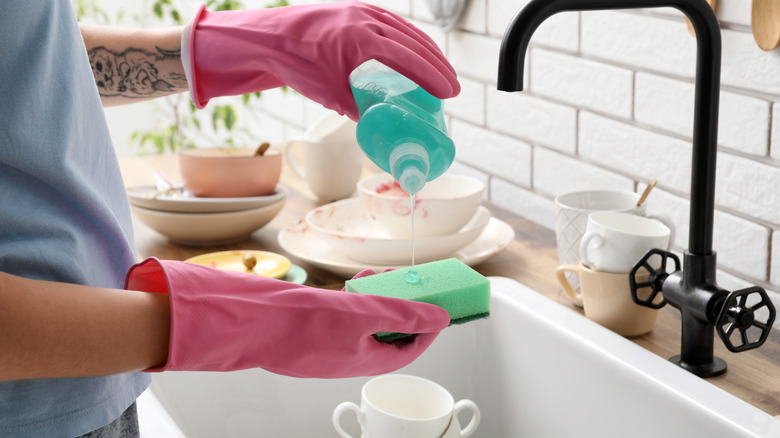
It's a trick my mom taught me years ago — top up a nearly empty bottle of dish soap with water. So imagine my surprise when I learned that apparently some professional house cleaners do it too. The reason for it is quite simple; adding water to the end of the bottle can make the product last a little longer. And since dish soap is formulated to work when mixed with water, it isn't like you're throwing something random into the equation.
We first need to understand dish soap to understand how diluting it works. Dish soap contains surfactants, giving it the ability to clean in the first place. They basically help water to spread across surfaces, loosen dirt, and lift grease so it can be washed away and they also help trap oily grime so it is carried away when you rinse. By adding water, you don't actually stop this process from working. You simply reduce the concentration of dish soap — and therefore surfactants — present.
From the perspective of professional house cleaners, it makes sense they'd want to stretch a bottle of dish soap. It would mean fewer refills and less product used over time plus it can also make a thick liquid easier to dispense which makes it easier to use for multiple cleaning jobs. After all, dish soap can be used all around the kitchen, and there are plenty of other unexpected things you can clean with it.
Should you dilute your dish soap at home?
You'll have to make a distinction between diluting dish soap as you use it and adding water to the bottle for prolonged storage. Mixing a little soap into a sink of warm water or into a separate container for a specific cleaning task is one thing, but topping up an entire bottle with water isn't always a good idea. Most commercially-sold dish soaps contain preservatives that help keep the product stable, and adding water can dilute those preservatives and cause microbes to grow. This is why many manufacturers actually advise against pre-diluting their products in their storage bottles. For example, in an email to Bon Appétit, a representative for Dawn said that the brand "[doesn't] recommend diluting your bottle of soap." (And that applies regardless of whether you're using blue or green Dawn dish soap.)
It's also worth remembering that more foam and bubbles don't necessarily mean better cleaning. In fact, if you're tackling very greasy pans, you'll need more detergent than you would for a few dirty plates, so having a diluted bottle for every job doesn't make much sense. The most sensible approach is to dilute a little soap with water every time you do the washing up, adjusting how much dish soap to add based on how dirty your dishes are. Then, at the very end of the bottle, you can always add in a little water to squeeze out a few extra cleans instead of topping the whole thing back up for prolonged use.