

Why Is Plywood Always Stacked In An Odd Number Of Layers?
When choosing the perfect wood for your DIY bookshelves, cabinets, underlayment, or roof sheathing, you might have considered plywood. However, the wide variety – different grades, ratings, thicknesses, and sizes — could make you feel out of your depth. To add to the confusion, labels also list the number of layers, such as 3-ply, 5-ply, 7-ply, and so on, which sometimes total up to the same thickness! Really, what's up with that?
But if, amid this confusion, you've noticed that most plywood is stacked in an odd number of layers (you can literally count them from the edge), know that it's for functional and aesthetic reasons. The short of it is that a plywood composed of an odd number of layers is structurally more symmetrical, stable, and balanced. Since its stiffness is distributed in both directions, it's less likely to warp, twist, cup, swell, bend, or shrink than solid wood.
That being said, you may occasionally come across even-layered plywood panels, such as 2-ply or 4-ply. While 2-ply is mainly used for decorative purposes, 4-ply may be used in mid-level construction and is specially engineered to distribute the weight evenly. While it has four plies, the middle two are glued with their grain running in the same direction, so they act as a single layer — meaning a 4-ply panel still has an odd number of layers. Still, it's considered less structurally sound as compared to 5-ply or thicker plywood panels.
Odd-layered plywood can ward off warping and twisting
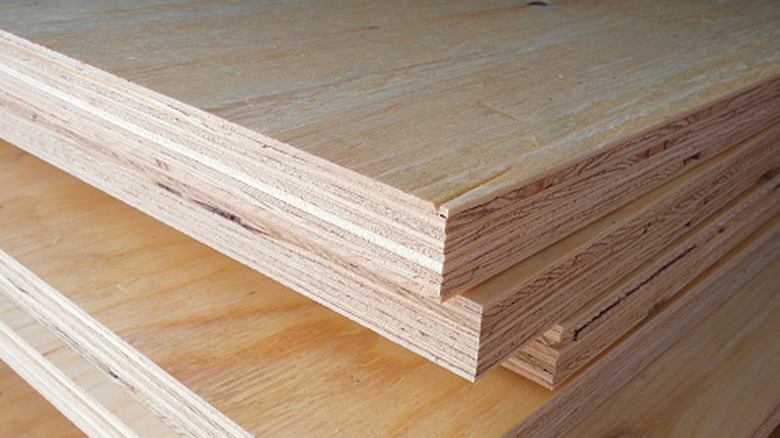
Unlike a solid piece of lumber, plywood is an engineered product where multiple wood veneers, or "plies," are bonded together with glue to form a single panel or sheet. When the plies are set, each one is placed so its grain runs perpendicular to its neighbor's (called cross-graining). In other words, if the face ply's grain faces north-south, the second layer's (or core) grain goes east-west, followed by the back ply matching the face ply's direction. As a result, your plywood's outer grain looks the same on both sides, providing a consistent finish to your project.
But such cross-graining is also essential to plywood's stability. To understand why, consider how wood behaves on its own. As a material, wood is anisotropic; that is, it behaves differently in different directions and is far more stable lengthwise than across the grain. By stacking another layer perpendicularly, you can help neutralize some of that cross-grain movement, which helps keep the board strong.
However, with only two layers, the veneers will still react differently when exposed to moisture, humidity, or temperature (because of their opposing grain directions), so the sheet may cup, twist, or pull to one side. By adding the third layer on top, you can balance the tension, ensuring the plywood sheet stays flat. It's also for this reason that thicker plywood is created by adding additional layers in pairs, keeping the total count odd.
Odd-numbered plywood can better handle splits
When you bend a plywood panel, it flexes around an axis that runs through its center. Going back to the 2-ply example, when it's under stress from heavy loads, that axis falls right along the glue line, which isn't as strong as the wood itself. As a result, such an even-layered formation is more susceptible to breakage and splits. In odd-layered plywood, on the other hand, the bending axis runs through the solid core wood sandwiched between the face and back, which can better handle that stress. This helps make plywood the go-to choice for load-bearing construction, including shelves and cabinets.
With that said, an odd number of layers won't guarantee a stable sheet if other variables are off. Ultimately, the point is to balance and counteract the tension and opposing forces, so the panel is stable and flat. However, if the plies aren't of the same thickness within the sheet, are bonded at less than 90 degrees, belong to a different species (many manufacturers combine different woods), or had different moisture content at the time of pressing, they might still give you trouble. So, choosing a good piece of plywood for every project is important.