

Why Do Painters Add Black To White Paint
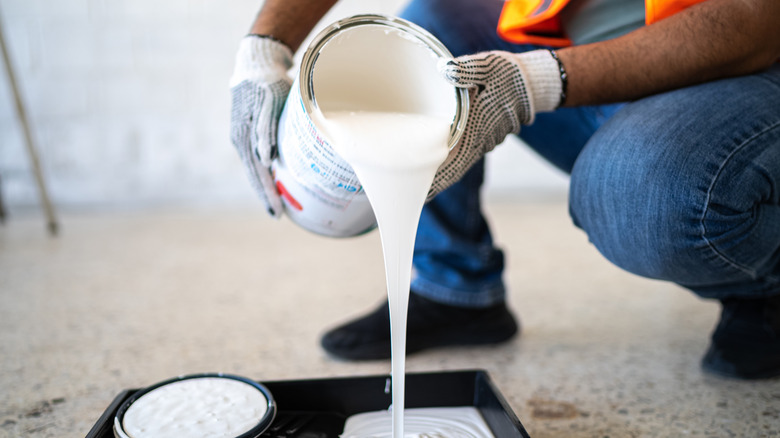
We all know how important it is to choose the perfect shade of white paint for your home. If you're not careful to pay close attention to the undertone, it can end up looking completely different from what you expected and ruin the whole vibe of your design. So, when purchasing cans of white paint, why do professional, residential painters ask to add a few drops of black paint? To find the answer to this question, we reached out to Sue Wadden, the Director of Color Marketing at Sherwin-Williams.
"Adding a small amount of black pigment to white paint can help soften its brightness and create a more nuanced, balanced shade," Wadden told us in an exclusive interview with House Digest. "From a color theory perspective, black can influence a white's depth and undertones, helping create softer off-whites or subtle grays that feel less stark in a space." This is great news for those who tend to avoid using this paint color in their home for feeling too cold and sterile. However, black doesn't affect all whites in a similar manner. "The exact effect depends on the paint's existing formulation and the amount of pigment added," Wadden said.
How black is mixed into white paint and what the results look like

Wondering how to tint your own wall paint like a pro? The experts at Sherwin-Williams have a specific process. "In professional paint tinting, carefully measured amounts of colorant are added to a compatible paint base to achieve a specific shade," Wadden explained. "Black colorant may be one component of a white paint formula, working alongside other pigments to create the desired depth and undertones." Considering the technicalities of the tinting process, it might not be worth it to try to make your own wall paint. She further explained, "Our neighborhood stores use precise tinting formulas to help ensure consistent, accurate color results, rather than relying on manually adding black paint to white paint." So, it's definitely not as simple as adding and mixing a few drops of black in a can of white and calling it a day.
However, prior to using this method, it's important to understand the shades of white this works best on and what the end results will look like. "This approach can be particularly effective when creating softer, more muted whites or whites with subtle gray undertones like Snowbound SW 7004 and Eider White SW 7014," Wadden said. "A small amount of black pigment can help reduce the intensity of a bright white, creating a more understated look that works beautifully in spaces where homeowners want a softer, more relaxed atmosphere." Since black is known to absorb light, it dulls the sterile feel white walls often give off — all without compromising the clean, minimalist look this color is often used to convey.
Scenarios where you shouldn't add black to white paint

Though black paint is a great way to soften the tone of white paint, it's not the right choice for every scenario. "I wouldn't recommend adding black pigment when the goal is to preserve the crisp, clean appearance of a bright white or maintain the warmth of a creamy white," Wadden said. In such cases, it's best to leave the paint as-is.
Mixing paint colors can be a finnicky game, and it requires an understanding of color theory to get the exact shade you're looking for. "Adding black can alter the color's undertones and overall appearance, potentially creating a cooler or more muted result than intended," Wadden explained. Due to the complexities of paint mixing, this may also be something to avoid DIYing, especially since painting your room isn't as cheap as you'd think it would be. "Rather than adjusting paint yourself, I always recommend choosing a professionally formulated shade that achieves the desired look and testing a sample in the space before committing," Wadden said.