

Follow These Pro Tips To Turn Clay Into A Stylish Restaurant-Quality Dinner Plate Set
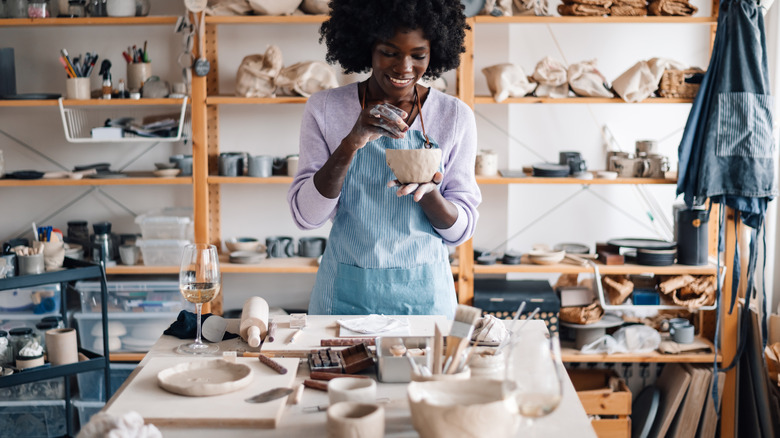
Dinner tastes better when serving your chef-level masterpieces on quality dishware that please the eye. Sadly, you'll have to fork out tens of dollars for a single plate, which translates to hundreds for a full set. So, to help you enjoy the benefits of fancy table settings without spending a bomb each time a piece cracks or you get bored, we spoke to Kate Nicholson, House Digest News Editor and Artist behind Kate Nicholson Ceramics for exclusive expert tips on making restaurant-quality dinner plates at home with clay.
Starting with supplies, she tells House Digest, "At the most basic, you can get away with a wire cutter, a large rolling pin, two long, flat sticks of wood about ⅜-inch thick, a knife, a rubber rib, a small, fine sponge, and a needle tool to write your name, initials, or your maker's mark on the base of the plates." Additionally, you'll need a flat wooden paddle (a spatula works, too) and a wooden board or a thick canvas to roll the clay on, as it'll stick to other surfaces.
Of course, clay is the main ingredient. "A single medium dinner plate will require about 3 pounds of clay," Nicholson explains. "Laguna B-mix, Laguna 65, and Standard 240 White are some of the most popular mid-fire clays in the U.S., but you could also ask the studio you plan to fire your plates at which clays they use." Finally, you'll need a cardboard or plastic template that's about 10 to 12% larger than the size of your desired dinner plates (standard ones generally have a diameter of 10 inches) to account for the clay shrinking when it dries.
How to craft dinner plates from clay using the slab-building method
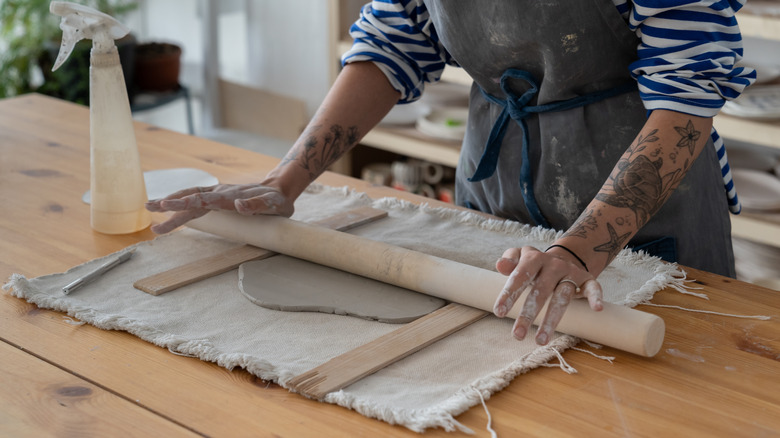
The first step is to wedge the clay. If you don't know how to ox-head or spiral wedge clay, Nicholson recommends slam wedging. Just cut a small piece from a freshly-opened block and throw it on your table a few times to flatten it (and work out your frustrations). Then, "Place the sticks on either side of the block, making sure that the gap between them isn't longer than the length of the rolling pin." Nicholson instructs. "Roll out the block of clay, gently rotating it as you go, until you have a slab that's as thick as the sticks."
Next, use your template and needle tool to trace the plate outline onto the clay slab before cutting it out with the knife." But don't throw out the excess clay — spray water on it and store it in a plastic bag for more DIYs like this beautiful clay jewelry tray. Now, wait for the plate to air dry until it feels like thick leather; don't let it dry beyond that, or it'll be challenging to work with. The exact drying time depends on your clay's softness as well as the space's temperature and humidity.
To give your plate a pretty rim, "pick up the circle of clay and gently hit the edges with a wooden paddle to form a rim, turning the clay in your hands as you work," Nicholson suggests. "The rim of the plate should be very roughly around ⅛ to ¼ inch thick, with the base thickness determined when you roll out your slab." Finally, leave it in a cool, dry spot for a few days or weeks so it dries completely.
Taking your homemade clay dinner plates to restaurant-quality dishes
Though the process of crafting clay dinner plates isn't too daunting, you must keep a few things in mind to ensure they're restaurant quality. Starting with the texture, "Run a rubber rib along the surface of the slab before cutting out the circle using your template. Try not to press too hard on the clay or you'll make the slab thinner than it should be," Nicholson suggests. "You should also run a damp sponge over the entire plate once the clay reaches the late leather hard stage." This will make them smooth to the touch.
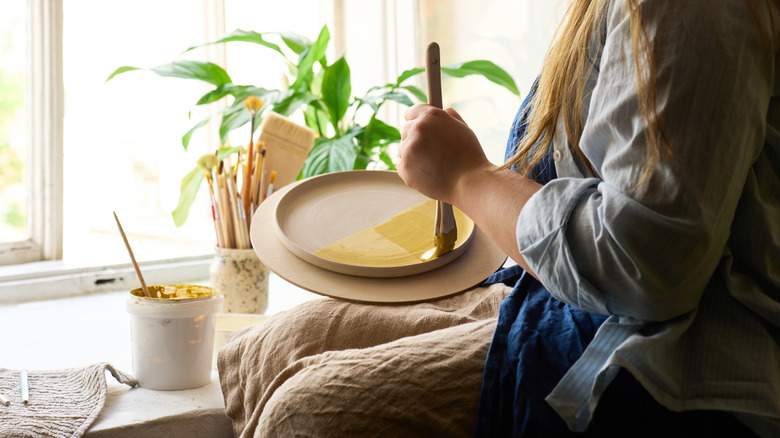
You also need to be careful with the finishing glaze if you plan on using these dinner plates for dining instead of decorating. "Ideally, use a glossy glaze rather than a matte or special glaze for plates. Amaco and Mayco are two of the largest commercial glaze manufacturers in the U.S., and they note which of their glazes are food safe on the packaging," Nicholson explains. The also offer an extensive range you can pick from. Plus, you can buy them in small quantities and apply them with a brush (like you'd do with paint).
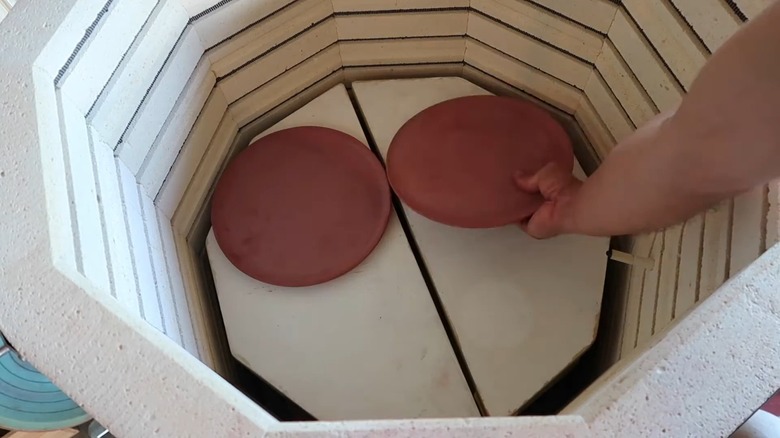
Finally, you'll have to find a studio that's open to kilning other people's work, typically for a small fee. It's important as "clay objects generally go through two firings: a bisque or biscuit firing at a lower temperature and a glaze firing at a higher temperature," she explains. And since a novice shouldn't undertake this, it's vital you visit a studio. "There's a great website called Kiln Share that's a good place to start when trying to find a kiln."
Things to keep in mind when making clay plates
While making dinner plates out of clay is a fun project, there are a few things you should keep in mind. According to Nicholson, the primary concern with dry clay is the dust. "Clay contains lots of silica, and when it dries, it turns into a fine dust that you can breathe in. Over time, this can lead to silicosis." Although you don't need to be too concerned when making a few plate sets once in a while, you should still be cautious. "Make sure you wash down the work surface with a damp cloth and wash the tools and even your clothing thoroughly after every session." She also advises working outdoors to minimize the mess (if you don't have a dedicated workshop or garage) and washing everything there to keep your drains from getting clogged. Further, Nicholson adds, "Keep the clay well wrapped or in a sealed container and stored outside your home; the same goes for the tools and other materials."
Transporting your still fragile plates to a studio for firing is another concern. "It's challenging but do-able to transport greenware to a studio, as long as the plates are well protected with bubble wrap, foam, or other cushioning materials." Additionally, make sure they're free from moisture. Finally, Nicholson recommends beginners to visit a pottery studio if possible. It can be way easier to make your plates in a community class with all the professional materials at hand. There you may also design matching ceramic drinkware or find more lovely pottery pieces to decorate your home.