

The Smart Hack That Keeps String Lights From Sagging Or Falling Down
We may receive a commission on purchases made from links.
A set of string lights bring a warm and unexpected glow to your backyard fence. This is an especially welcome sight when autumn nights become cold and foggy. It isn't any wonder that those tiny lamps on a string become such a decorating staple for the backyard. They're pretty much perfect as an accent — except, of course, when the strand of lights begins to sag, (or heaven forbid, fall). Usually, this sagging business isn't a gentle, almost elegant droop, either. Rather, the strand of lights begins to take on the sad, gravity-riddled appearance of an old pair of ballet tights that have danced "The Nutcracker" one too many holiday seasons. Thankfully, there's an easy trick that'll perk up the strand of lights on your fence and prevent a spill. All it takes is a handful of nails and a hammer.
You'll start by hanging nails on your fence, all in a row. You'll need enough nails to hold the length of lights you intend to hang up. Once that's done, drape the string of lights over the first nail, but don't just leave it like that. Wrap the cord around the nail once or twice before moving on. Each subsequent nail gets the same treatment. The result? Sagging stopped — falling, too. More importantly, when it's time to take the string down, you don't need any special tools. You just unwind the cord until it's free of each of the nails.
Things to consider before employing this hack
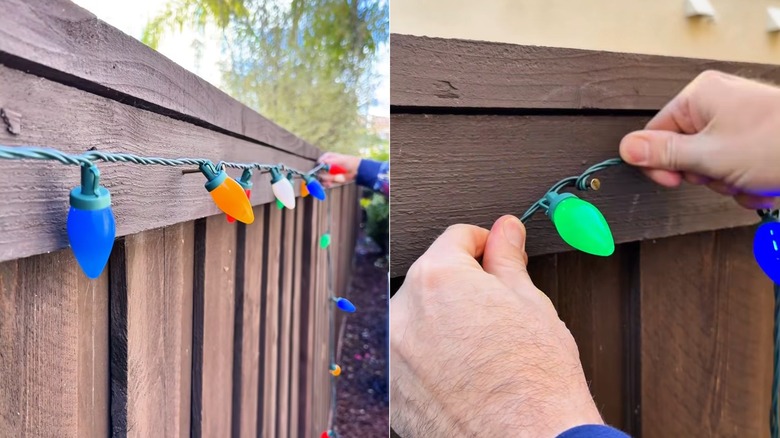
This is a handy hack for hanging Christmas lights, especially if you have a large backyard to cover. But not every type of nails will do. Nails with large heads will work better for this. If you hang the string of lights on, say, brad or finishing nails, there's a chance the cord could slip off its perch if the nail itself starts to droop downwards. This is because the head of the nail isn't wide enough to hold onto the cord. Using something like a common nail is a better bet, though if you're really the cautious type, you could try roofing or drywall nails. Not only do they have large heads, but they're also often thicker than other kinds of nails. This girth comes in handy when you have a particularly heavy string of lights.
On a related note, it's best to drive the nails into the fence at a downward angle. That is, the head of the nail should point toward the sky instead of straight out. This offers you further insurance that the light string won't slide around should the weather start to shake your fence. Finally, this technique should work for most types of lights. That said, you'll want to be careful not to get the hanging strands that come with icicle lights tangled up in the process. With those kinds, you'll want to make sure that the hanging strands are out of the way before you wrap the cord around the nail.
Can I use this nail trick to hang lights on my roof?
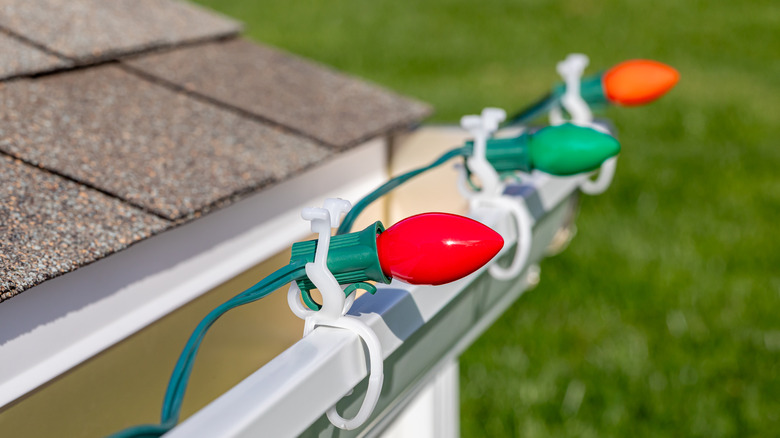
There are a number of easy ways to hang lights, and this particular hack works best if it's used on a fence instead of on your roof. Generally speaking, this technique isn't advised for lights that'll adorn your roof and gutters, thanks to the tiny holes the nails will make in the building materials. Even though they'll be tiny, they're big enough to cause materials, like wood, to splinter. After a while, the small cracks become large ones, and potentially causing the destruction of your roof.
When you're hanging outdoor light strings in this scenario, it's better to use light clips or clamps. Items like Home Accents Commercial Grade Light Clips are an example of what you'd be looking for. They were designed exactly for this type of decorating situation in mind and are much kinder to your home's exterior. And they work with most kinds of lights, from string lights to minis and all manner in between.
Finally, it probably goes without saying, but it's good to have a reminder: If any part of the light string's cord is damaged and the wires underneath the cord's plastic sheath are exposed, the lights shouldn't be hung at all. This is true, regardless of the method you'll use to hang them up.