

Use River Rocks To Create A Beautiful Solution For Poor Backyard Drainage
We may receive a commission on purchases made from links.
Splash blocks and downspout extenders allow you to breathe a sigh of relief and stop worrying about water pooling around your home's foundation. However, they do little for the aesthetics of your backyard. If you're tired of staring at plastic tubing every time you go outside, a useful drainage solution that's both practical and beautiful is river rocks. When laid out in a configuration that resembles a dry creek bed, you can control the direction of water coming out of your gutters and get a pump-free backyard stream.
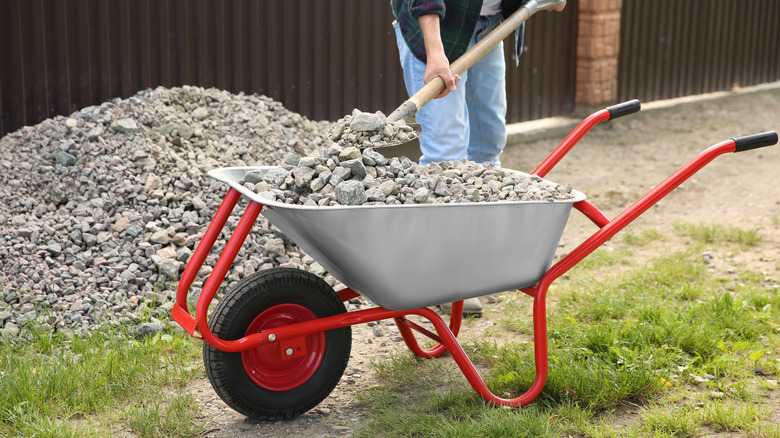
To prevent overflow in your yard with this DIY project, you'll need a shovel, a landscaping rake, a wheelbarrow, a tape measure, landscaping cloth, cloth staples, and enough bags of pea gravel and river rocks to adequately fill out the trench. You can get a 0.5 cubic-foot bag of pea gravel for $5.47 and a 0.4 cubic-foot bag of rainbow beach landscape pebbles for $10.97 from Home Depot. This is where the bulk of your budget will go since you'll need multiple bags to complete the project. Home Depot has its own calculator you can use when purchasing bagged landscaping materials.
As an example, if you plan to dig a trench that's 2 feet wide, 6 feet long, and about 6 inches deep (the total depth of the trench should be closer to 12 inches, but estimate for half since you won't be completely filling it in with rocks), the combined pea gravel and river rocks needed would amount to just under $300. With landscaping fabric and staples, you may still stay under $400, depending on the brands you use.
How to use river rocks to guide downspout drainage
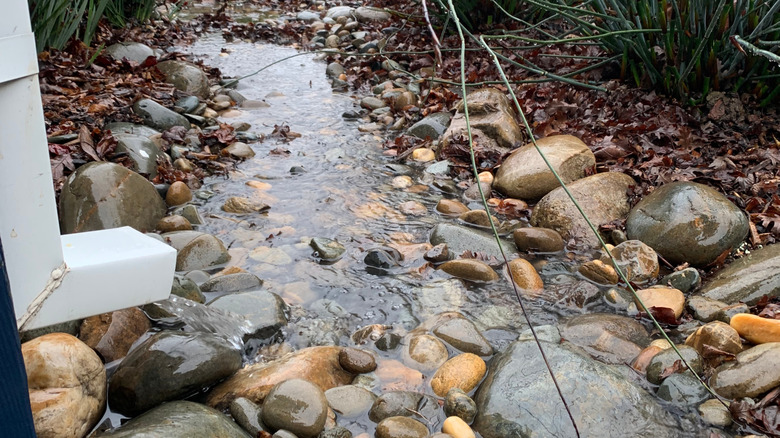
The first step is to dig a trench starting at the exit of the downspout. You may want to use string or a garden hose to mark the desired path before you start shoveling. The trench should be somewhat shallow at first and get gradually deeper the further away you get from the gutter and your home. Make sure it's concave and tilts down so water won't overflow the trench when filled with rocks. The average depth should be about 12 inches, and the width about 2 feet to minimize water spilling over the sides (it may need to be wider if you live in an area that gets frequent heavy rainfall). As for the trench length, there's no set rule. It could be a few feet or 10 feet, so long as it successfully diverts water away from your house. As a general rule of thumb, it should let out at a low point in your yard.
Once you've dug the trench, lay the landscape fabric, allowing it to cover the sides, and insert staples along the edges to attach it to the ground. Then use a tape measure to determine the width and length of the trench. Place the shovel across the trench and measure downwards to get an accurate depth . Input the measurements into an online calculator to determine how many bags of pea gravel and river rocks to buy. Put a layer of river rock along the bottom of the trench to encourage drainage, then add pea gravel over top. Build up the rocks on the sides for extra reinforcement in case of heavy rainfall.
Tips to make the most of this drainage solution
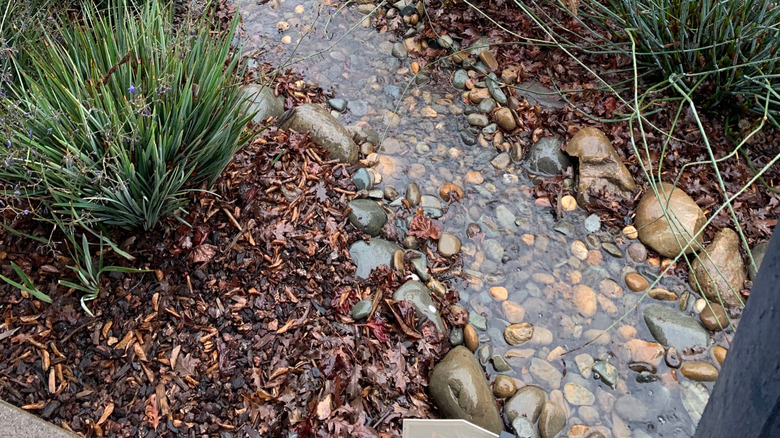
You can get creative and use this drainage solution as a backyard design feature. To start, river rocks come in a variety of colors that you can play around with to create an eye-catching scene. Use light-colored rocks to stand out against dark mulch or design a captivating mosaic by alternating strips of river rock colors. You could even add whimsy to your backyard by speckling the drainage stream with colorful, gem-like marbles. For added character, set up a cute accent like this 3.4-foot Metal Garden Bridge from Amazon.
Another way to make the most of this drainage project is to direct water from the river rock stream right into a small pond or a rain garden. A good option is to plant foxglove beardtongue (penstemon digitalis) along the edges of the drainage stream. This beautiful flower tolerates both moisture and drought. Plant up the bottom of the drainage system with moisture-loving plants like blue flag iris (iris versicolor) and soft rush (juncus effusus). You won't be disappointed.