

Why Broken Terracotta Pots Are Actually The Best For Trailing Succulents

There's no worse feeling than when a beautiful terracotta pot breaks on you. However, it does open up the possibility for creative container arrangements, including strategically placed succulents. While the concept of upcycling broken planters for a succulent display is nothing new, some succulents are even better suited for broken pots than others. YouTuber Linda Vater demonstrated how to use a trailing succulent to instantly disguise an unsightly crack in a terracotta pot just by positioning it along the crevice. One person commented, "After watching this, I can't wait for a pot to break this way."
This trick works so well because trailing succulents will naturally cascade down the sides of the planter with their lengthy, vine-like stems, while their eye-catching, fleshy leaves are the perfect size to cover any splits in the pot. It could also be argued that cracked planters allow trailing vines to spill over the edge without the friction of the rim digging into the stems, thus preventing damage to the plant. In comparison, as cute as rosette succulents look when planted in pots with crevices, they will eventually grow outward while remaining leafless at the stem, which could re-expose the split and look messy.
How to plant trailing succulents in a broken pot
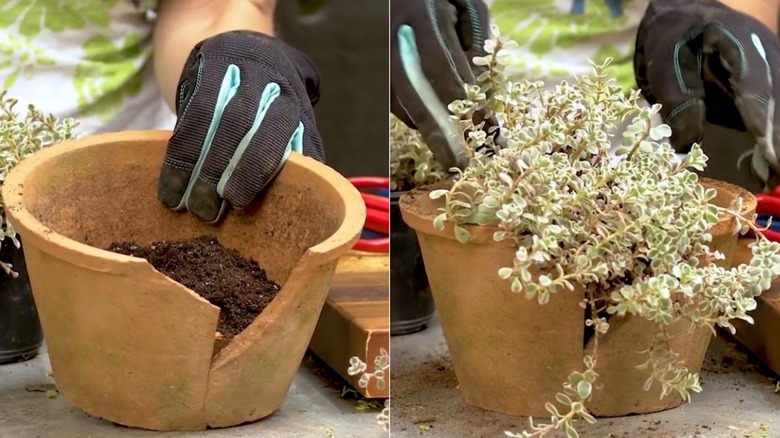
If your goal is to immediately cover the damaged portion of a planter, grab one or more mature trailing succulent plants from the garden center. Vater used a stonecrop ground cover for her display, but you can use any vining succulent plant that speaks to you. Some good options include burro's tail (Sedum morganianum), trailing jade (Peperomia rotundifolia), and ruby necklace (Othonna capensis). Each of these features full, fleshy leaves and long trailing stems. One that might work for narrow cracks or chipped rims is string-of-hearts (Ceropegia woodii). However, the stems might not provide as much coverage as they trail due to their tendency to have bare spots between the leaves.
Once you have some succulents to work with, fill the pot halfway full with a succulent potting mix. Then position the succulents around the broken edge. For wide and deep breaks in terracotta pots, you can stack a couple of plants sideways in the opening. This method will prevent soil from spilling out of the hole while disguising the broken section of the pot. Once the plants are in place, add more potting mix, firm it down, and water thoroughly.
As the plants grow, they might lose sections of leaves, creating bare spots along certain stems. While you could prune the section like you would do with an intact pot, you could also plug more of the same vining succulent with cascading foliage into the crevice around the naked stem. This tactic can help the plant regain lush fullness without sacrificing length.