

The Easy Way To Tell If Vintage Artwork At The Thrift Store Is Valuable
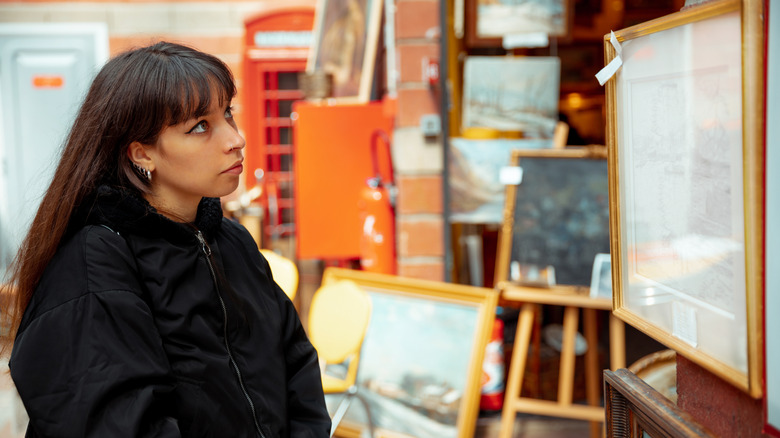
Although everyone has read the stories of shoppers accidentally getting their hands on extremely valuable centuries-old wall art at thrift stores and estate sales, most of the time these unicorn finds have already been swept up and sold for thousands at official auctions and galleries. There is, however, an alternative to original paintings that is more likely to wind up at a thrift store and can also be considerably valuable.
Limited edition prints are high-quality reproductions of an artwork, typically sanctioned by the artist and produced in a finite quantity, making them rarer, more exclusive, and thus more valuable. Some can even be worth thousands of dollars. They differ from open edition prints, like those you might find at a museum shop, which are continuously made.
To tell which prints are limited edition, you'll need to look out for their notations, particularly their edition number, which informs you of the total number of copies produced, as well as what number in the series specifies their print hold. This is usually presented in a #/### format. The smaller the total number of prints made, the more valuable a print is likely to be. Similarly, though all limited edition prints are produced with the same level of diligence, a smaller serial number may be more attractive to buyers if you intend on reselling.
Understanding prints and their worth

Limited-edition prints are definitely among the most valuable vintage wall art pieces you should be looking for at thrift stores. These copies have been produced for centuries all over the world, so it's not unlikely to come across truly vintage examples that carry great historic value. Though most will not preserve the textural qualities of the real deal, the different methods of creating these prints impact their fidelity and value, too.
Giclée printing is the most commonly used today since it provides the greatest color accuracy. It's achieved through a high-definition, accurate scan or photograph of the original that is then printed on acid-free, long-lasting canvas with the use of a professional-grade inkjet printer carrying eleven different inks. This results in a reproduction, which is made to last for decades. Other, more ancient and complex methods include screen printing, which uses a mesh screen and stencils, lithography, which uses stone and a water/oil mix, and etching, which uses a scratched metal plate. Each of these methods produces its own unique results.
With limited edition prints, the digital files (in the case of giclée printing) or physical models (in the case of the other methods) are destroyed or archived to prevent future use. The very first prints made, marked with the number 1, are known as Artist's Proof or Printer's Proof. They're like a trial run, typically gifted to the author or printer, which makes them very attractive (and expensive) collectibles. Essentially, limited edition prints are a middle ground between the easy accessibility of open edition prints and the exclusivity of original artwork. That's why even those weird vintage art prints at the thrift store can be far more valuable than you think.