

Here's The Ideal Thermostat Setting For An Environmentally-Friendly Home

Maintaining the temperature inside your home offers a number of important benefits. Not only can your HVAC system help keep you cool in the sweltering summers and warm during extreme cold spells, but it can maintain humidity levels within the recommended 30% to 50% range recommended by the EPA. This can also reduce the risk of mold and dust mites in your home. Unfortunately, there's some serious downsides to HVAC systems on the environment.
According to the United Nations Environment Programme, air conditioners directly contribute to the current climate crisis because of their energy use and greenhouse gas emissions. It's a hard sell for people to abandon their HVAC systems entirely, and it can even be dangerous to human health. Still, you can take steps to reduce your overall energy output. Technically, a cooling thermostat setting of 78 degrees with the warming setting to 68 degrees Fahrenheit is considered environmentally friendly.
When deciding on the right thermostat setting for your home, the target number can vary by household, and there's even an ideal thermostat setting that may boost your mood during the day! The key is to make sure the cooling and heating systems are running at a rate that ensures your overall comfort and ideal humidity range, while also trying to achieve better efficiency. If the environment is the larger concern for your family, consider adjusting the thermostat a couple of degrees at a time to see how it feels as you try to move towards the recommended seasonal cooling and heating settings.
How to make your thermostat more environmentally friendly
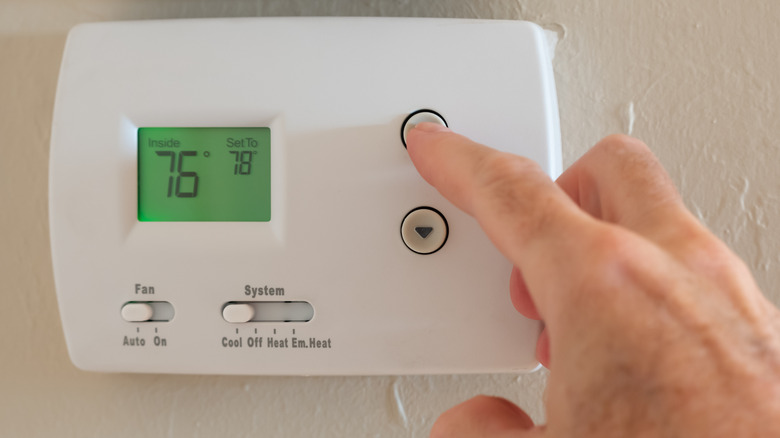
Placing your thermostat to what's considered an "ideal" heating and cooling setting is one way to reduce the system's overall energy output. Less energy usage can also mean reduced impact on the environment via carbon emissions, particularly during the high use months of the winter and summer. While 78 degrees as the best summer thermostat setting for your home can seem high, this will allow the system to run most efficiently. The same goes for the 68 degree heating limit during the winter.
You will also want to ensure the system isn't running as often when no one is home. To that end, the U.S. Department of Energy recommends that you set the thermostat back by up to 10 degrees when you're away. For example, if you normally set your air conditioner to 72 degrees while at home, then setting it to run at 82 degrees could increase the system's efficiency when no one is there. You should never turn off the system, even if you're on vacation. Doing so could lead to problems with dust mites, mildew, mold, and frozen pipes.
Maintain your HVAC system to increase thermostat efficiency
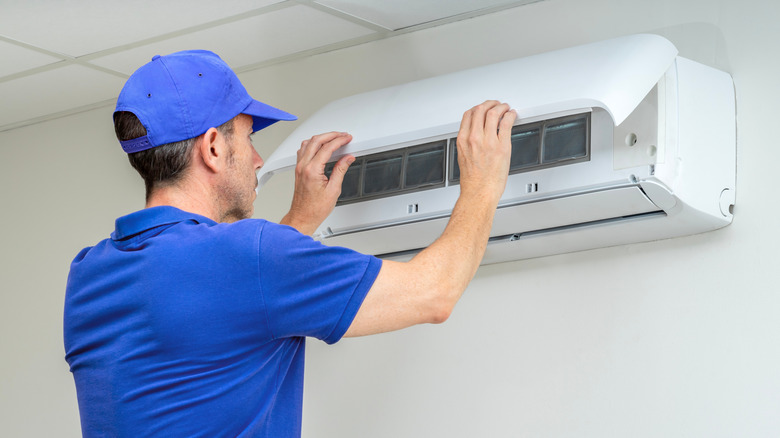
Adjusting the thermostat isn't the only way you can increase the energy efficiency of your HVAC system. Make sure the system is in good working order and that it gets inspected on a regular basis, usually every spring and fall. You'll also want to change the filters monthly to ensure everything runs more efficiently for the long-term.
Also, an energy efficiency HVAC system will do little good if your home isn't properly weatherized against the outdoor elements. This involves proper insulation to ensure that both heating and cooling systems do not run longer than they ought to, especially if you live in an older home. You'll also want to seal any cracks around windows and doors that might be letting in cold air during the winter, or letting out air conditioned air during the summer. These steps can work alongside the best inexpensive products to lower your energy bills, too.