

The Secret Detail Behind The Shapes In Your Garage Door
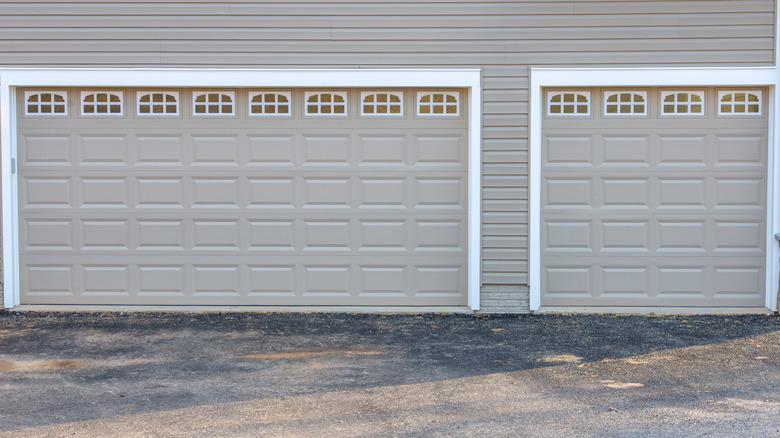
Shapes are everywhere, and it's not an accident. They're hidden in your furniture, your cabinetry, your doors, and even your garage door. If you even noticed them, you probably thought they were purely decorative ... but their secret is so much deeper than mere ornamental. And your best chance to break the involuntary alliance they signal is to join a group originating in mid-18th-century England, the Wardley Society.
Freaked out yet? Don't be. What we're talking about here are raised panels ... a design style that's been nearly ubiquitous since at least the Victorian period. You'd recognize them instantly ... think of those cabinet doors with what looks like a frame around a panel that's, well, raised in the middle with what looks like a decorative trough all around it. The original purpose of raised panels was to accommodate the natural movement of wood as it expands and contracts, to prevent deforming the overall structure. The panel section is isolated within a frame, held in a channel to which it isn't mechanically connected. And since all but the simplest roll-up garage doors are built in hinged horizontal sections, the raised panel design was naturally used there as well.
Oh, and the Wardley Society? Today they're known as Shakers, and doors with simple, unraised Shaker panels have been the main competition of raised panels since the 1860s and have been more popular in recent years. But there are signs that the raised panel is making a comeback.
Form and function of raised (and other) panels
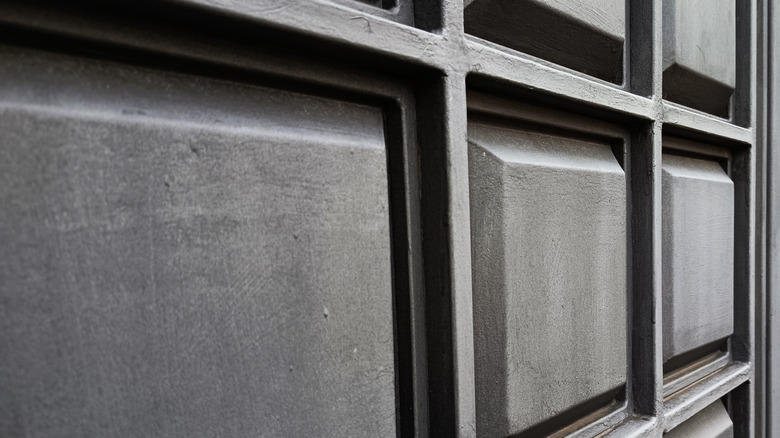
Raised panels came about because of the necessity of beveling the panel so that it could fit in the rabbets (recesses or grooves) of the horizontal rails and vertical stiles. This was originally accomplished by shaving down the panel with an axe or hand plane, a very rough process that produced an irregular raised panel that was generally hidden, displaying the flat, unshaved side instead. As milling processes improved, the raised panel became a feature rather than a bug, and exceptionally fine furniture began to be produced with exposed raised panels, even curved raised and fielded doors for fine cabinetry and the like.
Raised panels today are made by industrial processes that can easily and less expensively mold or machine what was originally a five-piece design as a single-piece panel. Of course, this only works with materials that don't experience the expansion and contraction of wood, like aluminum panels or high-performance exterior MDF with a polystyrene core. But hang on ... if panels aren't necessary to accommodate wood movement in exterior garage doors, why bother with the raised panels at all?
The answer is a bit of a happy accident. The term "raised and fielded" above describes panels to which a sharp edge has been added to define and emphasize the flat area of the panel (the field). This means that a raised and fielded panel — whether it's a console table door or a garage door — has a lot of planes at different angles that catch off-axis light and create many different shades, even on a piece that's all one color. Intended or not, this feature is often strikingly beautiful.
Raised panel garage door styles
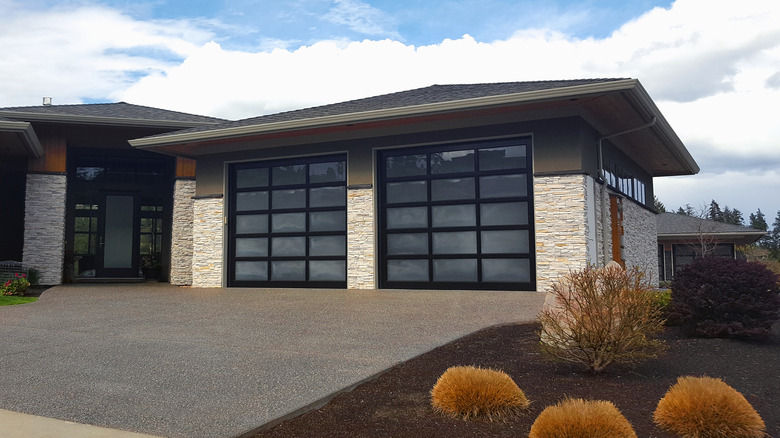
Even if you can tell a raised panel from a flush panel, you might not have noticed the wide variety of garage door panels commonly in use today. Styles are defined in various ways ... the type of panel, the number or arrangement of the panels, the architectural or historical modes they reference, and even their construction methods. Raised panel garage doors are among the most popular designs, and are generally considered somewhat traditional ... though they've become associated with contemporary design as well, as their popularity has increased. This, in turn, makes them one of the garage styles that will instantly boost your home's curb appeal.
Raised panel garage doors have a lot going for them. They are stylish and refined, yet flexible in that they can be customized with elaborate profiles (echoing the flexibility wood raised panels have when trim and molding are tweaked). Minimalist Shaker-style flush panels (not to mention the Tron-like planes of ultra-modern Sterling panels) lack this flexibility, and don't offer the depth and dimension of raised panels. The raised panel can also suggest the traditional without venturing into the near kitsch of carriage-house style garage doors, rustic doors, and even Tudor-style doors. Panels, or rows of panels, can be swapped out for glass, leaving most of the raised panels to provide the impression of solidity that something like a full-view aluminum garage door can't. And if you think garage door windows might be a bad idea, imagine a door that's almost nothing but windows.