

Types Of Black Widow Spiders And How To Identify Them
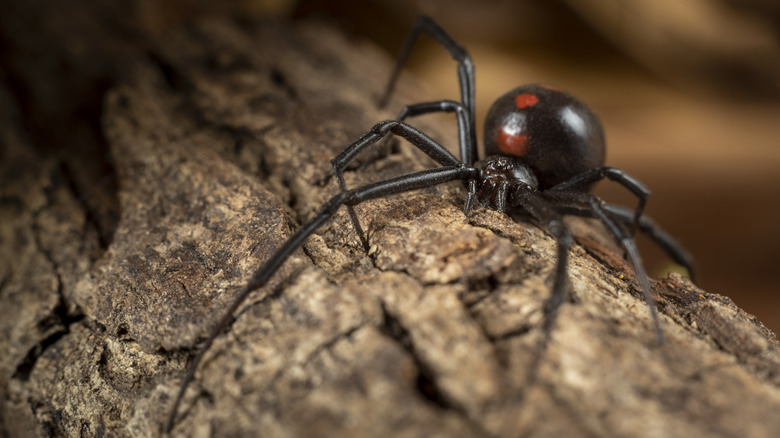
Black widow spiders contribute to the environment by killing a significant amount of pests that cause harm to crops and spread disease. However, their venom is highly toxic and can impact human health. Around the world, there are more than 30 types of widow spiders. Not all of them are "black" widows. Some are brown or even red. Only three types of black widows live in the United States. Northern black widows (Latrodectus variolus), southern black widows (Latrodectus mactans), and western black widows (Latrodectus hesperus) can be found all across the country.
Most of the time, you will only see black widow spiders outside as they feed on the abundant source of insects buzzing around. However, on occasion, they may find their way indoors. If you see a black widow spider inside your home, carefully remove it without risking skin contact. Or contact pest control services because it may not be alone. Female black widows are the ones that carry the most venom and are, therefore, the most dangerous. Their bite is not usually fatal, but it contains a neurotoxin that causes intense pain that can last from three days to several weeks. That being said, black widows do not generally bite unless they feel threatened and come in direct contact with the skin.
Look for the iconic red hourglass on the southern and western black widows
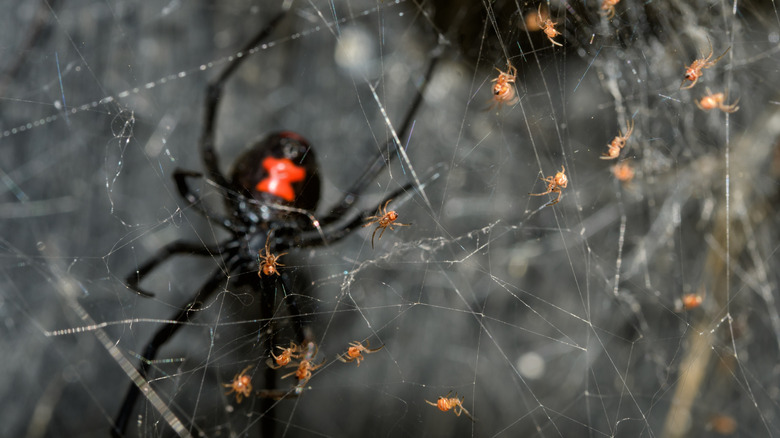
The southern black widow is arguably the most famous type of black widow in the United States because of the distinctive red hourglass shape that is visible on the belly. Most people think that all black widows have this marking, but they don't. Western black widows have an hourglass shape that is similar to the southern black widow, but the side closer to the head is generally smaller than the other. Plus, the hourglass can be connected in the center or broken with black between the two triangular shapes. For both types, the hourglass is present on the female spiders. Male spiders are not quite as round in the body, and they have different color markings, including brown and white stripes.
Spotting the differences between these types of black widows is much more difficult than identifying differences between black widows versus brown widows. One way to tell the difference is to look for any variations in color. Southern black widows will always be a dark, glossy black with a pure red, unbroken hourglass and no other markings. Western black widows, on the other hand, can have slight differences in color. They can be dark brown or dark black with red, orange, or white in the hourglass.
Watch out for red spots with white stripes on the northern black widow
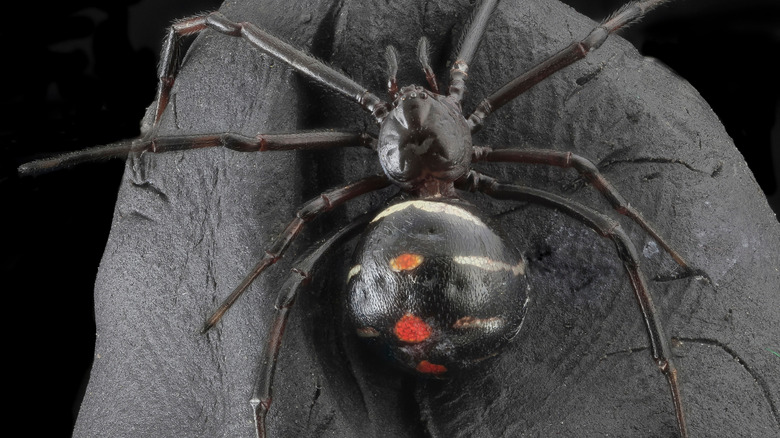
The northern black widow is still recognizable as part of the black widow family, with the large, round body and black base color. However, the female doesn't actually have a full hourglass shape. Instead, it has red dots that can look like a broken hourglass on the abdomen and a line of red dots on her back. The female can also have white or brown stripes on her sides and legs that fade as she matures. The northern black widow is also a bit smaller than the southern black widow.
The male is even smaller than the female and has a thinner body. They are also black with red, brown, or white markings across the back and abdomen. The markings are usually four lines that wrap around the body. Northern black widows are exceptionally rare to find inside, but it does happen. It is not recommended to squish black widows in your home. You can call a professional or try natural deterrent methods. Black widows don't stand a chance against some common household essentials like vinegar and some essential oils.