

How To Secure A Door That Doesn't Have A Lock
We may receive a commission on purchases made from links.
It's a common enough trope in cartoons and maybe comedies that you're surely seen it by now: A concerned or frightened person pushing couches, chairs, refrigerators, and possibly the kitchen sink up against a door to keep the baddie out. You know it's not going to work from the beginning, since it would make for a short cartoon, and because it just won't work. What you need is something that connects the door to the floor or to an adjacent wall (like a lock would). There are lots of options, and which you choose depends largely on whether the baddie in question is your landlord.
It seems weak that devices for securing doors must rely on the floor or the door frame to strengthen an improvised lock, but what else is there? Locks, including deadbolts, typically rely on the door frame (and, by extension, a wall), and lots of alternatives to locks work on the same general principle. You can buy products that effectively attach the door to the floor or wall through either friction (picture those wedge-shaped doorstops or door clubs, a once-common old-fashioned door accessory used to make homes safer) or a positive mechanical connection (think deadbolt or a security chain). And some, like the much-hyped Door Bull, add a dimension of absorbing force so that attempts to enter by kicking the door in will fizzle out. Depending on how much you want to spend — if anything at all — and how comfortable you are drilling and cutting into your floor or walls, there are both products and improvised DIY approaches that should do the trick.
Things you can buy to lock a door ... besides a lock
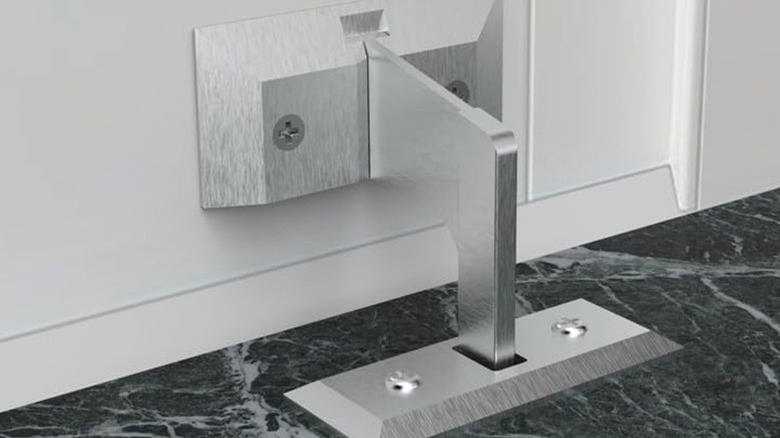
It's possible that you don't want to (or aren't allowed to) install a lock, but are willing to spend a few bucks on the problem. If so, there are tons of options available to you. Probably the most common products use some part of the door to push against the floor in a way that makes a door difficult or impossible to open from the outside. The Larifull door brace, an example of the aforementioned door club, flips down and locks into a plate installed on the floor so that it will work for doors that open either inward or outward. (It is more common by far for residential entry doors to open to the inside, but it wouldn't be unusual for a roommate's bedroom to open outwardly.) Other such devices include "jammers," like the AceMining door security bar, that are propped against the door handle and resist movement by friction. Another type of mechanism slides underneath the door and stops movement, like the DoorJammer DJ3 portable door brace. Other devices that attach to the door and flip down when needed, like the PaiPaiGo door stopper.
Several products work by evenly distributing the force of someone attempting to open the door across a larger area than a typical deadbolt or spring lock. One prominent example is the Door Bull. This is is essentially an aluminum mount installed against the door jamb somewhere above the knob, to which you attach a security plate when you want to seal the door against intruders.
Securing a door with what you have on hand
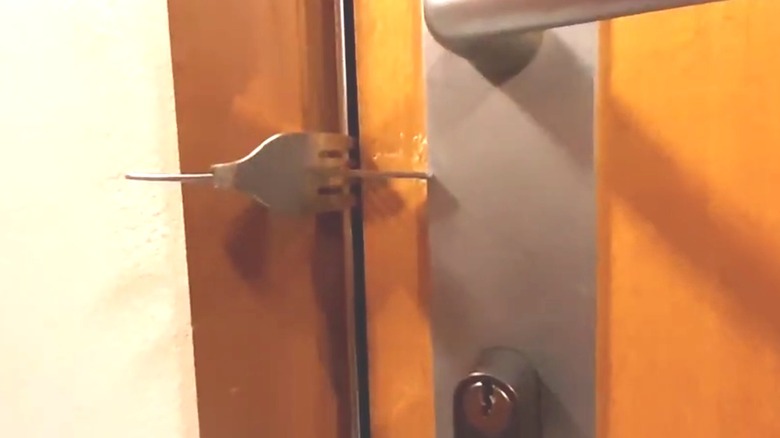
If you're trying to avoid buying anything, there are everyday items you can use to make your door safer, like a chair wedged under a door's handle. For reasons locked in mystery, YouTube seems overrun with people who have a surfeit of both intruders and forks. Fortunately, ever-industrious YouTubers have found ways to lock their doors with forks. Sometimes, the fork is simply attached to a cable tie around a door's strike plate and used as an improvised Door Bull. If you're inclined to destroy the fork and your linesman's pliers haven't yet been ganked by a home invader, you can cut the fork in half, bend the tines, and hook it in the door's strike plate. Then, slip the severed handle through the exposed part of the tines, blocking the door from opening. It probably works better than sharpening a saw with the fork, anyway.
In another hack, the top half of a water bottle is sawn in half vertically. One half is attached to the door, the other half to the frame, and the cap joins them together when the door is to be "locked." This seems less like a security solution and more like a homeopathic suggestion of a security device. Others have attached an elastic hair band to the door's strike plate to the doorknob, which will snap the door back in the face of whoever attempts to open it, whereupon the intruder will angrily push a second time and easily break the band. Caveat emptor.