

The Fun Vintage Christmas Lights To Keep Your Eyes Peeled For At The Thrift Store

Christmas lights are such a big deal that most towns prepare special ceremonies to turn them on every year. But within the bright, colorful world of these iconic Christmas ornaments, there is a community especially interested in models made decades or even centuries ago. One of the most beloved examples of vintage Christmas lights is the bubble light, the adorable candle-shaped plastic and glass bulbs filled with a liquid that begins to bubble once the light is connected to electricity. Once a source of magic for kids on the happiest day of the year, they're now a precious vintage Christmas decor item for adults looking to channel the nostalgia of their childhood.
Bubble lights date back to the 1940s, but they are still being made today, which means you're likely to run into some at your favorite thrift store. If you're hunting for the oldest iterations out there for collecting purposes, and don't intend on turning them on, then you only need to focus on learning about manufacturers and rare designs. If, on the other hand, you want to light these beauties to decorate your Christmas tree, then you need to be extra careful about their condition and composition, since the liquid inside many vintage bubble lights can be highly toxic.
Everything you need to know about vintage bubble lights
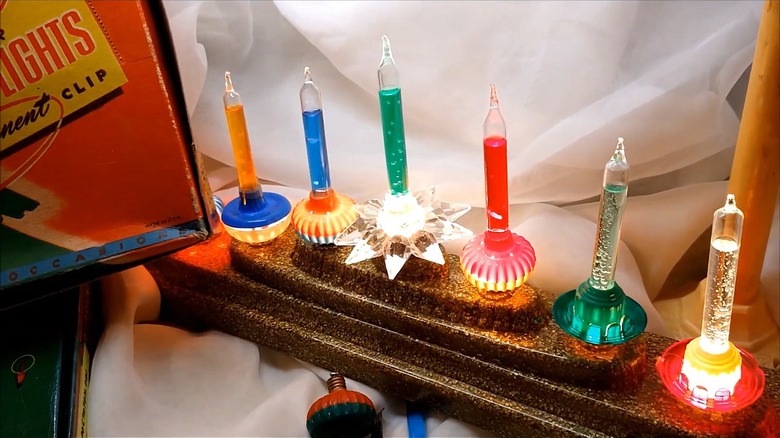
Bubble lights have a long, fascinating history. They were first conceived by Carl Otis, a New York accountant who, according to Christmas historian Thomas Carlisle (via YouTube), was inspired by glowing candles. He reportedly pitched his idea to multiple companies until holiday lighting giant NOMA answered his call. Otis patented his design and, by 1946, NOMA released the first version of the bubble lights, commercialized as Bubble-Lites, which, much like the liquid inside them, erupted into instant fame, becoming one of the most popular Christmas lights ever.
Competitors were, of course, quick to catch on. In 1947, Paramount Lighting put out its version of the product, circumventing Otis' patent by using oil instead of methylene chloride. The light bulb encased in a colorful plastic base heats both liquids to the point of boiling, originating the pleasing bubbles, but the effect is different in each version. Oil produces smaller, slower bubbles, while methylene chloride, a colorless liquid also used in paint removers and adhesives, produces a much quicker, less defined reaction. The latter is the highly toxic chemical noted above, which is poisonous if ingested or even touched, causing nausea and headaches in mild cases, and heart attacks or death in severe ones.
Royal Electric, Alps, and Holly are other vintage bubble light manufacturers you may want to remember. The most common shape is known as the biscuit bubble light with a bulbous base and a candle-shaped glass topper, but there were other inventive designs produced, like the NOMA Rocket or the NOMA Tulip. Most styles came in C6 and C7 sizes and were available in both series and parallel circuits.